
 (This post is also available to watch and listen to as a vlog/podcast. You’ll find it on YouTube and Spotify down at the bottom of this post.)
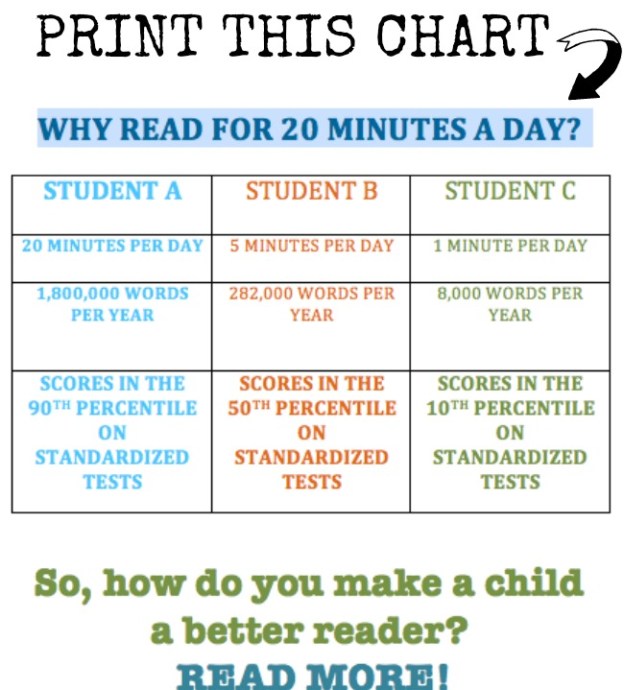
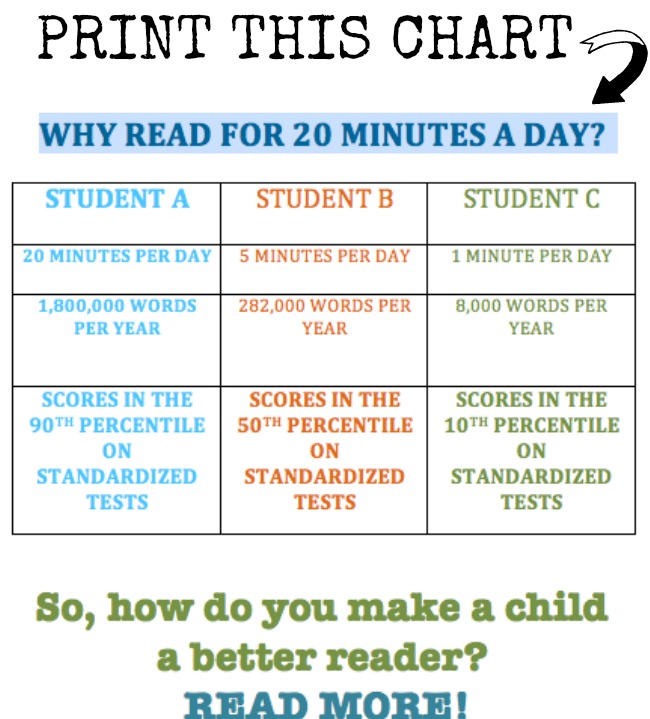
Read for 1 minute or less a day with your children and they may end up in the bottom tenth percentile! (But should you care?)
According to a number of educator resources and literacy advocates, children who read for around 20 minutes a day are exposed to as many as 1.8 million words per year, and this level of exposure is often linked to performance in the top 10% of standardised test scores. (phoenixacademyomaha.org)
While these figures reflect general trends rather than guaranteed outcomes, they do highlight the potential impact of regular reading habits.
Are test scores really the best gauge of childhood success?
I’ve seen this graphic (or something very similar) floating around the internet on a number of occasions. Often, the original context of these stats is lost and, instead, people (often parents) seem to see the higher test scores as the motivating call to action.
 However, while I agree with the idea that reading with your children is a good thing, I’m not sure if I agree with the hefty role being given to word volume, or the assumption that parents should only care about test scores. It’s part of the growing inclination of so many to try and quantify childhood learning.
Of course, some skills are more quantifiable than others: vocabulary, memory, the ability to follow instructions (this list is far from exhaustive). In this sense, it’s easy to see how an increase in vocabulary and memory might improve test scores. However, there are so many more important skills that reading helps develop than the capacity to have great test scores.
Children who read find themselves exposed to other ways of thinking, other worlds, and other people, in a much more intimate manner than you find in any other medium.
“One in Five UK children don’t own a single book”
That said, for many children, access to books (or even the idea of owning a book) is far from guaranteed. In a related post, I explore recent headlines suggesting that one in five children don’t own a single book, and dig into the complex role that book ownership plays in childhood literacy. You can read that post here.
For families concerned about the cost of books or about limited living space, it’s also worth knowing that there are fantastic digital alternatives to physical books. In a separate post, I explain how you can access thousands of free books on almost any smart device (phone, tablet, even a PC). You can read that post here.
Reading does a lot more than improve test scores
The characters, ideas, plots, scenarios, and places found within the pages of a book do not stay there; they find a home inside your mind. It’s about as close to telepathic communication as we can get.
 When a child reads a story where a character loses their memories, they aren’t simply exposed to a vocabulary-building exercise; they have been given access to some fairly complex notions about identity. This might lead them to ask questions about whether we are the sum of our memories, or something more. In essence, books (and perhaps fantasy books in particular) provide simple, digestible ways of thinking about some pretty big questions.
It kind of bothers me to see test scores held up as the pinnacle of childhood achievement. Test scores can be a great way of gauging a child’s engagement with their learning, but I’m a little dubious about regarding these scores as anything more than that.
A child’s ability to deal with the world outside of school will have a lot more to do with how much they understand, plus a host of skills that are even harder to quantify.
Academic skills are not simply the ‘Three Rs’
Many children will go on to opt for university or college at the end of their school career. Despite what they may assume, they may be surprised to discover how important it is to have a collection of skills that go beyond reading speed, vocabulary, and memory (the more testable skill set).
I tutored Philosophy undergraduates at Edinburgh University for four years (and was an examiner for one of those as well). It was amazing to see how often some students (who came in with less than stellar grades in high school) would somehow overtake their higher-scoring classmates. Often, this hedged on far less tangible/quantifiable skills than rote memory etc.
We wanted to see students demonstrate an understanding of the nuances of arguments; memorising facts and figures simply wasn’t enough (though it was, of course, valuable). What’s more, the ability to step outside rote learning and think for themselves enables students to create thought-provoking and insightful essays. I learned that high test scores aren’t always a clear indicator that someone will perform well, even in an academic environment.
Good teaching and the challenge of ‘soft skills’
 The abilities of a teacher are often assessed based on the test scores of the children they teach, but this can leave little room for some truly vital skills; like bolstered inquisitiveness, social understanding, and the ability to ground ideas within a real-world backdrop.
Teachers do a phenomenal job at encouraging these traits, and many more beyond those. I’ve met a good number of these teachers on the various school talks I’ve done, and it always impresses me to see how well-rounded their pupils are in ways that go far beyond traditional testable academic skills. I’m not an expert on the curriculum, but I’m fairly certain that these essential skills will be hard to locate by looking at where a child falls within the ‘national percentile’.
If you’re a teacher looking for ways to spark those kinds of wider conversations, I offer free school author talks that tie reading into big ideas, imagination, and creative thinking. You can contact me to discuss a talk or workshop here. I’m also currently working on a new range of classroom resources that will provide free activity sheets (and more) to support classroom discussion.
Alongside my school talks, I write books that open up the kinds of big ideas I’ve discussed here: from friendship and imagination to questions about memory, morality, and identity.
The Jack Reusen series (for ages 6+) brings magical disruption into Jack’s everyday life, whilst Marcus (for ages 10–12+) explores darker themes of power and consequence, all through a fantasy lens grounded in familiar Scottish settings.
You can find out more about my books here, or read them on Kindle Unlimited (here’s my Amazon Author page).
Free Classroom resources as soon as they’re ready
I’ll post new literacy resources here as soon as they’re ready, as well as other updates regarding books and literacy. To be the first to hear as soon as they’re available, you can subscribe using the box at the bottom of this post. Simply pop your email address into the box, click ‘subscribe’, and you’re good to go.
Reading is more important than test scores
Of course, we should read to our children for twenty minutes a day, longer if we get the time. For some of us, it’s part of the ever-shrinking portion of the day in which we can spend time together, without necessarily having to deal with some kind of screen.
Not only does it allow you and your child to discuss all kinds of topics and issues, but it also gives you a few moments in which to touch base and enjoy spending time together.
Reading, at least in this context, has much more to do with maintaining relationships and learning about the world we share, than it has to do with building vocabularies and assisting in academic scores.
Reading shouldn’t be marketed as a fast track road to success (even if the numbers suggest it); it’s an activity that opens dialogue, builds relationships, and encourages inquisitive minds. In short, reading opens us up to all of the fantastic skills that make us human. It doesn’t just help us test well.
If you have anything to share about any of the issues I’ve touched on in this post please feel free to share your ideas in the comments, or over on social media (here’s the Jack Reusen facebook account, and here is my Instagram account).
Want to read more on the topic of the deeper positive effects of extended reading? You’ll enjoy this fantastic post by teacher librarian Krystal Gagen-Spriggs about the great effects of developing a reading habit.
Thanks for reading, all the best, John
Discover more from Jack Reusen
Subscribe to get the latest posts sent to your email.

Pingback: 3 easy ways to make reading fun for kids | Jack Reusen
Pingback: One in Five UK children do not own a single book | Jack Reusen
Pingback: Green Flame Books: The Power of Reading Week long discussion | Jack Reusen
Pingback: Reading Fiction is Reading Minds | Jack Reusen