Monthly Archives: December 2017

Lore

Sometimes we struggle. Motivation fails us. I got a taste of that recently as I neared the 30,000 word point in my latest book. Knowing that I was writing horror a friend (thanks Jo!) recommended I check out a podcast called Lore.

Humans are the real monsters

Lore is a fortnightly podcast (or web radio programme for those who prefer that term) that discusses the paranormal, the odd, the unpleasant. However, its primary focus seems to be the darkness that dwells in us all. The selfish voice, the creature that panders to fear, the red eyed monster of rage; all of these are distinctly human, distinctly internal, monsters.

Listening to tales of Lore drew me to that dark place, allowed me a closer view of those nastier human foibles that are the true basis of horror. Aaron Mahnke (the host/researcher/creator of Lore) introduces the listener to a selection-box of human awfulness. From the true story of the Pied Piper of Hamlin (NOT for children or the faint of heart), on to multiple tales of witch hunts through the ages, to the story of H. H. Holmes, a conman who created, and utilised, a hotel full of secret passageways and an underground ‘lab’ for his own sick ends (this hotel has since gained the name ‘The Murder Hotel‘).

The events in ‘Marcus‘ don’t come close to the horrors Mahnke describes in his show (for starters mine is pure fiction). However, I’d like to give credit to Lore, and Mahnke himself. He produced something that offered a custom set of blinkers for this first-time horror writer at those times when sitcoms, kids books, and social media, threatened to draw me away from my writing.

More to learn

There’s something else that Lore helped me see though. Mahnke persisted, every two weeks he got another solid bit of work out into the world. Well rehearsed, well researched, well performed. You can go back to the very first podcast and see the show evolve, gain a following, and importantly offer Mahnke the recognition he deserves.He made something people enjoyed and the world rewarded him. It’s an important takeaway whenever you come across this sort of creativity. The word ‘inspiration’ is banded about a lot, it has transient, insubstantial overtones. Instead I would say that Mahnke’s efforts provide more confirmation than inspiration.

Listening my way through the first episodes gave me confirmation that the right content, found by the right audience, and offered up consistently, will yield positive results.

Mahnke has his own Amazon TV series now (based on the podcasts) but he has also demonstrated his mastery of storytelling through the podcast in a way which has allowed him to market his own writing. Author of a host of books, and clearly working purely within a field he enjoys. What he has done has given me confirmation that all the slog is worth it.

Thank you Aaron.

Why listen to Lore?

Simply put it’s fascinating (if disturbing in places). Often we hear that the world has ‘gone to the dogs’ or that society is being eroded by one modern creation/concept or another. A step back in time (and in some cases it’s an uncomfortably short step back) is enough to show us that human beings have always found ways to be awful to each other.I’m not trying to suggest that we’re living in a golden age but lore can take the rose tinted glasses off of the reminiscence to ‘yesteryear’. We get by, we look after one another, we do what we can to help one another. The stories in Lore highlight this as well. It’s in our nature; the flip side of our darker internal demons.

Watch the news and you can be forgiven for thinking that we live in an age of terror. I find it odd that comfort can be found to remedy this perspective by looking at the horrors of the past.

I hope you take a moment to pop by the Lore podcast page and give it a try yourself (and no I’m not being paid to promote it/endorse it/otherwise send traffic his way).

As always thanks for reading, and feel free to pop back and tell me if you enjoyed the podcast,

All the best, John

Mist or Fog

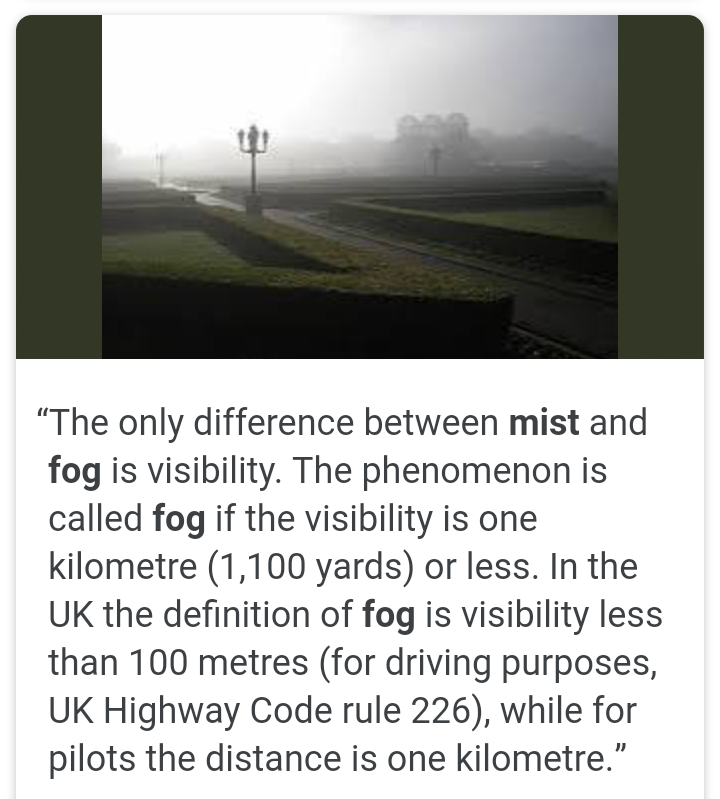
Fog makes it harder to write but it’s essential. (No I didn’t leave the window open to add atmosphere to my morning writing). 

The reason fog both helps and hinders in equal measure is research. In order for my books to make sense I have to research what I’m writing. It’s time consuming but necessary.

In my most recent writing stint I decided it was important to know the difference between fog and mist. A character has the power to disperse into a cloud. 

I thought the distinction between ‘fog’ and ‘mist’ would be an important one, and planned on using it in the book. Turns out it’s basically arbitrary. The distinction even gets cloudy (see what I did there) from one country to the next.

Apparently, for most of Europe it’s ‘fog’ when it impedes visibility for 1000m or less. Whereas here in the UK we don’t call it fog until one can eat it.So I went back and rewrote. My research felt fruitless but it actually saved me from writing something convoluted, hard to follow, and worst of all something that would have been nonsense.

Writing is often like that. You wait for the fog to clear. Do some research. Find out it’s just mist (at least in the UK) and get back to work.

Writers reading this, what odd facts have you discovered in your research? Did they force a change in your book?

I love getting comments so please feel free to have a blether in the comments section below. 

As always, thanks for reading, 

all the best, John 

Books are bad for you!

The primary criticism we hear about technological entertainment is that it is ‘anti-social’. I’ve also heard people insist that it makes people ‘less creative’.

When it comes to parenting advice it’s hard to ignore the growing idea that ‘Technology is BAD!’.

We seem to have a very different view when it comes to reading. It’s not a screen, it’s a ‘traditional’ form of entertainment, and it has a well-recognised link to creative and critical thought. All good, wholesome stuff, surely?

I’m not going to trawl the data running pros against cons. Instead I’ll share a very odd encounter I had with my wife’s grandmother. It was a few months ago and both my sons were fully absorbed in activities on separate hand-held devices. I felt the familiar squeamish sense that most modern parents probably feel; my children were ignoring guests in favour of their tech!

I was about to take their devises away when their great-grandmother looked at them with a smile: “It’s just lovely to see them like that.”

“Books are bad for you.”

It threw me into a sharp mental u-turn. She explained that as a child she was often criticised for her love of reading as it was ‘anti-social’. For some it was even seen as a waste of time, many told her that she should be doing something more ‘productive’. In short, she was told ‘Books are bad for you’. She looked at my sons’ use of tech as being equally beneficial to her childhood reading.

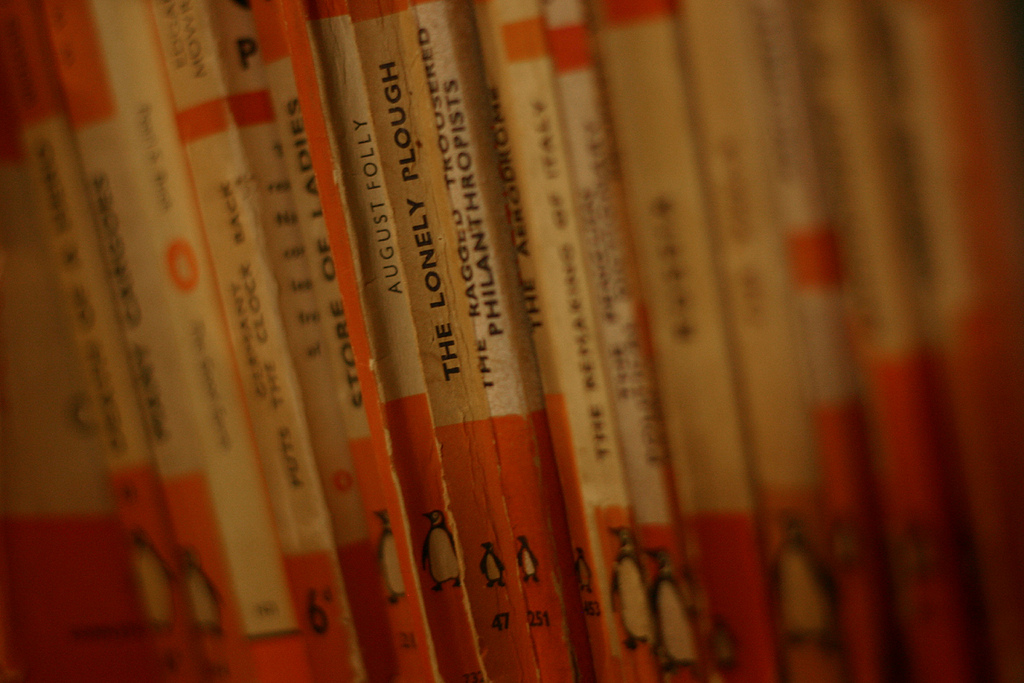
Penguin books began in 1935 and with the help of Woolworths, it pushed the notion of mass-market paperbacks into the public consciousness. It’s hard to speculate what the overall opinion of this new influx of books would have been even decades later but I imagine it would still be quite a new thing to see children in all walks of life sitting reading.

Computer games have been around since the seventies but the hand-held game didn’t appear in the mass market until I was a child (the late 80s early 90s). Even then it was only my ‘rich’ friends who had one. They were still a luxury and by no means ubiquitous.

Since then hand-held devices have grown cheaper and more accessible. Their capacities have grown more diverse as well, as they come to serve an increasingly social and educational role (Gameboys didn’t let you chat to your friends after dinner, and to the best of my knowledge Mario never helped any of my friends with their homework). This sort of tech has a lot going for it.

Even the gaming itself has come to offer more depth, with more demands on critical thought, and on creative energies. Should we be so quick to condemn these glowing rectangles that now permeate our lives?

Where’s the harm?

There’s clear evidence that the actual light generated by screens can have a detrimental effect on sleep patterns, but at the end of the day doesn’t all artificial light? Gaming is also known to increase serotonin levels to a degree that can trigger addictive behaviours. This isn’t good and I’m sure I see a degree of this in my own children, but the same jittery, manic effect can be achieved with a big bag of sweets sneaked in by Granny.

I’m not going to say screens are perfect (and as an author I obviously have a vested interest in getting people to read books) but I can’t help but wonder if we’re vilifying the tech rather than turning the lens on ourselves as parents.

At the end of the day my own interest in my facebook/twitter feed, my blog reader stats, or even my work e-mails, will have its own (fairly large) part to play in any detrimental technological experiences that my children have.

It’s not the zombie in their game that will do them the most harm, it’s the zombie on the couch beside them. He doesn’t demand ‘brains’ but instead insists ‘I can’t just now, I have to answer this e-mail’. It is here that technology does the most harm to a child’s development, and the solution is blindingly simple (though it will make most of us uncomfortable to admit it).

Does my out-of-hours attention to my e-mails etc. mean my kids will grow up thinking that they should never have ‘down-time’? Does my own interest in social media make it look like ‘likes’, ‘followers’, and ‘shares’ are of equal importance to real-world feedback? Tech isn’t to blame for this, it’s me. Tech isn’t bad, books aren’t bad, it’s the lack of family engagement and shared interests that does the most harm.

I’m off to read with my kids now. If you’d like to do the same feel free to grab a copy of my book Jack Reusen and the Fey Flame, a fantastical family adventure with were-polar-bears, magical fairgrounds, odd little men who kick heads first and ask questions later, and (of course) a world hidden just behind our own; a world called Fey.

As always, thanks for reading, if you have anything you’d like to share about this post feel free to pop something in the comments section below or over on my facebook or twitter profiles (and yes I do see the irony, given what I’ve just said about screens and social media).

All the best, John