

How Shared Stories Make Children More Empathetic Writers
(If you’d prefer to listen to this post you can find the corresponding podcast episode below)
Imagine I told you that there’s an activity that increases a child’s empathy, whilst enriching their job prospects and life satisfaction, and that this same activity can even positively influence their earnings later in life. Most parents would want to sign them up straight away.
It turns out that there is an activity like this. It has more impact than playing a musical instrument, or playing sports, and it’s probably easier to access than either of these: reading fiction.
In 2013, Claire Crawford and Jonathan Cribb analysed four decades of data following children from their early reading habits all the way into adulthood.
The data came from following those individuals as they grew and entered the workforce, all the while tracking their reading habits and their life experiences. (“The Link between Childhood Reading Skills and Adult Outcomes: Analysis of a Cohort of British Children”, Crawford & Cribb, The Institute for Fiscal Studies, April 2015)
Basically, they found that those who read fiction as children (and beyond) get statistically more out of life than those who don’t. Readers of fiction end up in better jobs, have better relationships, and feel generally better about their lives than those who don’t read fiction. This result is actually even more noticeable in fiction readers from lower-income backgrounds.
The results of the study are pretty interesting. I’ll try to avoid getting too into the weeds about the data here, but their findings could help inform the way that educators and parents look at reading, and the reading of fiction in particular.
The study found that children who read fiction regularly tended to show noticeably higher empathy and social intelligence than those who rarely picked up a story. Changes in soft skills like these don’t just impact school life, they can ripple through a child’s friendships, social confidence, and even their overall happiness as they grow. As the children aged, their answers showed that this was definitely true.
And it wasn’t just any kind of reading that resulted in this change either. It was the reading of fiction in particular that had the strongest and most consistent effect. An effect that exceeded that of reading non-fiction.
In 2018 two other researchers (Dodell-Feder & Tamir 2018) pulled together the results of fourteen separate psychology studies to get a more detailed view of the effects of reading fiction. Their results further confirmed that reading fiction has a noticeable effect on empathy scores. (Dodell-Feder & Tamir 2018, you can find a link to this paper here).
So what does this mean for young readers? A couple of weeks ago, in the podcast, we looked at the multitude of benefits of reading (beyond simple test scores). Combining this with the data just discussed, I thought that this time, we could hone in on two interrelated benefits of reading fiction: empathy and community.
What do we learn from our reading journeys?
 In what follows, you’ll see that writing from different perspectives typically comes more easily to those of us who read fiction. Possibly more than any other factor, reading has a huge ripple effect on both your ability as a writer, and on you as a person.
One skill that’s of vital importance to writers (young and old) is the ability to understand the lives of your characters. This is a lot easier when you’ve ventured into reading stories with a diverse group of characters first.
This is supported by the research as well. ‘Soft skills’ are one of the most noticeable gains from reading fiction. All of the research found links between reading and key soft skills like communication, teamwork, and creative problem-solving. These skills will make you into a better writer as well. The added bonus is that they give children tools they can use in every area of life, from conflict resolution to collaborative projects.
So, does being empathetic make you a better writer?
This is where I’ll have to become more anecdotal because it’s too hard to get people to agree on what makes someone a ‘good writer’.
What I can tell you, as a writer myself, is that the more you can empathise with other people, the easier you’ll find it to write your characters. What’s more, you’ll have the confidence to try telling the stories of people who may be quite different from yourself.
I love to people watch, and apparently, I’m not alone. It’s probably one of the most common shared traits that other authors have noted in conversations with me.
People-watching is a real-world behaviour that feeds into an author’s fictional ‘cast list’. You might see an authoritative mother at the supermarket with a crowd of high-energy kids to pull into order. The next thing you know, you’re picturing her as a magical part-polar-bear person. Mother to a brood of little part-bear-part-human kids rolling around and playing on a forest floor.
 Reading fiction takes this love of people-watching and turns it up to eleven! You get right inside another person’s head. You follow them on a life-changing adventure. You share their sorrow and their success, and you both come out the other side, changed by the experience.
“All the arts depend upon telepathy to some degree, but I believe that writing offers the purest distillation.” (Stephen King, ‘On Writing’)
It doesn’t surprise me that reading leads to more empathy because reading an author’s work puts you inside their mind. They may speak through characters, but they are also telling you some of their deepest secrets and sharing some of their most private ideas.
Stephen King is an interesting case. He grew up in a low-income home, where his mother was left to care for King and his big brother David. Stephen and David were keen readers and eventually aspiring writers who actually printed their own local newspaper as children (when Stephen was around 12 years old).
The studies described at the start of this post seem to underscore Stephen and his brother David’s entrepreneurial tendencies. Children from lower-income households demonstrated the most clear and profound positive effects from reading fiction out of all the groups in the Crawford & Cribb study.
A Therapeutic Twist on Reading
In fact, there’s even growing interest in the therapeutic use of fiction (though it’s still a developing field). Some clinicians are exploring how reading about characters who work through challenges and traumas might support those facing similar struggles. A recent Times article takes a closer look at these story-driven therapy techniques. You can read that piece here.
The basic idea is that the therapist, in effect, prescribes a book based on your own particular emotional and behavioural needs. I can’t claim any more detailed knowledge about whether this sort of therapy is effective, but it does sound intriguing.
The Crawford & Cribb study notes that children who read fiction had higher life satisfaction, stronger resilience in the face of challenges, and better mental well-being well into adulthood. With this in mind, it’s relatively easy to see how reading a more prescribed list of fiction might help with specific problems.
Stephen King wasn’t wrong when he compared the exchange of ideas in fiction to telepathy. However, the telepathy stretches further than the author and the reader.
Meeting a fan of a certain book is like meeting a fellow traveller
Now comes the weird and wonderful bit about fictional worlds. Imagine a fairly common occurrence: meeting someone who has read the same book as you, and then really think about what that means (if Stephen King is right).
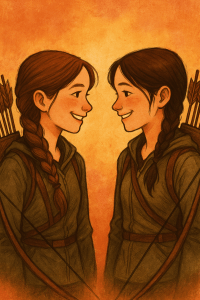 If you’ve ‘visited’ a fictional world and someone else has also visited that fictional world, then you have something odd in common, and with it, you both share a novel way to connect and understand one another that those who haven’t read that book lack.
If this stranger goes on to tell you that they feel a connection to a certain character, you can already start to understand what sort of person they are. Purely by knowing what it would mean to like that character, you can unpack some ideas about who this stranger is at their core.
Here’s a simple example: say someone strongly identifies with Katniss Everdeen from the Hunger Games series. You might infer that this individual feels inclined towards taking on responsibility; they may have a very serious, practical, grounded view of the world.
If they reference particularly telling scenes from the book, you might learn even more about them and update your view of them accordingly.
Shared experiences like these help you connect in quick and comfortable ways. It feels safe and natural to communicate with someone we see as like-minded. The Crawford & Cribb study describes this as a form of ‘cultural capital’.
It’s strange to think, but a shared interest in Michael Crighton’s Sci Fi, or Bridget Jones’ diary for example could be the difference between making a connection with a superior at work and blending into the rest of the workforce.
Mind-reading using alien worlds
This ‘cultural capital’ is really unusual but sort of amazing. At no point have either of you talked about any ‘real’ place or any events that ‘really’ happened, but still, you can gain a qualitative understanding of the person you are speaking to.
You’ve both ventured through the same world, with the same characters, on the same adventures. When you talk with someone about these things, their reactions to these people and events let you know real things about this stranger. You might get a feel for subtle things like their moral code, their sense of humour, their values, and their tastes. All in a comfortable and surprisingly fast exchange (it could be as simple as “What Hogwarts house would you be in?”)
In short, the fictional world you both share increased your empathy but also gave you an instant shortcut in the way you can get to know others who have visited the same fictional place.
 Not everyone is an extensive reader, but you could be, and in visiting more worlds, you increase the odds of having read a book that another stranger regards as their favourite. You increase your mind-reading power with every fictional world tour. With every strange adventure, you open up the possibility of making a connection with someone at lightning speed.
With such a powerful key to so many different minds, why wouldn’t you read all the fiction you could? (If access to fiction is tricky, this post shows you how to get free books on almost any device.)
Applying the Mind-reading to yourself
When you turn the lens in on the strange worlds that appear in your daydreams, your imaginings, and even when you play out a different way that you would have liked an uncomfortable situation to have gone, you create a tiny fictional world. When you expand it and try to tell that story, you open up the same mind-reading power on yourself.
Writing like this will make you much more aware of yourself, and if you’re lucky, much more comfortable with yourself. What’s more, if you read more fictional worlds, and meet more fictional characters, you furnish your own imagination with even more scenes and characters to blend together and create a new place, a new character. You give yourself the chance to make even better stories.
The evidence is pretty clear, and my own personal experience backs this up; read more (and write more) and your life gets better. Visiting all of those imaginary worlds is like a literal golden ticket to a happier, more fulfilled version of yourself.
Know a few young people who might enjoy an in-class writing workshop or a free book talk?
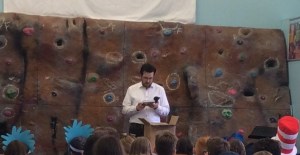 I run free school author talks that aim to unpack the empathy, imagination, and big ideas that help make the best stories.
If you’re a teacher looking for a fresh way to open creative conversations in class, I’d love to help. Simply click this link for details about my free author talks and writing workshops, as well as contact details.
Thanks, as always, for stopping by.
All the best, John
*Enjoyed this post? You can subscribe for updates using the box below, or check out my books for young readers by clicking this link.*
Discover more from Jack Reusen
Subscribe to get the latest posts sent to your email.
