Category Archives: Inspiration

Lore

Sometimes we struggle. Motivation fails us. I got a taste of that recently as I neared the 30,000 word point in my latest book. Knowing that I was writing horror a friend (thanks Jo!) recommended I check out a podcast called Lore.

Humans are the real monsters

Lore is a fortnightly podcast (or web radio programme for those who prefer that term) that discusses the paranormal, the odd, the unpleasant. However, its primary focus seems to be the darkness that dwells in us all. The selfish voice, the creature that panders to fear, the red eyed monster of rage; all of these are distinctly human, distinctly internal, monsters.

Listening to tales of Lore drew me to that dark place, allowed me a closer view of those nastier human foibles that are the true basis of horror. Aaron Mahnke (the host/researcher/creator of Lore) introduces the listener to a selection-box of human awfulness. From the true story of the Pied Piper of Hamlin (NOT for children or the faint of heart), on to multiple tales of witch hunts through the ages, to the story of H. H. Holmes, a conman who created, and utilised, a hotel full of secret passageways and an underground ‘lab’ for his own sick ends (this hotel has since gained the name ‘The Murder Hotel‘).

The events in ‘Marcus‘ don’t come close to the horrors Mahnke describes in his show (for starters mine is pure fiction). However, I’d like to give credit to Lore, and Mahnke himself. He produced something that offered a custom set of blinkers for this first-time horror writer at those times when sitcoms, kids books, and social media, threatened to draw me away from my writing.

More to learn

There’s something else that Lore helped me see though. Mahnke persisted, every two weeks he got another solid bit of work out into the world. Well rehearsed, well researched, well performed. You can go back to the very first podcast and see the show evolve, gain a following, and importantly offer Mahnke the recognition he deserves.He made something people enjoyed and the world rewarded him. It’s an important takeaway whenever you come across this sort of creativity. The word ‘inspiration’ is banded about a lot, it has transient, insubstantial overtones. Instead I would say that Mahnke’s efforts provide more confirmation than inspiration.

Listening my way through the first episodes gave me confirmation that the right content, found by the right audience, and offered up consistently, will yield positive results.

Mahnke has his own Amazon TV series now (based on the podcasts) but he has also demonstrated his mastery of storytelling through the podcast in a way which has allowed him to market his own writing. Author of a host of books, and clearly working purely within a field he enjoys. What he has done has given me confirmation that all the slog is worth it.

Thank you Aaron.

Why listen to Lore?

Simply put it’s fascinating (if disturbing in places). Often we hear that the world has ‘gone to the dogs’ or that society is being eroded by one modern creation/concept or another. A step back in time (and in some cases it’s an uncomfortably short step back) is enough to show us that human beings have always found ways to be awful to each other.I’m not trying to suggest that we’re living in a golden age but lore can take the rose tinted glasses off of the reminiscence to ‘yesteryear’. We get by, we look after one another, we do what we can to help one another. The stories in Lore highlight this as well. It’s in our nature; the flip side of our darker internal demons.

Watch the news and you can be forgiven for thinking that we live in an age of terror. I find it odd that comfort can be found to remedy this perspective by looking at the horrors of the past.

I hope you take a moment to pop by the Lore podcast page and give it a try yourself (and no I’m not being paid to promote it/endorse it/otherwise send traffic his way).

As always thanks for reading, and feel free to pop back and tell me if you enjoyed the podcast,

All the best, John

Mist or Fog

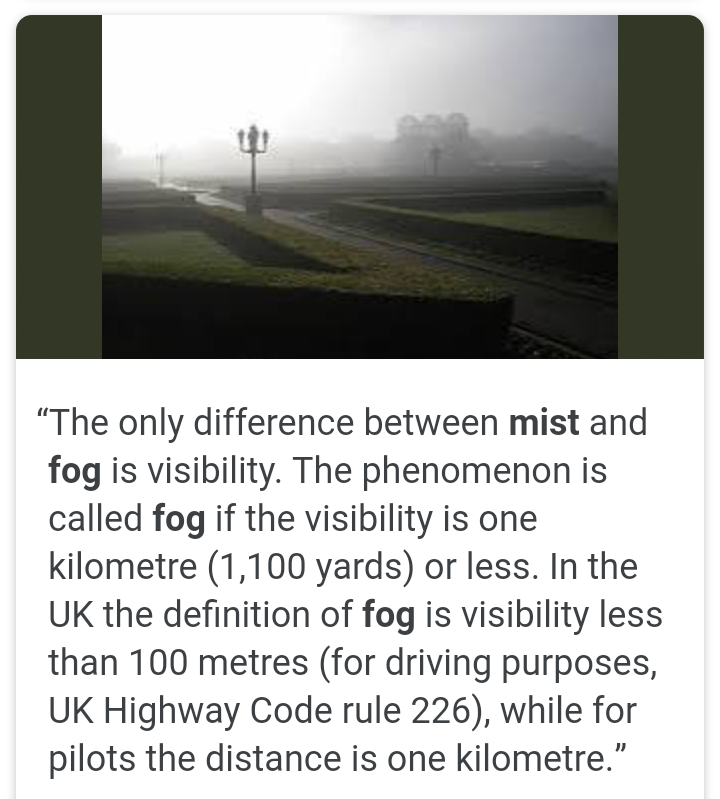
Fog makes it harder to write but it’s essential. (No I didn’t leave the window open to add atmosphere to my morning writing). 

The reason fog both helps and hinders in equal measure is research. In order for my books to make sense I have to research what I’m writing. It’s time consuming but necessary.

In my most recent writing stint I decided it was important to know the difference between fog and mist. A character has the power to disperse into a cloud. 

I thought the distinction between ‘fog’ and ‘mist’ would be an important one, and planned on using it in the book. Turns out it’s basically arbitrary. The distinction even gets cloudy (see what I did there) from one country to the next.

Apparently, for most of Europe it’s ‘fog’ when it impedes visibility for 1000m or less. Whereas here in the UK we don’t call it fog until one can eat it.So I went back and rewrote. My research felt fruitless but it actually saved me from writing something convoluted, hard to follow, and worst of all something that would have been nonsense.

Writing is often like that. You wait for the fog to clear. Do some research. Find out it’s just mist (at least in the UK) and get back to work.

Writers reading this, what odd facts have you discovered in your research? Did they force a change in your book?

I love getting comments so please feel free to have a blether in the comments section below. 

As always, thanks for reading, 

all the best, John 

When I grow up I want to write stories

Words come easily to some people. Even at a young age it’s easy to spot those children who will never struggle to be heard or understood. I wasn’t one of these children.

The simplicity and directness of language fascinated me. However, I made things hard on myself. I favoured ‘big words’ because they seemed to convey so much in such a short space of time.

For me ‘big words’ really were ‘simple’ words. It took me many years to see where I was going wrong.

Despite the seeming directness that a broad vocabulary offered, what I was really doing was alienating my peers.

Words are more complicated than I realised at the age of eight or nine. All the same, knowing what a change in word use can do makes it easier to tailor my speech and writing now.

At five years old I loved to write stories (you know the kind: you draw and colour it in (stay inside the lines!), then write a sentence underneath to make sense of it all). Teachers would ask what I wanted to be when I grew up and the answer always shifted between ‘archaeologist’ and ‘story writer’.

Eventually my love for dinosaurs was surpassed by my desire to be understood and to entertain. By my teens I had firmly decided on ‘writer’ as the end game.

It would be easy to say that I’ve always wanted to be a writer but it’s not quite true. My real motivation was to reach a point where people’s eyes wouldn’t glaze over as I spoke to them.

I would let myself hope to be interesting or entertaining but most of the time I’d settle for people remaining focused after 30 seconds.

As I entered university I also started to approach the idea of conveying ‘big ideas’. However, when I became a parent I realised that sometimes you can show big ideas with some very small actions.

The Jack Reusen books are wrapped around family and magic but the ‘big ideas’ are hidden behind that.

How important is comfort/safety? Can a full life be had without stepping away from the familiar?  Who should have power? Does power imply a duty to do right by those who do not have it? Should ‘dangerous’ knowledge be locked away/hidden from others?

My desire to become a writer can be confusing to some. However, far more people seem able to sympathise with a desire to be understood.

Did you struggle to be understood as a child? Do you find that writing helps you get past that? Perhaps you found a different form of expression. If so, what was it? Do you find that voice helpful/therapeutic?

As always, thanks so much for stopping by this page. All the best, John

Why are Jack Reusen books so short?

harry potter page 1A long long time ago (actually it was only three years back) I tried to read Harry Potter and the Philosopher’s Stone to my eldest son. It was a few weeks after his seventh birthday and he was on holiday from school. I thought that at last he was ready to sit down and enjoy one of the best children’s fantasy series ever written. He wasn’t.
Don’t get me wrong, he enjoyed it but his attention started lagging in the middle of each chapter. I tried to keep my reading as animated as possible but we still ended up stopping in the middle of some chapters. We would take a break, sometimes for a few hours, sometimes until the next day. For the most part it seemed to work. However, with each break he seemed to forget more details about the book.

At their heart Harry Potter books are mystery books in a fantasy setting. There are clues to remember and puzzles to solve throughout. Forgetting details in these sorts of books takes a lot of the oomph out of them.

I would be asked things like ‘Who’s Ron?’ ‘Why can’t Harry just do magic straight away?’ or possibly the most telling ‘Why does he live with his Aunt and Uncle?’ (asked when Harry has his first Hogwarts Christmas). It was clear he was forgetting more than he was remembering and at around chapter six or seven I could see that almost everything was going over his head.

We put Harry Potter away, to come back to when he was a bit older. All the same, the experience of trying to retain his interest lodged in my mind.

This sensation came back to me when November of 2014 rolled in. The nights grew long, and I discovered a new way to write. NaNoWriMo (national novel writing month) fell into my lap. They said something like ‘you have a book inside you waiting to get out’ and I realised that there really was.

Jack Reusen and the Fey Flame became something that I needed to write; something fantastical, exciting, relatable, and importantly, a book that could (hopefully) maintain the interest of an energetic seven-year-old like my son.

There are lots of books for seven-year-olds. Incredible, exciting, sometimes hillarious books, but I felt like I could write something a bit different. I wanted an element of the seriousness of ‘older’ fantasy books, and a slight taste of the danger and thrills that come with that.

From my own experience I realised that I could hold my son’s attention for about ten minutes, so (estimating a reading speed of about 250 words per minute) I worked out that my chapters needed to be no more than 2,500 words long.

I also wanted to make sure the story could be read all the way through in a relatively small space of time so I limited my chapter count to be sure that the whole book could be read in around a fortnight (at a rate of one or two chapters per night).

When I released the first book in the Jack Reusen series I began to hear that other families were having exactly the experience I’d hoped they would. (I was also pleasantly surprised to find out that some parents were sneakily reading ahead to see what happened next). These responses were brilliant, then, around a month after release, I heard something that changed the way I looked at the books.

At the time I worked in a local toy shop. One of our regular customers came in specifically to thank me for writing the book. I hadn’t been thanked for the book before.

It turned out that she had been trying to get her nine year old son to read chapter books for years. Nothing caught his interest. Then she gave him ‘…the Fey Flame‘ and apparently he read the whole thing in just a few nights. I was taken aback and told her how happy I was that he had enjoyed the book so much.

That boy wasn’t the last to say something similar about the Jack Reusen books. The shorter length seems to have made it easier for a lot of children to enjoy. Now that I know I’m helping kids get into reading I can’t bring myself to change the formula.

The original idea was to give families something that they could enjoy together, but a fantastic side-effect seems to be getting more reluctant readers caught up in a book. I love reading and the idea that someone might miss out on the enjoyment of it is disheartening. If writing short chapters and short books helps get a few more kids enjoying reading then I’ll write as many of these books as I can.

Thanks for reading and please feel free to share your own favourite short/quick reads in the comments below. All the best, John

Go hug your mum (most kids’ books would have killed her by now)

There’s an almost unspoken rule in kids fiction; before the story begins kill the parents. Harry Potter loses his parents, Sophie in the BFG is an orphan, etc. etc. Then there’s a whole other category of what you might call half-orphans; children who have lost their mothers (i.e. Danny [champion of the world], Hiccup [How to train your dragon], Belle [Beauty and the Beast].)

There must be some literary reason behind all this maternal slaughter but the one that seemed to flair up most for me (after I decided to keep my characters’ mums alive) came as a bit of a surprise.

Initially I assumed that all the parents were being killed off because parents would make the story too boring for kids. However, the more I write mum characters the more I see how brilliant, exciting, and shocking they can be. Turns out mums aren’t so boring after all. So why do so many children’s books commit matricide?

I can boil my feelings on it down to a moment I had when writing ‘Jack Reusen and the Fey Flame’. There’s a battle, a character full of malevolence and power is poised to begin a magical takeover of the non-magical world, and all the key good guys are lining up to stop him.

Key among these is a mum with more than enough power to take him on. Originally I had her set up to do just that and then something shoved that option aside; fear. Not her fear (she was brave, bold, and everything I needed her to be), instead I found myself burgeoned with ridiculous amounts of worry on the part of her child. This is when I realised the real reason that parents stay out of the action in children’s fiction; it’s all just too much for the children to take.

As a writer you’re faced with a choice between endless descriptions of a child’s concern for their parent, or you can avoid this and make the child seem uncaring or even callous in their disregard for their mum’s safety.

The simple truth is that you can’t write a believable child without addressing their relationship with their parents. When you take their parents out of the picture, your character can get on with the adventuring.

When you take the mum out, in a strange way, you remove the character’s worries about the possibility of losing a source of deep reassurance, support, and love. Mums can’t always be part of the action because the risk is simply too great for the child protagonists.

It looks like mums are sometimes too big, too emotionally all-encompassing to be included in children’s stories. In other words mums are a bit too awesome for kids books.

Can you think of any kids books that manage to keep the mums involved? Do you have any favourite literary mums? Feel free to share in the comments and over on Facebook or Twitter.

As always thanks for reading, and happy mothers day to all the mums out there.

All the best, John

Why a willful girl makes writing way more interesting

Strong female, character, agency, writing Thanks to a retweet by Ashleigh Bonner I recently came accross a blog post that significantly changed the way I’ve been looking at one of my central characters. The idea behind the post was to demonstrate what separates a good female character from one that is simply good at kicking butt. According to Chuck Wendig, the defining characteristic of a truly strong female character is agency; more specifically she asks writers to consider whether their story would have gone any differently if one were to remove or replace the ‘strong female character’.

If the story is not influenced directly by your character, if events don’t unfold as a direct result of her own decisions, then you’ve created a character without agency. No matter how physically strong she is, no matter what struggles she gets through, if all of her adventures simply happen to her then she isn’t demonstrating true strength.

To be honest a sense of agency seems so pivotal to the construction of any main character that I’d go so far as to say that the lack of it in any character (especially the protagonist or any secondary characters) is a key indicator that what you’re writing isn’t very good.

The main characters in my books are children, they can’t help but live in a world with a moderately reduced sense of agency (adults have a whole additional set of rules that they expect a child to follow). However, I try to ensure that even where the rules are followed, we nonetheless see a degree of choice from the characters.

Jack and Thea both typically do what their parents tell them to. However, I’ve been sure to include moments where circumstances change in such a way as to leave them the freedom to choose. When these moments arise I have to admit I could feel the personalities of both characters at their strongest.

Thanks to Chuck Wendig‘s post I’ve now got a clearer understanding of how important those moments of agency are when writing believable characters (even children). Children will experience a myriad of controlling forces during their young lives. In an ideal world most of these controls will be there to keep them safe. However, what shapes them as individuals are those very moments when they recognise grey areas in these rules and take the initiative to make their own choice.

Perhaps this is what makes young adult and teen fiction so popular; the very trait that we treat as the key indicator of adult agency is being explored in a raw and striking manner at precisely that life stage. We meet these fictional young men and women when they are claiming their own individual personhood. When thought of in this way, no matter how many butts your female character kicks, if you aren’t letting her make her own choices (good or bad) then you aren’t creating a person, at best you’re writing an exciting bit of furniture.

Thanks again to Chuck for opening my eyes, I’ve got an interesting new perspective on my writing now.

What’s your favourite female character, and why? Do you, like me, find yourself drawn to stories that focus on the development of a adolescent into and adult? Are there any books of this type in particular that resonate with you?

As always thanks for reading, all the best, John

(Also you’ll make my day if you pop over to have a look at the first book in the Jack Reusen series 😉 )

NOTE: The original post has been edited. I accidentally misattributed the author of the blog post. Many thanks to Ashleigh Bonner for helping me sort out my blunder. Ashleigh also writes her own awesome blog which you can find here.


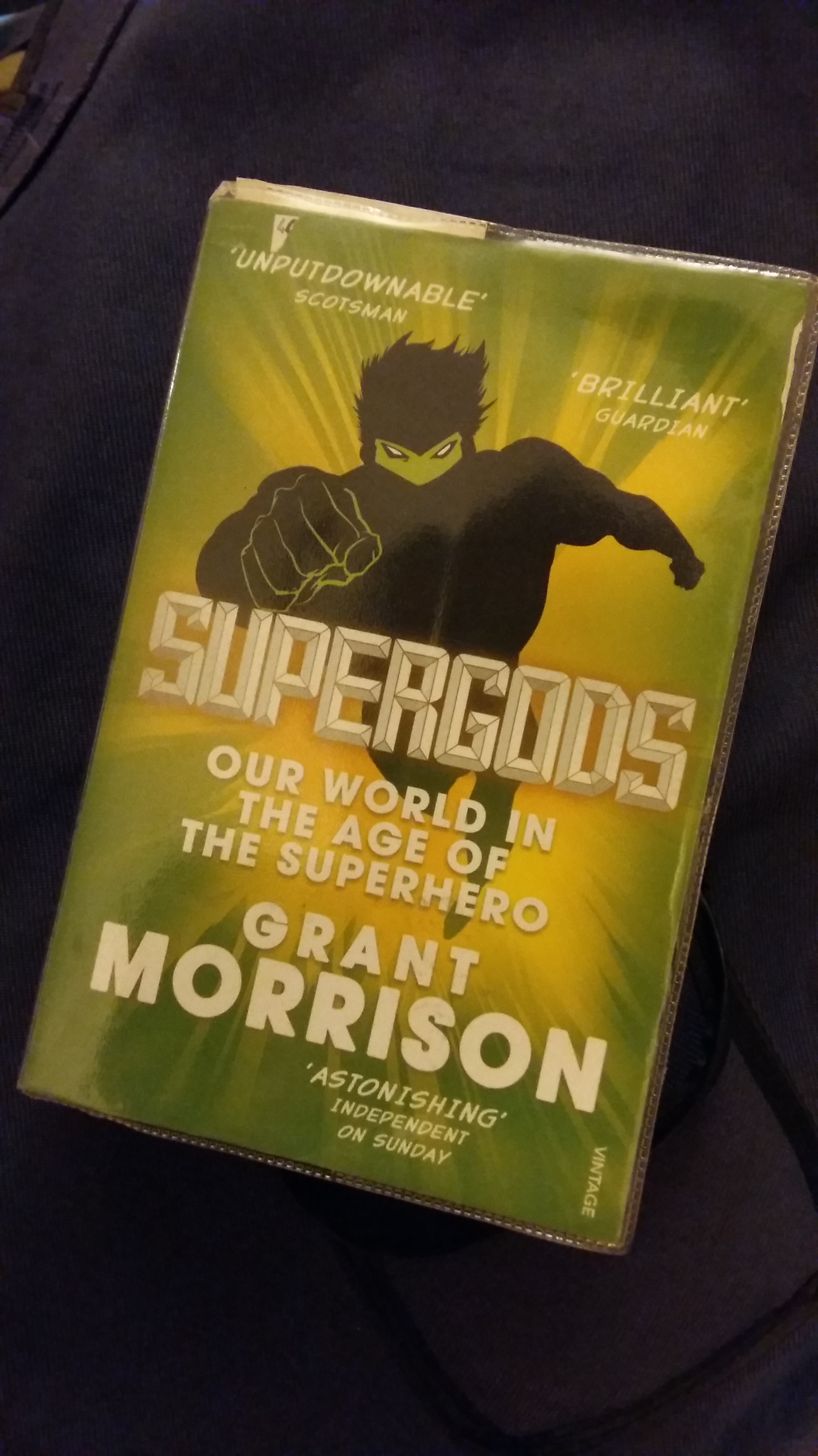
This month I will be mostly reading…’Supergods’ by Grant Morrison

As is probably the case for most parents, I don’t get as much time to read to myself as I once did. My reading list typically comes from the children’s section of the library but, despite the fact that there are some phenomenal kids’ books out there, it is nice to occasionally read something for ‘grown-ups’.

My ‘grown-up’ read this month is ‘Supergods‘; an effervescent, detailed history of our comic book heroes: those costume wearing vigilantes and demigods who have become an integral part of modern culture. I’m not done reading yet but the thing that stands out most so far is how unusual superhero writing actually is.

In many cases a modern comic book writer or artist is being handed the reins to a character who is older than they are. It’s fiction writing but not as we know it, and to be honest I think I’d find the whole thing pretty intimidating.

If you’re really lucky you’ll create something on par with what has come before, if you have actual talent behind you as well then you may manage to create something that stands out as a new and definitive chapter in that character’s story. However, the flip side is the prospect of fending off negative reactions from fans, and when it comes to comic book fans I’m not sure I’d have the mettle to put myself up to that task.

Two or three of the characters that feature regularly in the Jack Reusen books at least seemed to have come from somewhere outside my own mind. However, it must be a whole other level of adjustment to draw together a tale involving a character that you know was never yours to start with.

What I’ve found from Morrison’s book though is that great comic book writers somehow manage to push past these difficulties. They take charge of a character and sometimes even see themselves as raising the flag for a new and more culturally relevant incarnation of the character.

I’m not typically a non-fiction reader but I’m pleased I picked this up. It’s proving to be an interesting insight into a type of writer that, I’m sorry to say, I never gave much thought to before. Their job clearly comes with its own set of challenges and rules. Their word count is alarmingly tight, yet at times they are expected to convey huge ethical, metaphysical, or even deeply human concepts.

I love comic books (I have a couple of suitcases full of them to testify to that) and now thanks to Morrison’s book I have a deepening appreciation for the talent and work that goes into creating them.

Is there a particular superhero storyline that has struck a chord for you? Do you have a favourite character, is there a version that you consider better than other incarnations?

As always, thanks for reading, all the best, John

3 easy ways to beat writers block

I’ve been writing ‘properly’ for a few years. One of the best things about getting more experienced is the fact that writer’s block is definitely less of a problem for me now.

I won’t pretend that I never experience it now but it’s definitely…different than what it used to be. When I look at what’s changed in the way I work there are three main things that stand out:

Routine: By this I don’t mean time-tabling writing sessions or anything like that. Life is messy and hectic and (to begin with at least) you’ll probably see writing as more of a hobby. This often means it takes second fiddle to other priorities.

However, there is an element of routine that you can develop for those times you do steal an hour or two for writing.

Here’s mine: cup of tea, bar of chocolate, playlist of music that matches tone of writing (e.g. I recently wrote a science fiction book for adults and listened exclusively to Sci-Fi soundtracks).

The more I write with my tea, chocolate, music accompaniment, the more I associate my routine with writing. It’s now my go-to means of getting into writing mode.

Simple rewards: This one could tie to your writing routine (e.g. like me, you could choose to only eat your favourite chocolate bar while you’re writing). However, your reward can be any small thing that means something to you.

The important thing is that the reward becomes intricately associated with writing for you. It needs to be easily replicated, exclusive to those times you set aside for writing, and you need the will power to not partake at any other time.

There’s also a chance it could fit in with the third tip.

Read/watch something unfamiliar: If you always watch/read the same genre (and especially if that happens to be the same genre you write in) then it can be really refreshing to step away from that after a writing sessions  (or during breaks).
I’m a huge fantasy/sci-fi fan and these are my chosen genres to write in. However, I’ve experienced really satisfying changes to my writing through watching/reading horror, drama, thriller, comedy, and mystery.

Playing around with different genres is a great way of keeping your writing fresh and interesting for you as a writer. If you’re bored with what you’re writing then your readers don’t stand a chance.

That’s about it. I’m sure you’ll still have days where you ask the creative part of your brain for something golden and it just sits there handing you lumps of dirt. All the same, I get far less of those days now and these three things have definitely helped with that.
I hope you found these tips useful. Let us know in the comments if you have some hints of your own for dealing with the dreaded block.

As always, thanks for reading, all the best, John

Is there a word for things that stop being cliche?

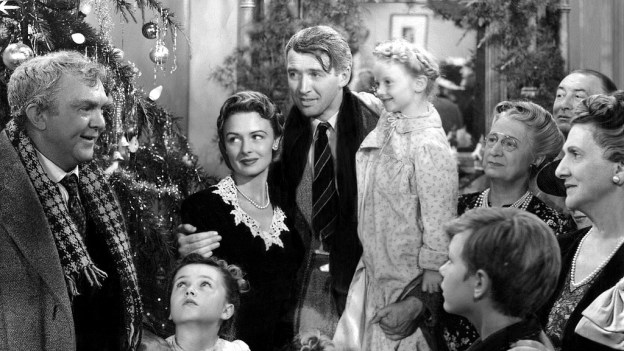
wonderful-life‘It’s a Wonderful Life’ is apparently always on at Christmas but to be honest I’ve only seen the film about two or three times in my whole life. There’s an idea going around that things like ‘It’s a Wonderful Life’ and other classics are on too much. It’s not unusual for people to call what I’d call ‘traditions’ cliche.

Recently they showed ‘It’s a Wonderful Life’ in a one night only event at our local theatre, mini cinema, and all round entertainment venue; the Strathearn Artspace. I didn’t make it along to their showing (sick kids etc.) but it put me in the notion for it so I hunted down a streaming copy (found it on Netflix) and watched it a few days later.

It was better than I remembered, and far from cliche. It got me wondering whether, especially at Christmas, there’s maybe a shelf life to things being ‘cliche’.

Is there a set time period between something being repetitive and it becoming traditional? I haven’t seen ‘It’s a Wonderful Life’ very many times but there are couple of films that I always associate with Christmas.

‘Elf’ only came out in 2003 but thirteen years seems to have made it pretty traditional for me. ‘Love Actually’ rolled out in 2003 too and I still enjoy it plenty at Christmas.

Maybe I’m a bit of a sentimentalist, maybe I pop on some blinkers at this time of year, but I like a bit of cheese. In fact I’m even pretty partial to some singing Santa decorations scattered around the house.

Are you a sucker for any Christmas ‘cliches’? What film/movie makes you instantly think of Christmas?

Feel free to share in the comments either here, over on facebook, or you can even tweet about it (if you’re into that sort of thing 😉 ). As always, thanks for reading, and merry Christmas folks 🙂


Boy from guitar lessons (it’s nice to be nice)

14224700_10157295428425401_4845612948376145664_nA few weeks ago, on the way out of my son’s guitar lessons I noticed one of the other kids watching me with a puzzled expression on his face, clearly trying to figure out where he knew me from. It’s not uncommon for me, for many years I worked in the local toy shop so a lot of local kids know me but struggle to get who I am out of context.

This wasn’t one of those times. Laden with bags, guitars, packed lunch boxes, and all the other paraphernalia that parents so often end up stuck with, I waddled along the corridor outside the music room. The puzzled boy kindly held the door open.

I thanked him and was half way through the doorway when he blurted out “Are you an author?”. At first I wasn’t sure what to say, I decided against my regular ‘Kind of, I write kids books.’ Replacing it with a simple “Yes, I am.”

He remembered me from a talk I’d done at his school. When I told him I’m still working on more books he explained that he thought the Fey Flame was great, then he thought for a few seconds and told me that, in fact, it was his “favourite book ever”.

It’s amazing to know that you’ve made something that someone has enjoyed that much. I’m so pleased he decided to share that with me because it made my day. It actually made my week.

Simply telling someone that you appreciate something they have done/made/written can be the most awesome thing, so thank you boy from guitar lessons. Thank you sincerely.

It’s so easy to praise people. Sometimes we need it more than you realise. None of us should be afraid to say a few words that could make someone’s day. So here’s a wee selection of praise I thought I’d pass on:

June: I have no idea where you get your energy and enthusiasm from but you’ve added a lot to our wee town. Thank You.

David: The Artspace is shaping up to be something brilliant. I don’t get along to events as much as I’d like because childcare isn’t always easy but I’ve always enjoyed the things I made it along to. It’s a real asset to the town.

Fun Junction: You guys are awesome. There’s a whole heap of stuff I could list here but mainly I’d like to highlight your awesomeness.

Valentines of Crieff: Superb clothes. Every shirt I owned used to bake me. I wasn’t a fan of dressing smart because it meant a day spent sweltered and sweaty. I have to admit I never spent as much on a shirt before but then I also never wore the cheap ones any longer than I had to. Thanks for helping me feel comfortable in my own clothes.

Marrianne: You are mental but like June you seem to give people the wee pushes they need all over the place. Most of all, on my part, thank you for being a constant wee niggling reminder that I need to get back to my writing.

On that note I’ll get back to my writing. I’m planning on sending Jack Reusen and the Fey Flame in to a publisher soon so it’s getting one last wee polish before it gets shipped out.