Category Archives: Green Flame Books Week long discussion

At the top of this group you will find a page filled with links to the most recent Green Flame Books literacy discussion topic

Story Ideas: Places

For the past few weeks, I’ve been adding a podcast to my range of content. This post is directly linked to this week’s episode titled “Story Ideas: Places”, where we look at a quick and easy way to jump-start your creative juices.

By the end of the activity, you should have a full story written up, and we’re also encouraging pupils to submit their stories to be read on the podcast (details on how to do that will be available below). With this in mind, I hope you enjoy this writing activity and read to the bottom to find details on how to submit your story to be read on the podcast.

Writing Activity Resources

Teachers
This week’s writing activity is pretty simple, but it should prove useful for those moments when a story simply isn’t coming to you. There are classroom sheets to go along with this activity. You can click here for a direct link to the Canva presentation, or download a PowerPoint version here.

Pupils/ Students
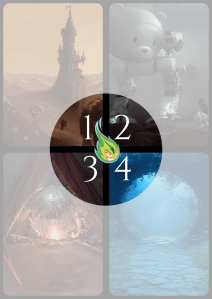
The activity sheets for this writing activity are pretty simple, and are designed with the expectation that there will be additional jotter or digital writing as well. A black and white version is available here, a colour one is available here, or you can get access to a Canva project edition (that you can edit) here.

Play along podcast episode (if you prefer)

You can play the accompanying podcast episode alongside the classroom presentation. I’ll call out the next section so you know when to change slides. (In future episodes, I’ll try to be more direct about this with something like ‘turn to the next slide’ after each section).

You can also pause at the end of the prompt on each slide to leave time for writing. All in, this will probably add up to about a 1-hour classroom activity. You’ll find the Spotify version of the podcast below, and links to it on other podcast platforms in this linktree.

On With the Activity (From here on out, this will match the content of the podcast)

Today, we’ll be looking at a writing exercise that focuses on setting and place in your storytelling. With this in mind, I thought I’d try something a bit different and begin the episode by reading the first chapter of my first book, “Jack Reusen and the Fey Flame”.
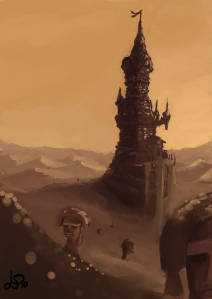
In this chapter, I played with the idea of setting. First, we look at how familiar places can become uncomfortable when we notice things that we don’t remember seeing before. Then, we look at what it feels like to feel lost, truly lost, and what our reactions to this feeling can tell us about ourselves.

You’ll see the meaning of the setting change a few times in this chapter. I hope you enjoy listening to the sample chapter, but whilst you listen, keep an eye (or ear) out for any times where the setting is moving the story forward.

(You’ll get the full chapter reading in the podcast episode. If you’d like to read the rest of the story with your class, you can also pick up a Kindle copy by following the links at the bottom of the page for purchasing, or reading for free through Kindle Unlimited, on Kindle in your country.)

The Writing Challenge

You’ll have seen a lot of focus on setting in the little excerpt I’ve just read, and now it’s your turn to experiment with a story setting.

You’ll have a full story by the end of this activity, but the direction we take may be a little different from the way you normally set up a story and I hope you enjoy it.

Story Ideas: Places

Being creative is a really useful skill in life (not just for storytelling) so learning tricks and techniques to get your creative side working is never a bad thing.

Today, we’re going to look at a quick technique that I use. It should help switch on that creative part of your brain and prepare you to create a fantastic story.

We’ll start with place as it’s sometimes neglected a little in storytelling. Starting with the place can sometimes launch you into a new story in unexpected ways.

Part 1: Somewhere different

Think of where you’re writing right now. Is there a place that could be the most opposite you could possibly imagine? Somewhere absolutely nothing like where you are sitting at this moment?

What is that place like?

What’s the weather like there?

Is it a safe place, or is it somewhere perilous?

If you were to sit down and write in this new place, what would you be writing with?

Would it be a scroll of paper with a feather quill and a bottle of ink, or would you be writing on a futuristic tablet with an AI that talks to you as though they’re the cleverest being in the galaxy?

Part 2: A stranger
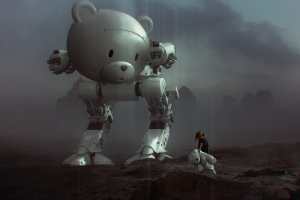
OK, now you know a lot about this new place, so let’s take a look around and see if there’s anyone there.

Who are they? Are they a human/ an animal/ an alien/ or something else?

What are they doing?

What mood are they in?

You now should have a setting and your main character. This isn’t everything you need for a story, but it’s a good start.

Part 3: Getting to know people
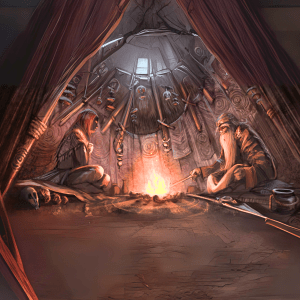
Now ask your character a few questions. What are their interests? What are their skills? What are their main fears? What would they like to be doing this time tomorrow?

Take your time with your character. Ask weird questions, but even ‘boring’ questions can give you ideas for your story. What might your character eat for breakfast? Where do they sleep? You might be surprised at the direction their story takes.

Part 4: Go and write

You now have two out of the three basic parts of a story; the last one is called ‘plot’.

What will happen to your character next?

Will something surprising happen to them?

What will they do as a result?

Will they be happy in the end?

Write your story in a digital format, or in your best handwriting, or draw some amazing pictures to make up a ‘comic book’.

When you feel your story has reached a natural end, please be sure to share your stories on the Celebrating Stories portal.

As the weeks go on, we’ll start reading one or two of your stories on the podcast each week.

You’ll find links to share your story on the classroom slideshow, which you can download over on the website. Alternatively, you’ll find a link to it in the episode notes for this podcast episode.

Your story could be the next one we read on the podcast!

Go here for the Google Form to submit your story (click this link). You can share handwritten stories, digital text versions, or even pictures.

Thanks for popping by

As always, thanks for tuning in to listen to this week’s episode of Lit Up With Green Flame, and for coming here to read the more extended version on the website. If you haven’t already, please don’t forget to subscribe on your favourite podcast platform.

We’re on Spotify, Apple Podcasts, Audible, Amazon Music, YouTube Podcasts, and many more. Just go to your favourite podcast app and search for ‘Lit Up With Green Flame’ (click here for the linktree that lists how to find us on your favourite podcast platform, just click on ‘Lit Up With Green Flame Books Podcast’ button to find the link). Subscribing is free, and you’ll be sure to catch the newest episode as soon as it’s live.

I hope you pop back next week when we’ll be looking at the strange world, and wild life of Roald Dahl (since it’ll be his Birthday in just a couple of weeks, he would have been 109 years old this year on the 13th September).

Also, if you’d like another writing activity to try, you could look at the one we did on Magical Realism a few weeks ago. You’ll find a link to that here.

Thanks again for listening in, and I hope you don’t mind the slightly longer episode this week.

All the best, John

Illustration of a child learning empathy through reading, symbolised by a thought bubble with diverse characters.

Reading Fiction is Reading Minds

How Shared Stories Make Children More Empathetic Writers

(If you’d prefer to listen to this post you can find the corresponding podcast episode below)

Imagine I told you that there’s an activity that increases a child’s empathy, whilst enriching their job prospects and life satisfaction, and that this same activity can even positively influence their earnings later in life. Most parents would want to sign them up straight away.

It turns out that there is an activity like this. It has more impact than playing a musical instrument, or playing sports, and it’s probably easier to access than either of these: reading fiction.

In 2013, Claire Crawford and Jonathan Cribb analysed four decades of data following children from their early reading habits all the way into adulthood.

The data came from following those individuals as they grew and entered the workforce, all the while tracking their reading habits and their life experiences. (“The Link between Childhood Reading Skills and Adult Outcomes: Analysis of a Cohort of British Children”, Crawford & Cribb, The Institute for Fiscal Studies, April 2015)

Basically, they found that those who read fiction as children (and beyond) get statistically more out of life than those who don’t. Readers of fiction end up in better jobs, have better relationships, and feel generally better about their lives than those who don’t read fiction. This result is actually even more noticeable in fiction readers from lower-income backgrounds.

The results of the study are pretty interesting. I’ll try to avoid getting too into the weeds about the data here, but their findings could help inform the way that educators and parents look at reading, and the reading of fiction in particular.

The study found that children who read fiction regularly tended to show noticeably higher empathy and social intelligence than those who rarely picked up a story. Changes in soft skills like these don’t just impact school life, they can ripple through a child’s friendships, social confidence, and even their overall happiness as they grow. As the children aged, their answers showed that this was definitely true.

And it wasn’t just any kind of reading that resulted in this change either. It was the reading of fiction in particular that had the strongest and most consistent effect. An effect that exceeded that of reading non-fiction.

In 2018 two other researchers (Dodell-Feder & Tamir 2018) pulled together the results of fourteen separate psychology studies to get a more detailed view of the effects of reading fiction. Their results further confirmed that reading fiction has a noticeable effect on empathy scores. (Dodell-Feder & Tamir 2018, you can find a link to this paper here).

So what does this mean for young readers? A couple of weeks ago, in the podcast, we looked at  the multitude of benefits of reading (beyond simple test scores). Combining this with the data just discussed, I thought that this time, we could hone in on two interrelated benefits of reading fiction: empathy and community.

What do we learn from our reading journeys?

Teaching empathy through stories that challenge expectation, like a sad ogreIn what follows, you’ll see that writing from different perspectives typically comes more easily to those of us who read fiction. Possibly more than any other factor, reading has a huge ripple effect on both your ability as a writer, and on you as a person.

One skill that’s of vital importance to writers (young and old) is the ability to understand the lives of your characters. This is a lot easier when you’ve ventured into reading stories with a diverse group of characters first.

This is supported by the research as well. ‘Soft skills’ are one of the most noticeable gains from reading fiction. All of the research found links between reading and key soft skills like communication, teamwork, and creative problem-solving. These skills will make you into a better writer as well. The added bonus is that they give children tools they can use in every area of life, from conflict resolution to collaborative projects.

So, does being empathetic make you a better writer?

This is where I’ll have to become more anecdotal because it’s too hard to get people to agree on what makes someone a ‘good writer’.

What I can tell you, as a writer myself, is that the more you can empathise with other people, the easier you’ll find it to write your characters. What’s more, you’ll have the confidence to try telling the stories of people who may be quite different from yourself.

I love to people watch, and apparently, I’m not alone. It’s probably one of the most common shared traits that other authors have noted in conversations with me.

People-watching is a real-world behaviour that feeds into an author’s fictional ‘cast list’. You might see an authoritative mother at the supermarket with a crowd of high-energy kids to pull into order. The next thing you know, you’re picturing her as a magical part-polar-bear person. Mother to a brood of little part-bear-part-human kids rolling around and playing on a forest floor.

A stylised version of a reader connecting with characters through books.Reading fiction takes this love of people-watching and turns it up to eleven! You get right inside another person’s head. You follow them on a life-changing adventure. You share their sorrow and their success, and you both come out the other side, changed by the experience.
“All the arts depend upon telepathy to some degree, but I believe that writing offers the purest distillation.” (Stephen King, ‘On Writing’)

It doesn’t surprise me that reading leads to more empathy because reading an author’s work puts you inside their mind. They may speak through characters, but they are also telling you some of their deepest secrets and sharing some of their most private ideas.

Stephen King is an interesting case. He grew up in a low-income home, where his mother was left to care for King and his big brother David. Stephen and David were keen readers and eventually aspiring writers who actually printed their own local newspaper as children (when Stephen was around 12 years old).

The studies described at the start of this post seem to underscore Stephen and his brother David’s entrepreneurial tendencies. Children from lower-income households demonstrated the most clear and profound positive effects from reading fiction out of all the groups in the Crawford & Cribb study.

A Therapeutic Twist on Reading

In fact, there’s even growing interest in the therapeutic use of fiction (though it’s still a developing field). Some clinicians are exploring how reading about characters who work through challenges and traumas might support those facing similar struggles. A recent Times article takes a closer look at these story-driven therapy techniques. You can read that piece here.

The basic idea is that the therapist, in effect, prescribes a book based on your own particular emotional and behavioural needs. I can’t claim any more detailed knowledge about whether this sort of therapy is effective, but it does sound intriguing.

The Crawford & Cribb study notes that children who read fiction had higher life satisfaction, stronger resilience in the face of challenges, and better mental well-being well into adulthood. With this in mind, it’s relatively easy to see how reading a more prescribed list of fiction might help with specific problems.

Stephen King wasn’t wrong when he compared the exchange of ideas in fiction to telepathy. However, the telepathy stretches further than the author and the reader.

Meeting a fan of a certain book is like meeting a fellow traveller

Now comes the weird and wonderful bit about fictional worlds. Imagine a fairly common occurrence: meeting someone who has read the same book as you, and then really think about what that means (if Stephen King is right).

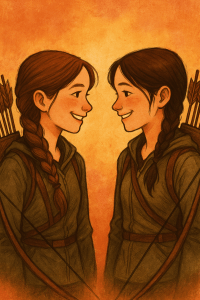
Two readers dressed as Katniss Everdeen smiling at each other, representing shared fictional experience.If you’ve ‘visited’ a fictional world and someone else has also visited that fictional world, then you have something odd in common, and with it, you both share a novel way to connect and understand one another that those who haven’t read that book lack.
If this stranger goes on to tell you that they feel a connection to a certain character, you can already start to understand what sort of person they are. Purely by knowing what it would mean to like that character, you can unpack some ideas about who this stranger is at their core.

Here’s a simple example: say someone strongly identifies with Katniss Everdeen from the Hunger Games series. You might infer that this individual feels inclined towards taking on responsibility; they may have a very serious, practical, grounded view of the world.

If they reference particularly telling scenes from the book, you might learn even more about them and update your view of them accordingly.

Shared experiences like these help you connect in quick and comfortable ways. It feels safe and natural to communicate with someone we see as like-minded. The Crawford & Cribb study describes this as a form of ‘cultural capital’.

It’s strange to think, but a shared interest in Michael Crighton’s Sci Fi, or Bridget Jones’ diary for example could be the difference between making a connection with a superior at work and blending into the rest of the workforce.

Mind-reading using alien worlds

This ‘cultural capital’ is really unusual but sort of amazing. At no point have either of you talked about any ‘real’ place or any events that ‘really’ happened, but still, you can gain a qualitative understanding of the person you are speaking to.

You’ve both ventured through the same world, with the same characters, on the same adventures. When you talk with someone about these things, their reactions to these people and events let you know real things about this stranger. You might get a feel for subtle things like their moral code, their sense of humour, their values, and their tastes. All in a comfortable and surprisingly fast exchange (it could be as simple as “What Hogwarts house would you be in?”)

In short, the fictional world you both share increased your empathy but also gave you an instant shortcut in the way you can get to know others who have visited the same fictional place.

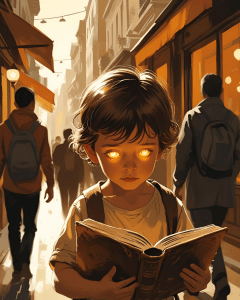
A whimsical image of a reader with glowing eyes, symbolising how reading fiction gives you 'telepathy'.Not everyone is an extensive reader, but you could be, and in visiting more worlds, you increase the odds of having read a book that another stranger regards as their favourite. You increase your mind-reading power with every fictional world tour. With every strange adventure, you open up the possibility of making a connection with someone at lightning speed.
With such a powerful key to so many different minds, why wouldn’t you read all the fiction you could? (If access to fiction is tricky, this post shows you how to get free books on almost any device.)

Applying the Mind-reading to yourself

When you turn the lens in on the strange worlds that appear in your daydreams, your imaginings, and even when you play out a different way that you would have liked an uncomfortable situation to have gone, you create a tiny fictional world. When you expand it and try to tell that story, you open up the same mind-reading power on yourself.

Writing like this will make you much more aware of yourself, and if you’re lucky, much more comfortable with yourself. What’s more, if you read more fictional worlds, and meet more fictional characters, you furnish your own imagination with even more scenes and characters to blend together and create a new place, a new character. You give yourself the chance to make even better stories.

The evidence is pretty clear, and my own personal experience backs this up; read more (and write more) and your life gets better. Visiting all of those imaginary worlds is like a literal golden ticket to a happier, more fulfilled version of yourself.

Know a few young people who might enjoy an in-class writing workshop or a free book talk?

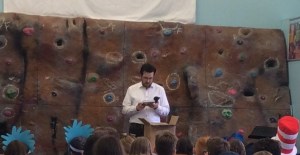
John Bray leading a school author talk in Perthshire with engaged children.I run free school author talks that aim to unpack the empathy, imagination, and big ideas that help make the best stories.
If you’re a teacher looking for a fresh way to open creative conversations in class, I’d love to help. Simply click this link for details about my free author talks and writing workshops, as well as contact details.

Thanks, as always, for stopping by.

All the best, John

*Enjoyed this post? You can subscribe for updates using the box below, or check out my books for young readers by clicking this link.*

Green Flame Books: The Power of Reading Week long discussion

Is reading for 20 minutes a day the ‘magic ticket’?

Reading for 20 minutes a day is often linked to better academic results, but what’s the science behind it?

Is there more to the story than test scores? And how big a deal is book ownership when it comes to childhood literacy?

This week’s Green Flame Books discussion dives into the power of reading and why access to books really matters. We’ll start tonight with a focus on “What Reading can do for you”: a post about the power of reading and why it’s not all about test scores.

You can also watch this post as a vlog on YouTube or watch or listen to it on the podcast on Spotify, listen here or click through to watch/listen on your app of choice:

Scroll down for a quick overview of the other topics we’ll explore together this week. Then join the chat on the blog and Instagram to share your thoughts.

Never Miss a Moment

Love a topic below? Tap the button to add ‘Green Flame Books: Literacy Discussions’ to your calendar.

You’ll get gentle reminders all week so you can join the conversation when it suits you best.

Click here to add the Green Flame Books calendar

Mon, 28 July

📖 Blog: Is 20 minutes the magic number?
Do test scores tell the full story about reading?

Tue, 29 July

📸 Instagram: Who Gets to Own a Book?
Let’s talk about book access—past and present.

Instagram posts page

Wed, 30 July

📸 Instagram: Book-rich or Book-poor?
Can digital books close the literacy gap?

Instagram posts page

📖 Blog: 1 in 5 UK kids don’t own a book
Could buying a book change a life?
📸 Instagram: Reading Lets You Share Worlds…
Which stories built your closest bonds?

Instagram posts page

Thu, 31 July

📸 Instagram: What Stories Do You Carry?
What tale from childhood has stayed with you?

Instagram posts page

Fri, 1st August

📸 Instagram: Which Story Opened Your Eyes?
What book helped you understand others?

Instagram posts page

📝 Instagram Prompt: Write about someone who loves what you hate
Can a character change your mind?

Instagram posts page

Sat, 2nd August

📖 Blog: Reading Fiction is Reading Minds
How shared stories build empathy in writers.

Sun, 3rd Aug

📸 Instagram: Why Do We Want Kids to Write?
What motivates young writers today?

Instagram posts page

To add the calendar to your own and join the discussion

Join the Green Flame Books Literacy Discussions Calendar

Alternative link to download an ical file if the one above link isn’t working

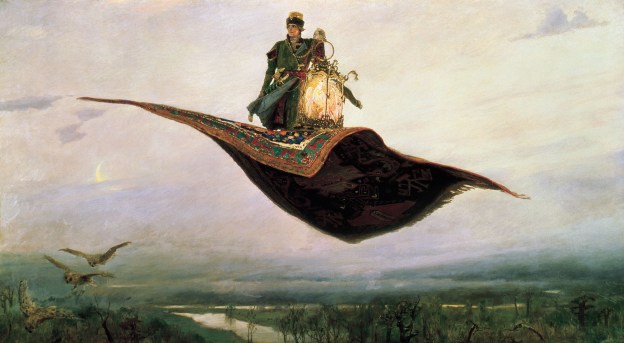
Viktor Vasnetsov’s ‘The Flying Carpet’ (1880) captures the surreal stillness of a fairy tale in motion—bridging folklore and fantasy long before modern genre lines were drawn

Magical Realism

Looking for a fresh way to spark creativity in writing? Whether you’re a writer trying to shake off some cobwebs or a teacher hoping to add a new twist to class activities, whatever brought you to this post, I hope you’ll find something useful in it.

TLDR… There’s a Podcast?

The world is a busy place so I’ve recorded a vlog/podcast of this post so you can listen as you do other things. You can listen to the podcast episode, or watch it as a YouTube video at the end of the post. You’ll also find links to teacher resources that you can use with your class as well

Magical Realism

If you’re sharing this with a class, it helps to start with a clear idea of what a ‘genre’ is. For what we’ll be working on today, it’ll be sufficient to say that a genre is a category of story. Book genres include categories like fantasy, sci-fi, mystery, and many more.

‘Literary fiction’ is a genre often found on university reading lists. It can sometimes be seen as the more ‘serious’ side of storytelling. One of its sub-genres, magical realism, mixes everyday life with magical moments in a way that is fascinating and quite different from typical fantasy books. The magic is subtle, unspoken, and completely mixed in with the ordinary and everyday.

‘Genre fiction’ is a term typically used for all the books that live in their own worlds outside of ‘literary fiction’.

‘Genre fiction’ tends to dominate bookshop shelves. These are the books readers seek out because they already love that type of story, whether it’s crime, romance, fantasy, or horror. ‘Genre fiction’ is easy to advertise and fairly easy to describe.

Unlike a ‘genre fiction’ category like fantasy, magical realism isn’t about big, magical worlds or epic quests. Instead, it features magic that’s accepted as part of daily life, whilst never being fully explained. The magic isn’t the focus. It’s just part of the world.

I first came across magical realism thanks to a high school teacher (Mr Johnstone), and I was hooked. Some fantasy authors, like Terry Pratchett, have poked fun at it. In fact, Terry Pratchett once joked that saying you write magical realism is “…a polite way of saying you write fantasy…” I can see what he means, but there is a clear difference between the two.

But what is Magical Realism?

Magical Realism is a literary style famously associated with Latin American writers like Gabriel García Márquez, Jorge Luis Borges, and Isabel Allende.

The most notable element of the genre is that when magical or fantastical events occur in an otherwise ordinary setting, no one within the story takes much notice (including the narrator).

In magical realism, the magic is ordinary. It’s not questioned. Characters don’t wonder how it works. They don’t even point it out. The narrator treats it like toast popping out of a toaster—normal and unremarkable.

The focus is always on the human experience. Even if there’s a ghost living in a tree or someone floating into the sky, it’s all part of the background, not the point of the story.

Take “One Hundred Years of Solitude” by Gabriel García Márquez. It includes flying grandmothers, ghosts, and prophetic scrolls—all treated as normal parts of life. That’s magical realism.

So, is it just ‘literary fantasy’?

So, is it just ‘literary fantasy’? It can feel that way. Books like “The Watchmaker of Filigree Street” by Natasha Pulley or “Before the Coffee Gets Cold”  by Toshikazu Kawaguchi clearly feature magic. However, they focus on people, relationships, and daily life, not magic systems or worldbuilding.

That’s also probably why they’re considered literary fiction; they treat the magic as background, not plot.

Even Terry Pratchett, who joked around about magical realism, often blurred the lines himself.

Pratchett’s Discworld books sometimes let magical elements go significantly unexplained. What’s more, every single Pratchett book I’ve ever read gives a deep and clear connection to the human (or troll, or dwarf, or golem, or even lowly goblin) components of the story. All of this lets some of Pratchett’s own work edge ever so closely into magical realist territory.

Other books for younger readers do this too. Philip Pullman’s “His Dark Materials” and Garth Nix’s “Keys to the Kingdom” series both dip into this space. They sometimes avoid explaining how the magic works, letting the mystery remain.

Is Magical Realism a genre that would work for Kids?

All of this said, magical realism in children’s books is rare. Why? Kids are still figuring out how the real world works. They need some explanation about almost everything that happens in a story, whether it’s ‘real’ or magical. Plus, learning how magic works can be a fun part of the story in itself.

In my own books, Jack starts out in our world and learns about magic bit by bit. Some things are left unexplained, but I explain enough to keep younger readers clued in. That much explanation is definitely more like traditional fantasy than magical realism.

So are there any magical realist children’s books?

The one exception to the seeming rule about the difficulties of creating magical realism for kids is Roald Dahl. His stories often treat magic as normal, but his gritty, sometimes unpleasant real-world details make his stories feel oddly grounded as well.

Roald Dahl’s writing is so distinctive that I’ll be exploring it in more detail in a later post.

Fantastical stories lift us out of the everyday, but they do it in a way that helps us see human behaviour more clearly.

Whether we’re worried about a basilisk in the basement of the school, a ghoulish creature hiding in our garden, a dog that somehow switches off all devices nearby, or if we’re gingerly climbing the slopes of Mount Doom, all of these experiences make their own sort of sense. We can see the real human parts all the clearer when everything else seems strange.

Magical realism, in contrast to fantasy, holds on tight to the mystery of how the magic works. For some young readers, that might feel unsatisfying. However, it’s still strange enough to make the feelings of the characters stand out all the stronger.

With this in mind, we can write magical realism with considerably less explanation than a fantasy story. You can basically jump straight into the strangeness and show the real human emotions all the more clearly.

Here’s a writing activity to try:

The Magical Object Writing Challenge

PART 1: The Magical Object

Give your main character a magical object. It can be weird, strange, or subtle (it doesn’t even have to be an object; it could be a creature of some sort like my story).

Here’s a tip for part 1: To imagine how to use your magical object, it can help to think about how we might describe something more ordinary. Think of a phone. Most of us don’t fully understand how it works, but a single phone can have some fairly big effects in a story.

PART 2: As Ordinary as a Pen

The character doesn’t know their object is magical. They’ve always had it, and they’re so used to what it does that they think it’s as ordinary as a pen or a pair of shoes. No one explains it. Not even the narrator.

Here’s a tip for part 2: To make this easier for yourself, avoid naming the object in the title. Avoid describing it early. Let it blend into the story naturally.

PART 3: Real Life Drama

Write a story about an ordinary day. Come up with something dramatic (yet ordinary) that could be going on. Show the object doing something unusual, but don’t explain how or why.

Here’s a tip for part 3: Your magical object can be part of the solution, but be sure to look at the feelings of the people in the story more than you talk about the object.

PART 4: Emotions

Focus on how it affects people. What are all the main characters feeling at the end?

Here’s a tip for part 4: A story’s conclusion is often when there’s an emotional change. The more dramatic the change, the more dramatic the ending. Anger to joy, sadness to humour, you can decide what feelings you’d like to see your characters show.

EXTRA NOTE

The quadrants on the worksheet don’t have to be the order your story goes in. Once you have notes in 1, 2, 3, and 4, you could grab a separate piece of paper (or a jotter) and write up a story there.

This way, notes from 3 could be your beginning, followed by the object ideas you noted in 1, you can use notes from 2 to help you move the story along, whilst remembering to keep the magic subtle, and then finish your story using notes from part 4.

The order in which you use your four sets of notes is up to you.

A Simpler Choice for Quicker Storytelling

It can feel strange to restrict your writing a bit. One of the amazing things about writing fiction is how wild and open it can feel. With a blank page in front of you, you could take the story anywhere.

However, sometimes, when you have too many choices, just making a single choice can feel like the hard part.

Cutting your options down can force you to sharpen up what you want to say, and the sort of story you want to tell. This can also tell you a little bit about how you felt when you were writing too.

What did your story teach you about yourself?

It can feel strange to restrict your writing a bit. One of the amazing things about writing fiction is how wild and open it can feel. With a blank page in front of you, you could take the story anywhere.

However, sometimes that freedom can be a bit of a problem. When you have too many choices, just making a single choice can feel like the hard part.

Cutting your options down with something like the writing challenge we’ve just looked at can force you to sharpen up what you want to say, and the sort of story you want to tell. This can tell you a little bit about how you felt when you were writing too.

If you chose something creepy, maybe you needed a little jump scare to wake up your brain a bit. Perhaps your story had a little sadness in it, so maybe you needed a chance to let out something upsetting. Maybe you went for a humorous story, so you might have needed a laugh.

Writing fiction lets you deal with real emotions in imaginary ways, and magical realism offers a slightly different way to do that than more traditional genres.

I hope you enjoyed the activity, and sometime soon I’ll be adding a portion to the podcast where I showcase listeners’ stories, so feel free to share your story using the contact links that you’ll find on social media and on the website.

Final Thoughts & Questions

How did you (or your class) get on with the writing activity? I’d love your feedback.

Do you know of any children’s books that feel truly magical realist?

Which book genre translates well to children’s books, and which doesn’t?

Let me know in the comments or message me on Instagram.

As always, thanks for reading, and don’t forget you can buy a copy (paperback or Kindle edition) of my own Fantasy book ‘Jack Reusen and the Fey Flame’ over on this page, or you can see all of my books on my Amazon Author page here.

All the best,

John

Files for Teachers

Here’s a Canva link to access the presentation file.

You can also follow this link to download classroom printouts in either black and white, or colour.

If you can’t access the Canva version, you can also download either a PowerPoint or PDF copy of the presentation for your smartboard to accompany the sheets using the Google Drive link above.

Watch or Listen to this post instead

Below are YouTube and Spotify versions of the vlog/podcast so you can listen to it as you do other things: