Tag Archives: books

Good Gracious it HAS Been a While!

Jack Reusen and the Chilren of Fate sneak peek cover 2I have been away from here for far too long. The perfect proof of this occurred to me a few weeks ago when someone who had attended one of my first-ever school talks (as a pupil) drove past me in Crieff High Street in a learner car.

Not only does that make me feel ridiculously old but it also highlights just how long I’ve been working on getting book three of the Jack Reusen series done. So I thought it was time for a very frank and honest update.

As of this afternoon, I am editing p167 of 202 of the final (post-editor, so it better be final) draft of Jack Reusen and the Children of Fate.

Karen, the illustrator has created a stunning cover for the book as well, and I’ve been in communication with the printers regarding pricing and print times for the first run (the first run of prints unfortunately always costs more and takes longer).

(Spoilers for book 2 ahead…)

This new addition to the Jack Reusen world follows Jack after he, his family, and his uncle’s cottage and garden landed in the heart of an ancient magical woodland within the world of Fey.

You’ll get to spend longer in Fey than you have in any previous Jack Reusen book. You’ll meet a strange new character who seems to be following Jack from inside his own mind. What’s more, you’ll get to learn more about Fey and how it’s connected to the Matter World. It’s a big story without being too big a read and I hope you enjoy it.

(…Book 2 Spoilers END)

There are twenty-one chapters in this new book (if you include the epilogue) and I’m currently editing chapter sixteen. I’m getting through about a chapter per day and I have some time off work so I may even get through more than that.

So, with only five chapters to go, I think it’s safe to say that I should be finished editing by the end of this week.

After literally years of plodding through drafts, I can’t believe I can say that the book will be ready in a week!
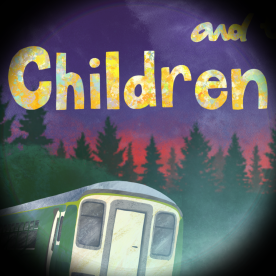
Jack Reusen and the Chilren of Fate sneak peek coverPrint turnaround can be as much as a month. However, as soon as I can get it uploaded, the book will be available digitally to read via Amazon Kindle (you can either read this on a Kindle reader or you could download the app and read it on any Android or Apple device).

I’ll obviously be back on here at each step of the process to keep people updated (especially once there are print copies available too). However, I promised myself that today’s post would be brief and to the point so that I could get back to work on the editing.

Wait What’s Happening?!

In brief:

The final draft of Jack Reusen and the Children of Fate will be done by the end of this week.

The digital edition should be available sometime next week.

And finally, at long last, the paperback edition should be available to buy in late April.

More to come…
fey-flameExtra Note: I also have plans to get an audiobook version of the first book out. This would take the form of either a podcast or an Audible audiobook, to be released sometime in the next few months. This is dependent on getting my office/ recording space in proper order so expect updates on that too.

For now, thank you so much for stopping by and please accept my apologies for the long (long long long…) wait for this next book in the series.

I hope you enjoy reading it as much as I have enjoyed writing it. It’s been a labour of love. The first version was very long. The delay has mainly come from trimming it into the reader-accessible version we now have.

I always want to create books that are as accessible to as many sorts of readers as possible, and I am really happy with the story we have now.

Thanks for stopping by, below you’ll find the mandatory self-promotional book plugs but you can skip these if you’ve already read the stories so far.

Thanks for stopping by and I’ll be much quicker to get back on here again next time,

All the best, John

***

Read my books digitally for FREE

reading reader kindle female

Photo by freestocks.org on Pexels.com

If you’d like to catch up on the first two books in the series you’ll find details on where to get these digitally (and potentially read them for free) below.

As always, you can get hold of print versions of the first two books from Fun Junction Toy stores, as well as by buying directly on this site (I’ll even sign a copy for you before it’s posted out). To buy from this site using PayPal, follow this link and click on the buttons for the books you’d like to buy.

Kindle Unlimited

All of my books are free to read for those with an Amazon Kindle Unlimited membership.

Kindle Unlimited currently offers a free trial for two months so you can see if you like their service.

After that, your membership would cost just £7.99 per month and you can cancel any time you like (including before the end of your two-month trial membership.

You said I could read your books for free?

Both of my main children’s fantasy books (The ‘Jack Reusen’ books, for 6 and up) are available on Kindle Unlimited. Here are the links for Amazon UK for ‘…Fey Flame‘ and for ‘…Spark of Dreams‘. On top of this, you can also find a short Christmas story I wrote a few years back, as well as my dark fantasy book (10-12+) ‘Marcus‘ (set in and around the old abandoned Victorian school in my home town of Crieff).

These are all available to read for free (even as part of your free trial) with Kindle Unlimited. What’s more, it’s always good to know that people are reading (and hopefully enjoying) my books.

If you’re in the USA, Kindle Unlimited has a similar free trial and you can find all of my books on my Amazon Author page.

A little more about my own books:

Once you’ve signed up to Kindle Unlimited, you’ll see that both of the Jack Reusen books come up as ‘free’, so you can read the whole adventure so far, for nothing.

Jack Reusen and The Fey Flame‘ introduces you to the land of Fey, as creatures (and other things) make their way through to the ‘matter-world’ (basically our world). Jack and his family have to discover a way of closing a collection of ‘breaches’ between the two worlds to make their world safe again.

*
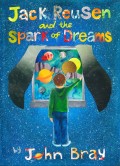
cover with blurb and barcode 2 trimmed‘Jack Reusen and the Spark of Dreams‘ is a slightly different kind of adventure. People are losing their ability to dream. Every night more and more people lose the certain something that makes human beings so good at solving problems and creating things; the spark of dreams. Jack discovers that he could be the key to understanding what’s causing this change, and he may even be the only person who can solve it and bring back the dreams and imaginations of hundreds of people.

I hope that both of the Jack Reusen books give you and/or your kids something to enjoy as you read them. Let me know what you think.

As always, thanks for stopping by my site, and I can’t wait to share even more details of my newest book,

All the best, John
3 easy ways to make reading fun for kids

I’ve now been on bedtime story duty for twelve years. We’ve been on adventures in day-to-day worlds, trailed through fantastical realms, crept through sinister space ships, been on arctic expeditions, and much more besides.

It’s great to read to your kids, it offers lots of benefits. I’ve written before about the importance of reading to children. If you’d like to check that out just click this link.

If you are an adult in the UK who struggles to read but would like to get better you can get help from ‘The Big Plus’. You can find out more by clicking this link or phone them on 0800 917 8000.

Make Storytime Fun

In the past twelve years of bedtime stories, I’ve explored as many different ways of holding a child’s attention as I could think of. Some of these didn’t work, some had the opposite effect, and some were downright ridiculous.

However, in among all of the experimentation I’ve found at least a few things that definitely helped keep my kids enthralled enough for a half-hour or so of reading each night. This immersion in the story world has definitely helped develop their own love of reading too (to the point where I’m steadily being made redundant).

Giving the characters some personality

Photo by Gravitylicious.com on Pexels.com

The big thing that really caught their attention in the early days of story reading was something that might make many feel self-conscious, but it’s well worth the effort…voices.

You don’t have to be perfect; your Winnie the Pooh doesn’t have to sound exactly like the Disney version, your Gruffalo doesn’t have to sound like Robbie Coltrane, and later on, your Hagrid won’t have to sound lie Robbie Coltrane either.

You’re not trying to win an award, your kids won’t be overly critical (especially if you start early). Just make an effort. Changing your voice, even a little, will encourage most children to pay attention.

At baby and toddler stage they’re keyed-in to notice even the slightest changes in your voice. The more you change your speech patterns, the bigger the interest will be (at least that’s what I found).

I’ve always included voices when reading. They haven’t always been perfect but when we moved on to books without pictures it almost became a necessity. With a larger group of main characters, it helped a lot to have different voices so my kids could keep up with the story.

This has apparently had such an effect that my eldest son recently told me that when he reads by himself he hears different character voices inside his head. Good to know it was worth the odd sore throat.

Set the scene

Another important discovery in the early days of storytime was to add a bit of theatre to make ‘story time’ into an event.

We didn’t do this all the time but sometimes I felt it was necessary. One of the biggest changes was the move on to chapter books. Without pictures, it was sometimes necessary to do something to draw my kids deeper into the story. I had to think outside the box.

For example, we might build a fort in their room after tea, then read in it for bedtime. I sometimes set up special lights to make the room look different (cheap battery-powered fairy lights bought in the pound shop or other bargain shops were ideal for this).

Whatever made storytime stand out was worth a try. If we had time, it could be something big but most nights it was as simple as switching off the room light and using a reading lamp and some fairy lights. Here’s one tactic that I found really useful.

Let them pick

You should let them pick their own story. I won’t lie to you here; you may have to read the same picture book every night for a month if you do this. However, back at a time when their whole day was dictated by others (where they went, who they met, what they ate), this was one of the only ways my kids were getting to engage in making their own choices in life (albeit on a pretty small scale).

What’s more, it also gave me an early insight into their tastes and personalities. They’ve surprised me many times, especially at the library or book shops when looking for something new.

Let them look through and see what stories really stand out to them. This is actually a lovely experience, and it’s something I’m sure most parents will get a kick out of.

Try and enjoy it yourself

This is a sort of ‘bonus tip’ on top of the three mentioned so far I’d add this extremely important extra. Make sure you’re comfortable, happy, that you’ve got a good seat/beanbag/ whatever you like to sit on, and most importantly that you’ve got a wee cup of tea/coffee on hand to stop sore throats.

It can be hard to disconnect from things now. I know my phone beeps multiple times an hour, I’m guessing yours does too. I’ve come to see that half-hour as a welcome break in that constant stream of information. I put my phone away, I grab a cup of coffee, my kids get into bed (or sometimes sit with me) and we take a step away from our world for a little bit.

Reading to your kids doesn’t have to be a begrudging task that we do because we feel we ‘have to’. It can be a relaxing break from day-to-day life. Do what you can to enjoy the slower pace, the focussed time, the moments to catch up and laugh with your kids. Don’t get me wrong, I’ve had more than a few nights where I can’t believe we’re reading the Gruffalo AGAIN (for example), but most of my nights have been something brilliant.

I wouldn’t give up story night for anything and I hope these hints help you find ways to enjoy it more too.

Please let me know if you try any of these hints in the comments below and as always thanks for reading,

All the best, John

Books are bad for you!

The primary criticism we hear about technological entertainment is that it is ‘anti-social’. I’ve also heard people insist that it makes people ‘less creative’.

When it comes to parenting advice it’s hard to ignore the growing idea that ‘Technology is BAD!’.

We seem to have a very different view when it comes to reading. It’s not a screen, it’s a ‘traditional’ form of entertainment, and it has a well-recognised link to creative and critical thought. All good, wholesome stuff, surely?

I’m not going to trawl the data running pros against cons. Instead I’ll share a very odd encounter I had with my wife’s grandmother. It was a few months ago and both my sons were fully absorbed in activities on separate hand-held devices. I felt the familiar squeamish sense that most modern parents probably feel; my children were ignoring guests in favour of their tech!

I was about to take their devises away when their great-grandmother looked at them with a smile: “It’s just lovely to see them like that.”

“Books are bad for you.”

It threw me into a sharp mental u-turn. She explained that as a child she was often criticised for her love of reading as it was ‘anti-social’. For some it was even seen as a waste of time, many told her that she should be doing something more ‘productive’. In short, she was told ‘Books are bad for you’. She looked at my sons’ use of tech as being equally beneficial to her childhood reading.

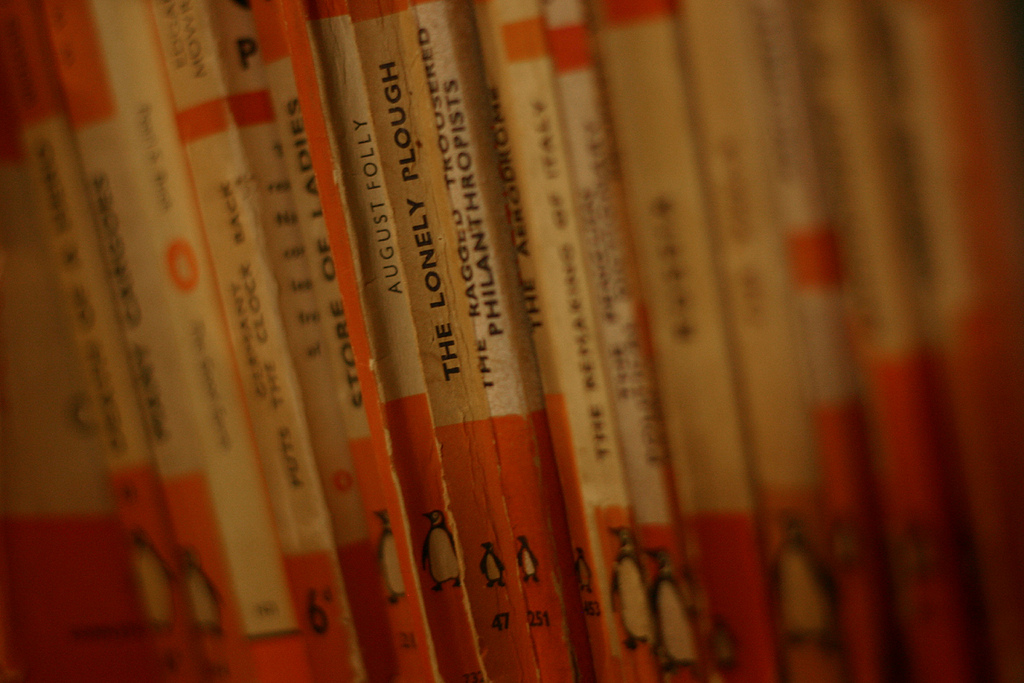
Penguin books began in 1935 and with the help of Woolworths, it pushed the notion of mass-market paperbacks into the public consciousness. It’s hard to speculate what the overall opinion of this new influx of books would have been even decades later but I imagine it would still be quite a new thing to see children in all walks of life sitting reading.

Computer games have been around since the seventies but the hand-held game didn’t appear in the mass market until I was a child (the late 80s early 90s). Even then it was only my ‘rich’ friends who had one. They were still a luxury and by no means ubiquitous.

Since then hand-held devices have grown cheaper and more accessible. Their capacities have grown more diverse as well, as they come to serve an increasingly social and educational role (Gameboys didn’t let you chat to your friends after dinner, and to the best of my knowledge Mario never helped any of my friends with their homework). This sort of tech has a lot going for it.

Even the gaming itself has come to offer more depth, with more demands on critical thought, and on creative energies. Should we be so quick to condemn these glowing rectangles that now permeate our lives?

Where’s the harm?

There’s clear evidence that the actual light generated by screens can have a detrimental effect on sleep patterns, but at the end of the day doesn’t all artificial light? Gaming is also known to increase serotonin levels to a degree that can trigger addictive behaviours. This isn’t good and I’m sure I see a degree of this in my own children, but the same jittery, manic effect can be achieved with a big bag of sweets sneaked in by Granny.

I’m not going to say screens are perfect (and as an author I obviously have a vested interest in getting people to read books) but I can’t help but wonder if we’re vilifying the tech rather than turning the lens on ourselves as parents.

At the end of the day my own interest in my facebook/twitter feed, my blog reader stats, or even my work e-mails, will have its own (fairly large) part to play in any detrimental technological experiences that my children have.

It’s not the zombie in their game that will do them the most harm, it’s the zombie on the couch beside them. He doesn’t demand ‘brains’ but instead insists ‘I can’t just now, I have to answer this e-mail’. It is here that technology does the most harm to a child’s development, and the solution is blindingly simple (though it will make most of us uncomfortable to admit it).

Does my out-of-hours attention to my e-mails etc. mean my kids will grow up thinking that they should never have ‘down-time’? Does my own interest in social media make it look like ‘likes’, ‘followers’, and ‘shares’ are of equal importance to real-world feedback? Tech isn’t to blame for this, it’s me. Tech isn’t bad, books aren’t bad, it’s the lack of family engagement and shared interests that does the most harm.

I’m off to read with my kids now. If you’d like to do the same feel free to grab a copy of my book Jack Reusen and the Fey Flame, a fantastical family adventure with were-polar-bears, magical fairgrounds, odd little men who kick heads first and ask questions later, and (of course) a world hidden just behind our own; a world called Fey.

As always, thanks for reading, if you have anything you’d like to share about this post feel free to pop something in the comments section below or over on my facebook or twitter profiles (and yes I do see the irony, given what I’ve just said about screens and social media).

All the best, John

Why are Jack Reusen books so short?

harry potter page 1A long long time ago (actually it was only three years back) I tried to read Harry Potter and the Philosopher’s Stone to my eldest son. It was a few weeks after his seventh birthday and he was on holiday from school. I thought that at last he was ready to sit down and enjoy one of the best children’s fantasy series ever written. He wasn’t.

Don’t get me wrong, he enjoyed it but his attention started lagging in the middle of each chapter. I tried to keep my reading as animated as possible but we still ended up stopping in the middle of some chapters. We would take a break, sometimes for a few hours, sometimes until the next day. For the most part it seemed to work. However, with each break he seemed to forget more details about the book.

At their heart Harry Potter books are mystery books in a fantasy setting. There are clues to remember and puzzles to solve throughout. Forgetting details in these sorts of books takes a lot of the oomph out of them.

I would be asked things like ‘Who’s Ron?’ ‘Why can’t Harry just do magic straight away?’ or possibly the most telling ‘Why does he live with his Aunt and Uncle?’ (asked when Harry has his first Hogwarts Christmas). It was clear he was forgetting more than he was remembering and at around chapter six or seven I could see that almost everything was going over his head.

We put Harry Potter away, to come back to when he was a bit older. All the same, the experience of trying to retain his interest lodged in my mind.

This sensation came back to me when November of 2014 rolled in. The nights grew long, and I discovered a new way to write. NaNoWriMo (national novel writing month) fell into my lap. They said something like ‘you have a book inside you waiting to get out’ and I realised that there really was.

Jack Reusen and the Fey Flame became something that I needed to write; something fantastical, exciting, relatable, and importantly, a book that could (hopefully) maintain the interest of an energetic seven-year-old like my son.

There are lots of books for seven-year-olds. Incredible, exciting, sometimes hillarious books, but I felt like I could write something a bit different. I wanted an element of the seriousness of ‘older’ fantasy books, and a slight taste of the danger and thrills that come with that.

From my own experience I realised that I could hold my son’s attention for about ten minutes, so (estimating a reading speed of about 250 words per minute) I worked out that my chapters needed to be no more than 2,500 words long.

I also wanted to make sure the story could be read all the way through in a relatively small space of time so I limited my chapter count to be sure that the whole book could be read in around a fortnight (at a rate of one or two chapters per night).

When I released the first book in the Jack Reusen series I began to hear that other families were having exactly the experience I’d hoped they would. (I was also pleasantly surprised to find out that some parents were sneakily reading ahead to see what happened next). These responses were brilliant, then, around a month after release, I heard something that changed the way I looked at the books.

At the time I worked in a local toy shop. One of our regular customers came in specifically to thank me for writing the book. I hadn’t been thanked for the book before.

It turned out that she had been trying to get her nine year old son to read chapter books for years. Nothing caught his interest. Then she gave him ‘…the Fey Flame‘ and apparently he read the whole thing in just a few nights. I was taken aback and told her how happy I was that he had enjoyed the book so much.

That boy wasn’t the last to say something similar about the Jack Reusen books. The shorter length seems to have made it easier for a lot of children to enjoy. Now that I know I’m helping kids get into reading I can’t bring myself to change the formula.

The original idea was to give families something that they could enjoy together, but a fantastic side-effect seems to be getting more reluctant readers caught up in a book. I love reading and the idea that someone might miss out on the enjoyment of it is disheartening. If writing short chapters and short books helps get a few more kids enjoying reading then I’ll write as many of these books as I can.

Thanks for reading and please feel free to share your own favourite short/quick reads in the comments below. All the best, John

Filling in the shadows

the_open_door_by_la_duqueBeing immersed in a book is very different to a movie; as events unfold right inside your head, they can elicit much more visceral responses. There’s something so weird (considering you’re just looking at some shapes on a page) but also something completely amazing about the whole process.

However, I’ve always run into problems when it comes to thrillers and/or horror stories. On a recent camping holiday where all tech stopped, I decided to pick up a wee collection of short stories based around ghost tales of Scotland.

During the day it was an enjoyable read and it helped fuel some ideas for the darker elements of future books. Then night fell, and the family went to sleep, and with wind howling around the tent I made the mistake of jumping back in. The horrors in the stories bled out of the pages and into the inky black night outside the tent. I jumped at the slightest sound. At one point the sound of an inconsiderate passing sheep mutated and left me gulping back bile.

It’s safe to say that my imagination likes to run with things at night. As a child reading famous five books the wind rustling leaves in the garden below could be nothing but lurking smugglers or other ne’er-do-wells. In my teens I read alien conspiracy stories and watched the faces of prowling cats distort in midnight lights to become malicious grey aliens preparing to abduct me (or had they already abducted me and wiped my memory?).

It took till adulthood for me to realise that a good night’s sleep would not be mine if I read this style of book. All the same I still forget sometimes and once again my mind will reel as the shadows take form and watch me, always behind my shoulder or just at the peripherals of my vision. Slowly creeping closer whenever my attention lapses.

I thought I’d be safe when I started reading the next book in Lari Don’s ‘Mythical creatures’ series, but no. There is one component perfectly crafted to leave children uneasy but to creep parents out to their core.

Don uses the old myths of celtic ‘Faerie folk’ (also used as part of the inspiration for the Fey folk of my books). However, Don stays closer to the legends as these faeries are far from benevolent; they are notorious stealers of children. Their technique is the worst bit; not only do they take your sleeping child from their bed but they replace them with a ‘changeling’ or ‘glimmer’ enchanted to look identical to the missing child. Your child is gone but you don’t notice, you walk into their room in the morning to find them unresponsive and clearly unwell, then over the next few days this replacement will either ‘die’ or disappear themselves.

What’s more is that by now it’s too late for you to claim your child back, as they have now been sentenced to a life in the land of the faerie folk; by eating their food they are doomed to never be able to eat human food again. Even if you somehow found your child and took them home the first bite of human food would turn them to dust. So..yeh…that’s some nightmares for parents right there.

The creepiest bit of ‘Wolf Notes’ (Don’s second ‘mythical beasts’ book) so far has got to be a wee boy’s little sister telling her mum that the boy in her arms in not her son but is instead a ‘doll’, a copy of her big brother. Somehow this got me worse than anything I’ve read by Stephen King.

Does horror in books get to you worse than horror in movies/on TV? What hides in the shadows in your house?

Feel free to share in the comments below. As always, thanks for reading, all the best, John