Tag Archives: identity

One simple tip for a first time writer (and three that may only work for me)

First off, I should point out that most ‘real’ first-time writers are around four to six years old. This fact is central to what we’ll be looking at in this post.

It may sound pedantic, but it’s true; pre/early school is typically the age at which we begin developing our writing habits, as we learn to get our point across using the written word.

If you are older than a preschooler, and I’ll assume you are, then you are probably not a ‘first time writer’.

This is obviously a bit trite but it does help to keep it in mind as you work: You have been writing for a long time, you’re not as new to this as it appears. I’m not sure how other writers will react to what I’m saying here but from my own experience, I know how important this idea can be. This particular reminder has already helped me countless times when my writing confidence has taken a nosedive.

So with this trite idea in hand let’s forge on. The first issue to tackle is experience. If you aren’t a ‘first-time writer’ then what are you?

Teenager?

If you are in your teens then you have about a decade of projects and creative writing exercises under your belt.

What’s more, you already have your own perspective on the world. In our teens, we experiment with our identities possibly more than at any other time in our lives. We start to step back from our beginnings and try as best we can to look at them objectively.

If you are a teenager then you are probably currently right in the midst of this existential crisis. Who are you? Is your family ‘normal’? Is your upbringing ‘typical’? Are you seeing cracks in your worldview from asking these questions?

We may call it ‘teenaged rebellion’ but really it’s the beginning of considering who we are and what we truly identify with. This gives you a unique voice that will only become more unique the more you use it. Your writing will be all the stronger if you embrace your individuality as it stands at this moment.

Twenty-Something

In your twenties, you may have gained experience from college/university-level assignments. Perhaps you’ve dabbled in fiction already and/or worked together a collection of short stories.

Alternatively, you may have written reports for work, or you may have provided social media support for an employer. (We all know what it’s like; ‘You’re young. You’ll know how this social media stuff works’.)

Whatever your work or education level, it’s likely you’ll have had to write a few words since leaving school.

This is also a time that most older adults remember fondly (and definitely explains why the TV show ‘Friends’ is still so popular). It’s a time when people form a more independent identity and potentially develop deeper relationships than they did in high school.

With this in mind, what you have to say should appeal to a fairly wide audience. Combine your individuality, a bit of youthful energy, and some more life experiences than you had as a teenager, and you have a backdrop from which to write something excellent.

Thirties

As above, but add ten years of changing jobs, more complex life circumstances, and/or varying responsibilities. By this stage, you’ll likely have written a good few more words.

Chances are you will have honed your ability to get your point across and you may even have found subtle ways to include your own slant in your writing.

Your life choices, experiences, disappointments and triumphs are there to draw from in your writing.

Onwards

You get the idea. Every extra year provides you with more life experience and a more complex skillset.

Whether you’re fifteen or fifty, keep in mind the fact that you will have something to say and there will be someone out there who wants to read it.

The Tip

So what’s the tip?

I’ll try and condense it. Stop thinking of yourself as a ‘first time writer’. Even as a teenager you have around a decade of writing experience. Whilst this might not make you a writing ‘expert’ it’s enough for you to forget the ‘first-time’ label. Throw it away, the term ‘first time writer’ is dead weight.

Remember this and allow yourself to relax. There’s enough work to be done in completing your first book and reworking it over and over into something you feel proud to call your own. Why add the extra work of belittling what you have achieved already?

I could come up with analogies like the relationship between running and completing a marathon, or baking and creating a wedding cake.

You have the basic skills to write your first draft and you can sort out your more obvious mistakes in your second draft.

You’ve got this.

Hold on to your ideas

You have the basic skills needed to write. You may even have more comprehensive capacities drawn from various jobs and other training. You’ll know yourself whether you feel confident in getting an idea across.

However, ‘getting an idea across’ implies that you have an idea and this may not always be the case when you sit down to write. Sometimes all those great ideas evaporate as soon as you switch on your computer. This is the guts of every writer’s primary villain; writers’ block.

There’s one way to minimise the risk of that blank screen; always trust that you can write (at least well enough for your first draft) but I would suggest that you never place too much trust in your memory. The truth is that most of the things we think of writing about are fairly ephemeral until we nail them down onto the page. These woolly ideas can be pretty hard to remember even a few minutes later.

Put simply, don’t trust your memory to hold on to those important plot points, character traits, scene-setting descriptions, and action-driving moments of conflict.

When you have ideas write them down. Send yourself ideas as private messages, carry a notebook with you, phone your house and leave a message on your answering machine, whatever it takes. Just don’t lose your ideas.

When you’re at your laptop/PC get those ideas organised and added to the main text. Get that first draft written. Add to it as often as you possibly can.

After the first draft?

From then on it could be down to asking a (good*) friend to read your work and give you the most detailed feedback they can manage. (*Giving truly objective and detailed feedback is not an easy task so be careful who you ask).

After this, a proofreader or editor is a must. Someone even more objective, and importantly someone with industry experience. You should expect to pay for this service but it really is worth it. This individual will help you make your work the best it can be.

Get that first draft written!

However, none of that is important right now. You only have to think about your first draft.

You are not a ‘first-time writer’, you know enough to get started already. Go write!

You said something about three other tips?

Yep, three more tips (that’s the way these posts work isn’t it?). I’ll keep this brief:

Drink tea

Maybe not tea, but pick a beverage which you will need to prepare somewhere away from your desk/workspace.

You’re likely to find your drink cold or at least feel thirsty within about a half-hour to an hour of taking your beverage to your desk and this gives you an excuse to step away from the screen.

If you’re feeling the dreaded ‘writers’ block’ kicking in, you’ve now got an excuse to leave the keyboard/notebook and clear your head for five minutes. (And stop staring at a blinking cursor.)

Alternatively, if you’re immersed in your writing, then you won’t notice you need another cup. Another cup of tea isn’t important enough or jarring enough to draw your attention away when things are going well. This means that you can happily write away until you reach a natural stopping point and the only price is a slightly dry throat.

It’s honestly the most useful writing habit I have formed.

Leave the house/ get exercise

Fresh air can’t be beaten to help you feel better. Add to that some green spaces and you have a recipe for a huge wellbeing increase. Even in the current lockdown, most places are still allowing individuals a bit of time outside for exercise. Go out and use it, go somewhere with life in it if you can, green spaces, in particular, can be great mood enhancers (this sounds like hippy-dippy stuff but there’s some real science behind it, the citations in this post on heart.org are pretty comprehensive)

Alternatively, take up some other activity which gets you moving. I used to go for a swim as a one-hour break before I had lunch. I would try and beat my previous speed/ number of lengths. Swimming isn’t an option for most of us now but some other activity which allows you to compete purely with your past self could be just as good.

The personal challenge and the change in focus got me ready for my afternoon writing session. What’s more, I can’t help but feel that the increase in oxygen in my blood helped sharpen my mind.

The afternoon soon became my most productive writing time.

Talk to other writers

It can be hard to meet other writers in person but I can heartily recommend using Twitter as a means of sharing the highs and lows of writing.

Great hashtags to follow are #amwriting #WritingCommunity and #writerslife.

If you feel like chatting about writing with me you’ll find me at @Johntoyshopguy.

If you aren’t a Twitter user then I can’t suggest any alternative I’m afraid. In terms of a free to use, easy to access, writing community resource, my own experience has led me to realise that there simply is nothing remotely comparable as a place to communicate with other writers.

It’s easy to join Twitter. It’s much less probing than Facebook, You can use a pseudonym, you don’t have to display any personal details, and all you need is an email address to join. Click this link to join now.

(Bonus tip) Reward yourself

Pick an achievable short to mid-term goal and choose a reward to give yourself when you reach it. Here are some I use.

  • A (small) favourite chocolate bar when you complete a chapter (mine is a Kinder Maxi bar, at 21g every few hours of writing, it’s not going to ruin my health).
  • Ten minutes of a favourite show/ podcast/ book when you’ve written a thousand words.
  • A very special treat (you pick) once you reach a special stopping point. E.g. half-way through your plan, once an important scene is complete, once you finish your first draft.
  • Etc. Etc. You get the idea. Basically, look after yourself. Writing a book is a large undertaking. It can be emotionally draining. Make sure you look after your own needs and find ways to congratulate yourself as you progress.

Be nice, leave a comment

I’d love to hear about your project or anything else you’d like to share about your experiences with your first book.

Please leave a comment below. I’m happy to respond to any comments/ questions.

As always thanks for reading, and all the best with your writing, cheers, John

Characters who write themselves into your world

No one warned me about this when I started writing but sometimes characters appear in your work by accident. They must come from somewhere but you have no way of figuring out where, it’s like they’ve made themselves out of nothing.

Tam was like that. I never included it in the books but Tam’s appearance was initially quite sinister. 

Jack had barricaded himself in a cabin (along with some others) to keep a host of dangerous magical creatures outside. I was picturing everything in my head when suddenly I was looking out of someone else’s eyes. Someone who was trying to break into the cabin.

Nothing in Jack’s world had been first person up till then and I had no idea who this character was meant to be. I had made no decision to add a character but here one was, breaking into the cabin, leaving the door open, and endangering everyone inside.

The overall feel was extremely uncomfortable and everything this character did broke away from what I had planned. Through this strangers eyes I saw my characters standing in Mick’s kitchen, sure they were safe. Then the stranger strode into the room and kicked their best hope right in the head, knocking him unconscious. I was even sure I felt Fynn’s head as Tam’s foot connected.

I’m still not sure how this happened and Tam definitely isn’t the only character who appeared from nowhere.

My academic background focused on the formation of the self. It was all about early years behaviour and stimulus, nature vs nurture, self-awareness, and importantly the vital role the stories we tell about ourselves play in all of this.

These ‘characters’/selves are always attached to a human body and I’d assumed something similar would be true of fictional characters. I thought I would be in charge of every character. I was definitely sure that I would be responsible for every character that appeared in my writing. I was very wring.

Perhaps this was a side-efdect of writing in the faster-paced style required for National Novel Writing Month (50,000 words in one month). Or maybe Jack’s world was already that vivid to me.

It all worked out well and I love the character of Tam (I even gave him a large role in book three). However, I still feel an odd shudder when I think of how I was first introduced to him.

Have any authors reading this encountered a character like this? Does your writing sometimes surprise you?

Feel free to comment below. As always thanks for reading, all the best, John 

Crivens!

feegle3At the moment our house is enjoying a full-on adventure with the wee free men and their ‘Hag’ Tiffany Aching. Terry Pratchett’s ability to create a world filled with humour, excitement, intelligence, and heart is not compromised by writing for children. The Tiffany Aching series includes four (soon to be five) books, set in his iconic Discworld, and each book focusses on a young woman called Tiffany as she grows into a fine upstanding witch.

Out of my two my eldest is especially enthralled with the books. The first book (The Wee Free Men) went down a treat and he really got a kick out of the violent, loud, yet loyal and caring ‘Nac Mac Feegle’ (or ‘wee free men’). It’s a book series that I enjoyed myself years before I became a parent and there’s something really special about being able to share it with my kids now.

The thing that impresses me most is one simple fact that, in itself, shouldn’t be impressive: the main character is a girl. Every book follows Tiffany, sure the wee free men are there too, as are a few other male characters, but the character we follow through every page is Tiffany. This shouldn’t be a big deal but it is. So many books for children (my own included) focus on the adventures of a boy as the main character, and in most cases he’s also cast as the hero. It makes a refreshing change to see that a girl can be just as heroic, just as relateable for two young boys as any male protagonist (I feel I redeemed myself a little with Spark of Dreams, you’ll see Thea’s heroics near the end of the book).

Not once have my kids asked ‘but why is a girl doing everything?’ not once have they complained. Both my six (soon to be seven) year old, and four year old sons have barely noticed that they’re following the adventures of a girl. Perhaps it’s because this is one of the first chapter books I’ve read to them (smaller frame of reference), or maybe their generation has different expectations than mine did. Whatever it is, I’m getting a lot of enjoyment out of knowing that my two kids clearly know how brave, clever, and heroic girls can be.

I’ll be rectifying my own lack of a central female character in my books next year as I delve more into Thea’s story, and follow her on a voyage around the world of Fey. It’s in the planning stages at the moment, so very little is concrete, but I can’t wait to delve into the world of legends, mythological animals, and the downright made-up stuff that I’ve got planned for next year’s batch of books.

Tiffany-Aching-Poster-600x686In the mean time I heartily recommend Pratchett’s Tiffany Aching books (‘The Wee Free Men’, ‘Hatfull of Sky’, ‘Wintersmith’, ‘I Shall Wear Midnight’, and Pratchett’s soon to be released, final Discworld book ‘The Shepherd’s Crown‘). In the first book you’ll follow Tiffany as she meets strange little blue men, discovers she might well be a witch, and has to fight the Queen of the Fairies. I’m sure you’ll enjoy them as much as we are. All the best, John

What Reading can do for you

(This post is also available to watch and listen to as a vlog/podcast. You’ll find it on YouTube and Spotify down at the bottom of this post.)

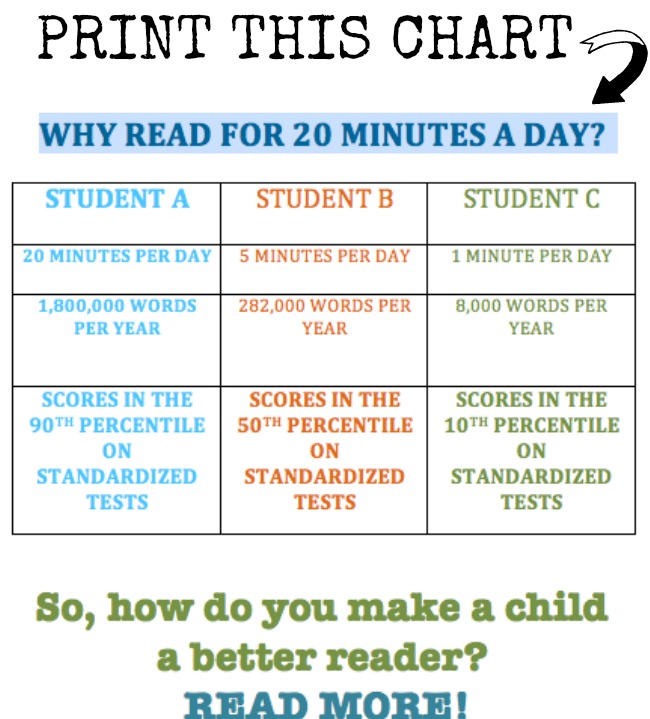
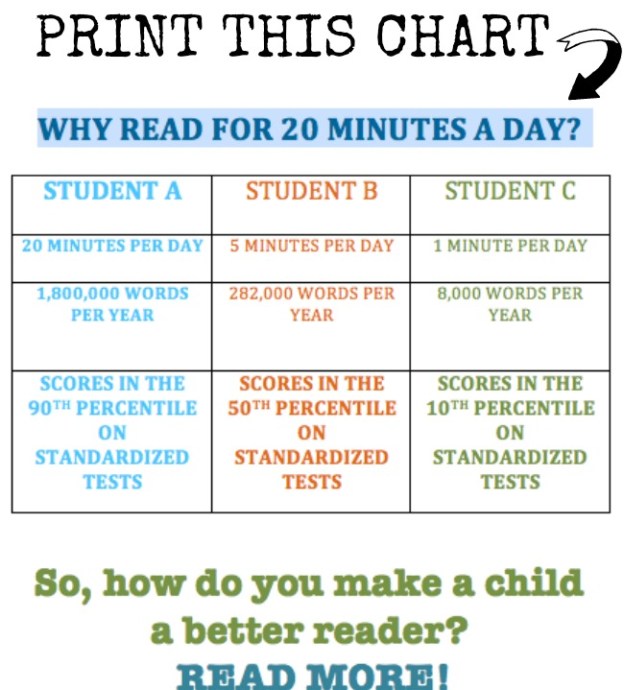
Read for 1 minute or less a day with your children and they may end up in the bottom tenth percentile! (But should you care?)

According to a number of educator resources and literacy advocates, children who read for around 20 minutes a day are exposed to as many as 1.8 million words per year, and this level of exposure is often linked to performance in the top 10% of standardised test scores. (phoenixacademyomaha.org)

While these figures reflect general trends rather than guaranteed outcomes, they do highlight the potential impact of regular reading habits.

Are test scores really the best gauge of childhood success?

I’ve seen this graphic (or something very similar) floating around the internet on a number of occasions. Often, the original context of these stats is lost and, instead, people (often parents) seem to see the higher test scores as the motivating call to action.

However, while I agree with the idea that reading with your children is a good thing, I’m not sure if I agree with the hefty role being given to word volume, or the assumption that parents should only care about test scores. It’s part of the growing inclination of so many to try and quantify childhood learning.

Of course, some skills are more quantifiable than others: vocabulary, memory, the ability to follow instructions (this list is far from exhaustive). In this sense, it’s easy to see how an increase in vocabulary and memory might improve test scores. However, there are so many more important skills that reading helps develop than the capacity to have great test scores.

Children who read find themselves exposed to other ways of thinking, other worlds, and other people, in a much more intimate manner than you find in any other medium.

“One in Five UK children don’t own a single book”

That said, for many children, access to books (or even the idea of owning a book) is far from guaranteed. In a related post, I explore recent headlines suggesting that one in five children don’t own a single book, and dig into the complex role that book ownership plays in childhood literacy. You can read that post here.

For families concerned about the cost of books or about limited living space, it’s also worth knowing that there are fantastic digital alternatives to physical books. In a separate post, I explain how you can access thousands of free books on almost any smart device (phone, tablet, even a PC). You can read that post here.

Reading does a lot more than improve test scores

The characters, ideas, plots, scenarios, and places found within the pages of a book do not stay there; they find a home inside your mind. It’s about as close to telepathic communication as we can get.

When a child reads a story where a character loses their memories, they aren’t simply exposed to a vocabulary-building exercise; they have been given access to some fairly complex notions about identity. This might lead them to ask questions about whether we are the sum of our memories, or something more. In essence, books (and perhaps fantasy books in particular) provide simple, digestible ways of thinking about some pretty big questions.
It kind of bothers me to see test scores held up as the pinnacle of childhood achievement. Test scores can be a great way of gauging a child’s engagement with their learning, but I’m a little dubious about regarding these scores as anything more than that.

A child’s ability to deal with the world outside of school will have a lot more to do with how much they understand, plus a host of skills that are even harder to quantify.

Academic skills are not simply the ‘Three Rs’

Many children will go on to opt for university or college at the end of their school career. Despite what they may assume, they may be surprised to discover how important it is to have a collection of skills that go beyond reading speed, vocabulary, and memory (the more testable skill set).

I tutored Philosophy undergraduates at Edinburgh University for four years (and was an examiner for one of those as well). It was amazing to see how often some students (who came in with less than stellar grades in high school) would somehow overtake their higher-scoring classmates. Often, this hedged on far less tangible/quantifiable skills than rote memory etc.

We wanted to see students demonstrate an understanding of the nuances of arguments; memorising facts and figures simply wasn’t enough (though it was, of course, valuable). What’s more, the ability to step outside rote learning and think for themselves enables students to create thought-provoking and insightful essays. I learned that high test scores aren’t always a clear indicator that someone will perform well, even in an academic environment.

Good teaching and the challenge of ‘soft skills’

The abilities of a teacher are often assessed based on the test scores of the children they teach, but this can leave little room for some truly vital skills; like bolstered inquisitiveness, social understanding, and the ability to ground ideas within a real-world backdrop.
Teachers do a phenomenal job at encouraging these traits, and many more beyond those. I’ve met a good number of these teachers on the various school talks I’ve done, and it always impresses me to see how well-rounded their pupils are in ways that go far beyond traditional testable academic skills. I’m not an expert on the curriculum, but I’m fairly certain that these essential skills will be hard to locate by looking at where a child falls within the ‘national percentile’.

If you’re a teacher looking for ways to spark those kinds of wider conversations, I offer free school author talks that tie reading into big ideas, imagination, and creative thinking. You can contact me to discuss a talk or workshop here. I’m also currently working on a new range of classroom resources that will provide free activity sheets (and more) to support classroom discussion.

Alongside my school talks, I write books that open up the kinds of big ideas I’ve discussed here: from friendship and imagination to questions about memory, morality, and identity.

The Jack Reusen series (for ages 6+) brings magical disruption into Jack’s everyday life, whilst Marcus (for ages 10–12+) explores darker themes of power and consequence, all through a fantasy lens grounded in familiar Scottish settings.

You can find out more about my books here, or read them on Kindle Unlimited (here’s my Amazon Author page).

Free Classroom resources as soon as they’re ready

I’ll post new literacy resources here as soon as they’re ready, as well as other updates regarding books and literacy. To be the first to hear as soon as they’re available, you can subscribe using the box at the bottom of this post. Simply pop your email address into the box, click ‘subscribe’, and you’re good to go.

Reading is more important than test scores

Of course, we should read to our children for twenty minutes a day, longer if we get the time. For some of us, it’s part of the ever-shrinking portion of the day in which we can spend time together, without necessarily having to deal with some kind of screen.

Not only does it allow you and your child to discuss all kinds of topics and issues, but it also gives you a few moments in which to touch base and enjoy spending time together.

Reading, at least in this context, has much more to do with maintaining relationships and learning about the world we share, than it has to do with building vocabularies and assisting in academic scores.

Reading shouldn’t be marketed as a fast track road to success (even if the numbers suggest it); it’s an activity that opens dialogue, builds relationships, and encourages inquisitive minds. In short, reading opens us up to all of the fantastic skills that make us human. It doesn’t just help us test well.

If you have anything to share about any of the issues I’ve touched on in this post please feel free to share your ideas in the comments, or over on social media (here’s the Jack Reusen facebook account, and here is my Instagram account).

Want to read more on the topic of the deeper positive effects of extended reading? You’ll enjoy this fantastic post by teacher librarian Krystal Gagen-Spriggs about the great effects of developing a reading habit.

Thanks for reading, all the best, John

And…they’re off!

cover with blurb and barcode 2 trimmed

Another wee sample of Karen’s artwork

Jack Reusen and the Spark of Dreams‘ is ready! The artwork is done, the text has been edited, all files have been sent off to the printers, and now comes the waiting. (Though the wait won’t be too long for the kindle edition, which I’ll have ready sometime tonight.)

The process for print editions is fairly simple; first they send me a digital proof (which I expect to receive sometime early next week). After this comes approval of the proof, which is kind of an odd thing to do actually; basically I send them an e-mail saying ‘yes I like my own book, send me lots’. Once I’ve told them I like my book it can take seven to ten working days for them to to print up a bundle and send them to me.

I’ll probably end up posting a lot of updates on Facebook and Twitter once I’ve got a tracking number, so if you follow either account expect to see lots of posts about UPS on the day the books head my way.

To be sure that you get hold of one of the first copies you can pre-order one by leaving a comment below (they’re £6.99) and you can either pick them up at Fun Junction, get me to deliver them to you personally, or if you’re further away I can post one out to you.

Writing this book has been a totally different experience than the last one. Knowing that people have read the first, that some readers might be emotionally invested in certain characters (no I haven’t killed anyone, nor do I plan to), and knowing that there are many more books planned, has meant that I’ve had to be very careful with this one.

There are some scenes that had to be big and dramatic and they change characters in ways that might take them a couple of books to recover from. That’s what all these big delays have been about (I originally planned on having the book out in April). The trickiest part has been the fact that two key story lines run from just one early scene involving Fynn and Thea.

They come out of the event changed, but getting the balance between developing a character in that way, and just all-out changing them is difficult. Every change I made to that one scene (you’ll see what it is soon) had a heavy ripple-effect throughout the book, at times it was like playing Jenga with a sledgehammer. After a lot of work I think I’ve got it right and I hope you guys enjoy the journey that both of these characters go on.

Jack Reusen and the Spark of Dreams‘ is darker than the Fey Flame (though not by a lot), my proofreader/editor left me a note about three quarters of the way through the book that simply read ‘this is freakin’ scary!’. Don’t let this put you off though. I’ve left a lot of the scarier scenes open in a way that lets the reader fill in the gaps with their own imagination. This way, readers at my eldest son’s age (seven in a few weeks) will likely find these parts a lot less frightening than their parents.

Overall the story is based around what the world would be like if people didn’t dream, imagine, or come up with new ideas. Some of this is a little scary but mostly I wanted to deal with how important imagination is for everyone. Jack has to navigate a city that doesn’t dream and it doesn’t look like a nice place to live.

I’ve said before that there are ‘zombies’ in this book, but they aren’t undead, flesh-eating monsters; they’re innocent people who are sleep-walking through life and have lost something important because of it. Jack goes through a crisis of confidence but we all know that in the end he’ll have what it takes to help them.

Thea hasn’t been left out either; she gets to be an action hero in this book. Her fight scenes were some of the most enjoyable things I have ever written (though you’ll have to get a fair bit through the book to see them) and I’m really looking forward to seeing what kind of girl she develops into in future books.

Sorry for the long post, as you can probably tell, I’m a little excited about launching the latest Jack Reusen book. I really hope you like it (when the books finally get here). I’ll keep you updated here and on the Facebook and Twitter accounts about when to expect them. In the mean time I’ve got a school book talk to prepare for. I’m off to Comrie Primary on Monday (my school between the ages of five and seven) and I’m really hoping the children there enjoy their introduction to Jack and his friends.

All the best, thanks as always for reading, cheers, John

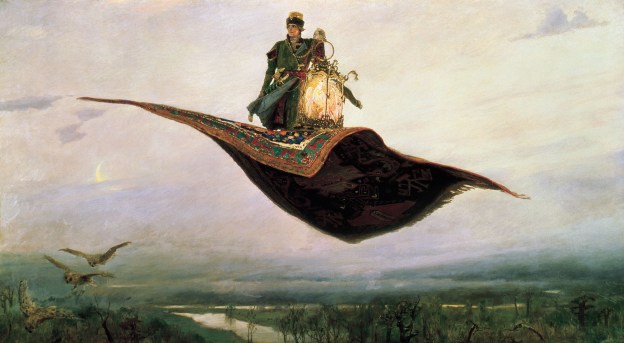
Viktor Vasnetsov’s ‘The Flying Carpet’ (1880) captures the surreal stillness of a fairy tale in motion—bridging folklore and fantasy long before modern genre lines were drawn

Magical Realism

Looking for a fresh way to spark creativity in writing? Whether you’re a writer trying to shake off some cobwebs or a teacher hoping to add a new twist to class activities, whatever brought you to this post, I hope you’ll find something useful in it.

TLDR… There’s a Podcast?

The world is a busy place so I’ve recorded a vlog/podcast of this post so you can listen as you do other things. You can listen to the podcast episode, or watch it as a YouTube video at the end of the post. You’ll also find links to teacher resources that you can use with your class as well

Magical Realism

If you’re sharing this with a class, it helps to start with a clear idea of what a ‘genre’ is. For what we’ll be working on today, it’ll be sufficient to say that a genre is a category of story. Book genres include categories like fantasy, sci-fi, mystery, and many more.

‘Literary fiction’ is a genre often found on university reading lists. It can sometimes be seen as the more ‘serious’ side of storytelling. One of its sub-genres, magical realism, mixes everyday life with magical moments in a way that is fascinating and quite different from typical fantasy books. The magic is subtle, unspoken, and completely mixed in with the ordinary and everyday.

‘Genre fiction’ is a term typically used for all the books that live in their own worlds outside of ‘literary fiction’.

‘Genre fiction’ tends to dominate bookshop shelves. These are the books readers seek out because they already love that type of story, whether it’s crime, romance, fantasy, or horror. ‘Genre fiction’ is easy to advertise and fairly easy to describe.

Unlike a ‘genre fiction’ category like fantasy, magical realism isn’t about big, magical worlds or epic quests. Instead, it features magic that’s accepted as part of daily life, whilst never being fully explained. The magic isn’t the focus. It’s just part of the world.

I first came across magical realism thanks to a high school teacher (Mr Johnstone), and I was hooked. Some fantasy authors, like Terry Pratchett, have poked fun at it. In fact, Terry Pratchett once joked that saying you write magical realism is “…a polite way of saying you write fantasy…” I can see what he means, but there is a clear difference between the two.

But what is Magical Realism?

Magical Realism is a literary style famously associated with Latin American writers like Gabriel García Márquez, Jorge Luis Borges, and Isabel Allende.

The most notable element of the genre is that when magical or fantastical events occur in an otherwise ordinary setting, no one within the story takes much notice (including the narrator).

In magical realism, the magic is ordinary. It’s not questioned. Characters don’t wonder how it works. They don’t even point it out. The narrator treats it like toast popping out of a toaster—normal and unremarkable.

The focus is always on the human experience. Even if there’s a ghost living in a tree or someone floating into the sky, it’s all part of the background, not the point of the story.

Take “One Hundred Years of Solitude” by Gabriel García Márquez. It includes flying grandmothers, ghosts, and prophetic scrolls—all treated as normal parts of life. That’s magical realism.

So, is it just ‘literary fantasy’?

So, is it just ‘literary fantasy’? It can feel that way. Books like “The Watchmaker of Filigree Street” by Natasha Pulley or “Before the Coffee Gets Cold”  by Toshikazu Kawaguchi clearly feature magic. However, they focus on people, relationships, and daily life, not magic systems or worldbuilding.

That’s also probably why they’re considered literary fiction; they treat the magic as background, not plot.

Even Terry Pratchett, who joked around about magical realism, often blurred the lines himself.

Pratchett’s Discworld books sometimes let magical elements go significantly unexplained. What’s more, every single Pratchett book I’ve ever read gives a deep and clear connection to the human (or troll, or dwarf, or golem, or even lowly goblin) components of the story. All of this lets some of Pratchett’s own work edge ever so closely into magical realist territory.

Other books for younger readers do this too. Philip Pullman’s “His Dark Materials” and Garth Nix’s “Keys to the Kingdom” series both dip into this space. They sometimes avoid explaining how the magic works, letting the mystery remain.

Is Magical Realism a genre that would work for Kids?

All of this said, magical realism in children’s books is rare. Why? Kids are still figuring out how the real world works. They need some explanation about almost everything that happens in a story, whether it’s ‘real’ or magical. Plus, learning how magic works can be a fun part of the story in itself.

In my own books, Jack starts out in our world and learns about magic bit by bit. Some things are left unexplained, but I explain enough to keep younger readers clued in. That much explanation is definitely more like traditional fantasy than magical realism.

So are there any magical realist children’s books?

The one exception to the seeming rule about the difficulties of creating magical realism for kids is Roald Dahl. His stories often treat magic as normal, but his gritty, sometimes unpleasant real-world details make his stories feel oddly grounded as well.

Roald Dahl’s writing is so distinctive that I’ll be exploring it in more detail in a later post.

Fantastical stories lift us out of the everyday, but they do it in a way that helps us see human behaviour more clearly.

Whether we’re worried about a basilisk in the basement of the school, a ghoulish creature hiding in our garden, a dog that somehow switches off all devices nearby, or if we’re gingerly climbing the slopes of Mount Doom, all of these experiences make their own sort of sense. We can see the real human parts all the clearer when everything else seems strange.

Magical realism, in contrast to fantasy, holds on tight to the mystery of how the magic works. For some young readers, that might feel unsatisfying. However, it’s still strange enough to make the feelings of the characters stand out all the stronger.

With this in mind, we can write magical realism with considerably less explanation than a fantasy story. You can basically jump straight into the strangeness and show the real human emotions all the more clearly.

Here’s a writing activity to try:

The Magical Object Writing Challenge

PART 1: The Magical Object

Give your main character a magical object. It can be weird, strange, or subtle (it doesn’t even have to be an object; it could be a creature of some sort like my story).

Here’s a tip for part 1: To imagine how to use your magical object, it can help to think about how we might describe something more ordinary. Think of a phone. Most of us don’t fully understand how it works, but a single phone can have some fairly big effects in a story.

PART 2: As Ordinary as a Pen

The character doesn’t know their object is magical. They’ve always had it, and they’re so used to what it does that they think it’s as ordinary as a pen or a pair of shoes. No one explains it. Not even the narrator.

Here’s a tip for part 2: To make this easier for yourself, avoid naming the object in the title. Avoid describing it early. Let it blend into the story naturally.

PART 3: Real Life Drama

Write a story about an ordinary day. Come up with something dramatic (yet ordinary) that could be going on. Show the object doing something unusual, but don’t explain how or why.

Here’s a tip for part 3: Your magical object can be part of the solution, but be sure to look at the feelings of the people in the story more than you talk about the object.

PART 4: Emotions

Focus on how it affects people. What are all the main characters feeling at the end?

Here’s a tip for part 4: A story’s conclusion is often when there’s an emotional change. The more dramatic the change, the more dramatic the ending. Anger to joy, sadness to humour, you can decide what feelings you’d like to see your characters show.

EXTRA NOTE

The quadrants on the worksheet don’t have to be the order your story goes in. Once you have notes in 1, 2, 3, and 4, you could grab a separate piece of paper (or a jotter) and write up a story there.

This way, notes from 3 could be your beginning, followed by the object ideas you noted in 1, you can use notes from 2 to help you move the story along, whilst remembering to keep the magic subtle, and then finish your story using notes from part 4.

The order in which you use your four sets of notes is up to you.

A Simpler Choice for Quicker Storytelling

It can feel strange to restrict your writing a bit. One of the amazing things about writing fiction is how wild and open it can feel. With a blank page in front of you, you could take the story anywhere.

However, sometimes, when you have too many choices, just making a single choice can feel like the hard part.

Cutting your options down can force you to sharpen up what you want to say, and the sort of story you want to tell. This can also tell you a little bit about how you felt when you were writing too.

What did your story teach you about yourself?

It can feel strange to restrict your writing a bit. One of the amazing things about writing fiction is how wild and open it can feel. With a blank page in front of you, you could take the story anywhere.

However, sometimes that freedom can be a bit of a problem. When you have too many choices, just making a single choice can feel like the hard part.

Cutting your options down with something like the writing challenge we’ve just looked at can force you to sharpen up what you want to say, and the sort of story you want to tell. This can tell you a little bit about how you felt when you were writing too.

If you chose something creepy, maybe you needed a little jump scare to wake up your brain a bit. Perhaps your story had a little sadness in it, so maybe you needed a chance to let out something upsetting. Maybe you went for a humorous story, so you might have needed a laugh.

Writing fiction lets you deal with real emotions in imaginary ways, and magical realism offers a slightly different way to do that than more traditional genres.

I hope you enjoyed the activity, and sometime soon I’ll be adding a portion to the podcast where I showcase listeners’ stories, so feel free to share your story using the contact links that you’ll find on social media and on the website.

Final Thoughts & Questions

How did you (or your class) get on with the writing activity? I’d love your feedback.

Do you know of any children’s books that feel truly magical realist?

Which book genre translates well to children’s books, and which doesn’t?

Let me know in the comments or message me on Instagram.

As always, thanks for reading, and don’t forget you can buy a copy (paperback or Kindle edition) of my own Fantasy book ‘Jack Reusen and the Fey Flame’ over on this page, or you can see all of my books on my Amazon Author page here.

All the best,

John

Files for Teachers

Here’s a Canva link to access the presentation file.
You can also follow this link to download classroom printouts in either black and white, or colour.

If you can’t access the Canva version, you can also download either a PowerPoint or PDF copy of the presentation for your smartboard to accompany the sheets using the Google Drive link above.

Watch or Listen to this post instead

Below are YouTube and Spotify versions of the vlog/podcast so you can listen to it as you do other things:


Was Enid Blyton a bad writer?

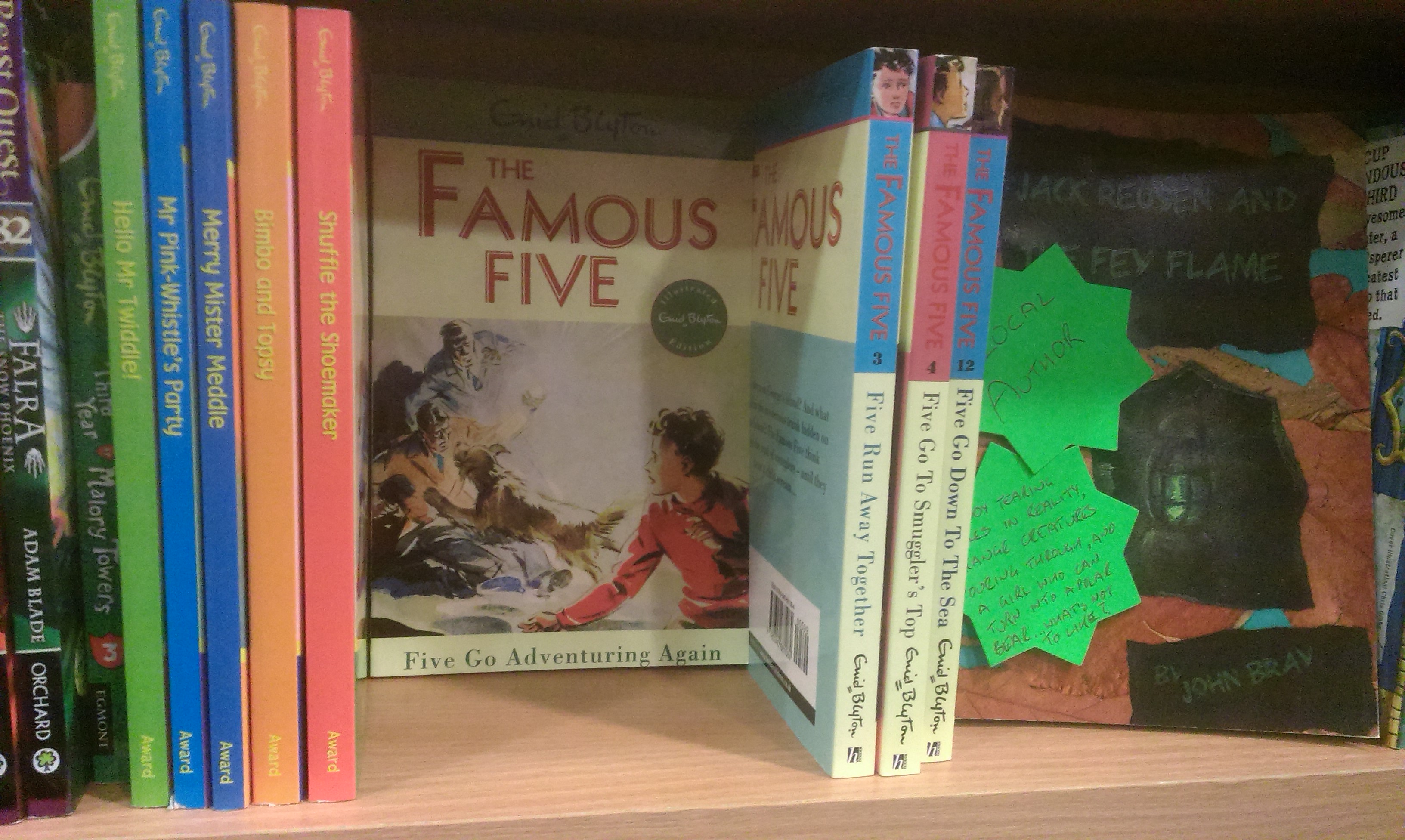
wpid-imag1413_burst008.jpgEnid Blyton is responsible for a huge portion of missed sleep from my childhood. The Famous Five books and the ‘Mystery’ series were staple components of my evenings (and long into the night) from the age of about eight or nine till I started high school at twelve (we don’t do middle school in Scotland). She opened a world of adventure to me but I have to admit she also wedged me thoroughly into a literary rut.

With Blyton’s books I developed a love of reading that became a core part of my identity, ever since then I’ve regarded myself as a passionate reader. However, her writing style left me cocooned from other works of fiction; she wrote in a relaxed, easily accessible, manner that demanded little of the reader and simply allowed the story to flow.

In many ways reading Blyton was like watching TV; I simply allowed the story to unfold before me, often going for chapters without feeling as though I needed to put much of my own thought in at all. This is the blessing and the curse of Blyton’s writing. Her books were published at a time when children were just beginning to migrate towards television as the entertainment medium of choice, Blyton appeared with an alternative.

I grew up in the eighties and by then we had access to so much more child-orientated TV than the generations that preceded us. The challenge was even greater for authors then than it had been back in Blyton’s day. Eighties children’s authors had to go foor the popular vote by whatever means necessary. They grasped for the ghoulish in the form of the Goosebumps series or pandered to a growing culture of pre-teen girls who aspired to a fantasised version of teenaged life in books like the Babysitters club. Meanwhile, in a dusty antique book shop on a holiday trip to Lincoln cathedral I came upon the famous five. I was hooked.

Blyton enjoyed (and still enjoys) the backlash from librarians, teachers, and other people who wish to promote ‘proper literature’ to children the world over for her work. Rhiannon Lassiter’s mother (Mary Hoffman) banned Blyton, you can see what Lassiter thought to that by following this link.

For many Blyton was low brow, pandering and, at best, akin to the type of bargain-bin paperback frivolity that adults buy at the train station or airport to help pass the time. In essence it was (is?) seen as just one step up from a magazine.

I can’t help but wonder if this is just a case of the anti-popularism which is often sported by the self-designated cultural elite, who seem to feel the need to put down anything popular as bourgeois and watered-down alternatives to ‘real’ literature/art in general.

I’ve never gone for this kind of thinking, I liken it to the idea that fine dining is always superior to fast food. Of course there’s something to be said for an excellently prepared meal but sometimes you really just want a greasy cheeseburger and fries from a burger van. (Neither fine dining nor fast food have the best credibility as sources of nutrition, in both instances it’s all about the taste, the aesthetic)

I think the same thing is true of literature, sometimes we’ll want to enjoy the complexities and nuances of an exquisite work of fiction but sometimes, and I think this goes ten-fold for those who are just beginning their literary journey, sometimes you just want to be swept up in an adventure.

So was Enid Blyton a bad writer? In my mind the answer is a resounding NO; she provided me a literary foothold in an era in which electronics and TV were taking over every aspect of the life of a child. She let me escape that world (a little) and allowed me access to the world of my imagination in a way that the alternatives simply couldn’t. Was she a literary marvel? Probably not, but the service she did perform well was to allow children to marvel at what a book could do.

I am the first to admit that moving on from Blyton’s style of writing was quite hard but as I noted in a previous post I found a way, as I’m sure many many more people did as well. There isn’t a doubt in my mind that the modern book industry would be an shell of its current state if it wasn’t for her prolific contribution to children’s literature, if for nothing else but that her works stood as an alternative to the proliferation of TV into the lives of children. In this sense, at least in my opinion, she stands up as a literary hero in her own right.

DON’T FORGET: Book one of the Jack Reusen series: ‘Jack Reusen and the Fey Flame’ is available in both paperback and in digital format. You’ll make me as happy as four kids and a dog with a picnic blanket and lashings of ginger beer if you click on this link to pop over to the ‘books’ page where you can find out more about the book and get details on how to get hold of your copy. I hope you like it as much as I enjoyed writing it 🙂

Book 3: working title…

moirai_by_pandorasconviction-d4njggqWho doesn’t like a sample of the next book at the end of a book they’ve just enjoyed reading? I know I like a wee taster, if for no other reason than it tends to prompt me to pre-order the next instalment so I don’t miss out.

Well I decided in “Fey Flame” to do just that, it was an easy move since I’d already written the first four chapters of the next book before I published ‘Fey Flame’ (NaNoWriMo needed me to get an extra 15,000 words done before I’d be able to submit).

Well roll around ‘Spark of Dreams’ and we get a wee dilemma: book three doesn’t (/didn’t) have a title, let alone a few chapters to work from. Aside from a fairly detailed idea of what will be happening in the next book, up until tonight, there wasn’t really any substance to it.

Well now there is, I now have some actual, solid, story writing down for it and I’m pretty excited to see how this one plays out.

Anyway, without further ado, may I present to you the working title of book three…

“Jack Reusen and the Children of Fate”

I say ‘working title’ and it is just that, I’d love feedback on what people think of it, especially if you have views on what children might think to it.

I’ll be asking my eldest son in the morning but it’d be great to get a wider perspective on what people think. The story will centre around the families of Fynn, Alyssa, and Granny Reusen and will tell us more about these characters and the magic they wield. What’s more we’ll also get a revisit from the ‘Wishmaster’ (though he may be less nasty in this book).

Anyway, it feels great to have that dealt with. I now have a complete book (along with epilogue and taster) to edit, some artwork to figure out to show off the books and hold them together, plus I’ve got book three taking shape before my eyes. All in all it’s great having a sense of where I’m going next.

Also, don’t forget there’s still the option of getting to appear in ‘the Spark of Dreams’ as a ‘zombie’ (plus some of these characters might get the chance to follow on into book three). There’s not much time so if you’d like to see your name appear in the book I’ll need to know in the next couple of weeks. As always, thanks for reading, all the best, John

A place that’s safe

wpid-imag1289.jpgWe all need a place where we can feel like ourselves. Sometimes as an adult it’s hard to remember how difficult it can be to find that place. As adults these places can even be kind of portable. We can take our identity with us in the clothes that we wear, the books we have in our bag and a whole host of identity affirming things like tattoos and piercings.

What’s more we can alter our environment through choice by picking a favourite coffee place, a spot at the library, even simply a seat in the staff room.

However, children lack this luxury (and I’m not trying to condone letting your child get a tattoo or get a piercing here). A lot of children, especially in early primary school, will have a whole collection of decisions made for them: their clothes will be chosen for them, their meals decided in advance by someone else, even what they do with their day is largely out of their control.

Kids go to school, they then get rushed off to whatever club or group their parents have signed them up to, in amongst that you wonder how they manage to find something that feels like ‘theirs’. In the midst of all this jostling its inevitable that children may sometimes need a secret place or, if they’re lucky (or are an only child), they might even get a room of their own. It sounds like a difficult task yet somehow we’ve all gone through it and we all managed to find that place.

When I was a kid (with a younger sister who got into everything) my safe places could sometimes get kind of small. Sometimes it would be an old biscuit tin filled with niknaks and half broken toys that I didn’t want to part with. I sometimes wonder if this was the beginning of the traditional ‘man’s bit box’ (typically filled with screws, odd bolts, parts of old electronics and a host of possibly dud batteries.

However, I also felt safe and like myself in big, open, natural, places like forests and the ‘beaches’ beside rivers. I always used to imagine all kinds of weird and wonderful stories there, somehow these places seemed more connected to magic. It’s probably why so much the books are set in these kinds of places.

I can’t help but wonder if my experiences are unusual or if feeling safe and more like yourself in these kinds of places is quite common. Where did you feel most at home as a child? What places offered you the most adventure and did you have a niknak box? As always, thanks for reading, all the best, John