Author Archives: John Bray

Unknown's avatar

About John Bray

I'm the author of the 'Jack Reusen' series of books. My main website follows my writing adventures. When I'm not writing I'm taking in the countryside around my home in Perthshire, listening to podcasts on history and writing, creating websites for local businesses, or baking and cooking. Thanks for stopping by my profile and please feel free to say hello over on any of my blogs, Cheers, John

A young child sits alone in a quiet library corner — evoking the quiet, unseen moments of book deprivation.

One in Five UK children do not own a single book

You’re wrapped in blankets, it’s way past bedtime, torch and book in hand, you venture off to other worlds and wild adventures…

You’re in a calm spot in the playground during lunch, snack in hand and one of those awesome books from the book fair in the other…

You look up from a two-hour car journey, oblivious to the entire drive because you were so engrossed in your story…

Having that book in your hand may have been a significant part of your childhood (I know it was part of mine).

However, for almost one out of every five UK children, these experiences may sadly be alien and unheard of for them. Though, as we may find below, the truth could be a little more promising.

The headline behind the headline

Headline illustration showing that 1 in 5 UK children do not own any booksIn a study conducted by the National Literacy Trust, researchers found that 18.6% of UK children aged between five and eight do not have a single book that is theirs at home.

It’s a fairly shocking statistic, and one that can be hard to imagine for book lovers. It’s also one that many commentators (such as this recent Guardian article) have been quick to jump on.

Personally, I find the focus on book ownership a bit odd. After all, you can own a whole library of books and never read any of them. In fact, there are considerably more concerning statistics to consider (which I’ll go into later in this post).

How do different families define ‘ownership’?

On the subject of ‘ownership’, I have a few concerns. Firstly, children self-reported their book ownership, and this leaves a lot of room for misunderstandings and misinterpretations.

It’s also worth remembering that these children may have hand-me-down books from older siblings or parents. The chance that this alone would prevent a child from describing such books as ‘theirs’ is minimal. However, it does speak to a potential bias to be found when assessing ‘ownership’ in some households.

I had access to many books as a child, only a handful of these were books I would have described as ‘mine’ at the time, and even then I would only think of myself as ‘owning’ books when I was a little older. The other books in the house were treated in a more utilitarian manner. Basically, most of the books in our house were ‘family books’.

Books as a shared family resource

Illustration of a cozy family setting where multiple children share books and toys togetherMany families encourage an outlook like this regarding resources like books, toys, games, game systems, and more. A more utilitarian approach could come from a number of reasons, whether it’s a household where money is tight or simply a household that avoids conflict over leisure resources. In households where parents choose this more utilitarian approach, the children themselves may not feel that it’s appropriate to describe themselves as ‘owning’ certain toys, and perhaps books as well.

A favourite teddy bear may belong to an individual child but maybe toy cars or lego blocks are sort of “everyone’s”. In circumstances such as this, books could theoretically be regarded in a similar fashion.

I’m not saying this is the situation in the case of every one of those ‘one in five’ but the potential is there for a five-year-old to regard themselves as a non-book-owner in a household where books are a family resource.

Libraries are amazing!

It’s also worth remembering that library use is heavily promoted by most primary schools at this stage in a child’s life (5-8 years old). They might not consider themselves to own any books, but they could still be reading regularly.

Half of the children surveyed said that they read daily, with twelve in every thirteen children saying that they read sometimes at home.

This made me pause; if twelve children out of thirteen still read occasionally at home, then where are they getting access to that reading material? As noted, maybe self-reported book ownership isn’t everything.

A More Concerning Statistic
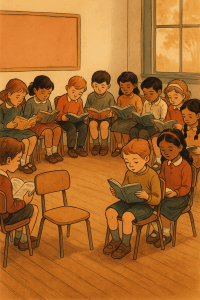
Illustration highlighting that 1 in 13 children don’t read for pleasure, with a lone chair highlighting a non reader in classroom reading circle.However, let’s circle back to a more real and still troubling statistic.

It’s true that, despite the apparent lack of access implied by not owning their own books, twelve out of every thirteen children reported that they read at home. If these results are to be believed, then twelve out of thirteen children aged 5 to 8 are reading sometimes.

Something encouraging seems to be happening here. I’d like to think that access to library books and other borrowed reading material plays a role (though I don’t have any figures to back that up).

However, we still have a child missing out on the benefit of reading. It may not be the one in five kids who report not owning a book, but there is a child in every thirteen who reports never reading. I feel this is the child we should be concentrating on.

Who isn’t reading?

The related statistic that I feel we should return to is this idea that one in thirteen of the children surveyed supposedly ‘never read’.

However, even here, I can’t help but wonder if this ‘scary number’ might be able to be softened a little.

First, let’s think about their sample age group; the children in this study were between the ages of five and eight. Whilst many five-year-olds can read surprisingly well, I do have doubts that a significant number of them would be doing so with enough confidence to say that they read for pleasure themselves at home.

Let’s also remember that reading confidence may come on much more slowly for some children. Factors such as learning impairments, as well as issues regarding concentration, will inevitably make it harder for a child to self-describe as a ‘reader’.

Just looking at dyslexia, the NHS website lists the estimated UK incidence of dyslexia as one in ten. However, Dyslexia comes in varying levels of severity, so I wouldn’t suggest that this will be the only influence on readership in children between five and eight years old.

I know several people with dyslexia who happen to be more avid readers than I am (and were so as children too), so I won’t simply jump to the conclusion that a child being dyslexic will instantly mark them as a ‘non-reader’.

All in all, I’m finding it hard to come to any concrete conclusion from the National Literacy Trust’s findings. So let’s return to the matter that many news outlets have focused on; book ownership.

Why get so hung up on book ownership?

Image of a large stack of unread books The 'To-Be-Read Pile’ emphasizing book ownership versus actual readingAs an author, I obviously see a more pragmatic benefit from people buying my books for their children. Book ownership supports your favourite authors and helps ensure the publication of more books you like. Is this important for child literacy, though? No, not really.

So, what is the argument for having a child perceive some books as ‘theirs’?

For some families, the purchase of a book may seem frivolous, an unnecessary expense when libraries are available. As a parent, I’m aware of how much it costs to provide your child with all the other things they need. If money gets tight, I imagine sacrificing book ownership seems like a small sacrifice in the face of other financial concerns.

I prioritise book ownership because I (and my wife) like to read. However, this isn’t enough on its own for anyone to criticise or question another parent who doesn’t prioritise book ownership.

My children typically get a few new books for their birthdays and more for Christmas. I also use Kindle Unlimited myself, meaning that they can access any Unlimited book they like using my account (and read it using our kindle, our household tablet, or on the app on their phones).

They both read fairly regularly, and I know that this provides considerable educational benefits (as I’ve noted in a previous blog post). However, they also both get books from the library. Between library use and the Kindle Unlimited lending library, often what they read wouldn’t count as ‘their’ books either.

This said, I know my children are in a privileged position when it comes to book ownership. Reading for pleasure and literacy proficiency aren’t just ‘nice to have’ perks; they have a profound and tangible effect on job prospects.

Keep reading for pleasure

Oxford Uni conducted a study on the correlation between reading for pleasure as a teen and management positions later in life. The results are fascinating, but, needless to say, it’s probably a good idea to encourage teenagers to read for pleasure as well.
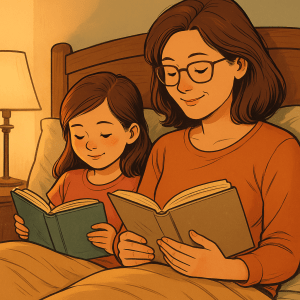
Warm, cozy illustration of a child reading in bed her mother reading by her side evoking the joy of reading for pleasureChildhood reading can also influence your adult wage level (especially if you start off less well off). In a study for ‘The Institute for Fiscal Studies’ (Crawford and Cribb, 2015) their findings gave little correlation for other quality of life indicators. However, in terms of average wage, those who read as children had a much better rate of pay as adults.

In another study (2021), The National Literacy Trust pointed out a similar important correlation between book ownership and literacy:

“…children who reported that they had a book of their own were not only more engaged with reading but also six times more likely to read above the level expected for their age than children who didn’t own a book (22% vs. 3.6%)…” (‘Book Ownership in 2021‘ posted on the National Literacy Trust’s website 12 Nov 2021

There’s no question that book ownership is a good thing for children. My primary concern is whether news sources like the Guardian are focusing too strongly on ownership. As though simply owning a book is ‘enough’.

But why are so many children not reading at all?

Perhaps, but perhaps some children aren’t reading for other reasons. I’m most interested in what’s happening with the one in thirteen who report that they ‘never read’.

The statistics for non-readers are presented in the Guardian as though they’re a worrying new development. However, it would seem that 1 in 13 non-readers has been a UK constant for some time.

Is this lack of reading a ‘new development’?

Illustration of a puzzled child sitting alone while others are enjoying books, representing children who don’t read for pleasure at allThe reported one in thirteen ‘non-readers’ (7.7%) is remarkably close to the same figures regarding ‘non-readers’ in a similar 1980s study on the same subject (here it was 7.3%). This study was conducted by the Centre for Longitudinal Studies, Institute of Education, University College London.

For four decades (at least), one out of every thirteen British children has reported themselves as not reading for pleasure/recreationally.

Many factors may lead to their lack of recreational reading. A lack of book ownership may (of course) play some part in this, but I suspect that it isn’t the only reason that these children don’t read.

Whatever the cause may be, there’s little doubt that their lack of recreational reading will have a negative effect on both their personal and professional lives.

In a previous post, I looked in much more detail at the positive effects of recreational reading, so I won’t go into it too much here. Needless to say, reading recreationally is proven to be good for an individual on multiple levels.

The positive responses to a tricky problem

Obviously, any country would hope to promote a behaviour that has a positive effect on its citizens’ future. Seeing the number of non-recreational readers go up over the course of forty years is not exactly ideal (if only by a fraction of a percent). It is, however, promising to hear the measures described at the end of the Guardian article.

Private companies such as McDonald’s have made a concerted effort to get more books into the hands of children. On top of this, we have phenomenal events like World Book Day, which also strive for the same outcome.

In fact, World Book Day (also run by the National Literacy Trust) goes a step further, by hosting and promoting events and activities which help to normalise reading for children who may not otherwise recognise it as a ‘normal’ behaviour.

1 in 13 children not reading in 2022 is as troublesome now as it was in 1980. We should be doing what we can to lower this number. Reading is a phenomenal activity, whether viewed as leisure, an escape, or as a learning tool.

However, this statistic has only shifted by a minimal amount over the course of forty years so I’m also wary of treating it like a new development.

I suppose the moral of the story is that we should read more to our children. We should also buy books as gifts for any children we know (when finances allow), and (crucially, perhaps) we should try to normalise reading for pleasure. Children mimic what they see adults do, after all; if we adults read more, then it seems more like the ‘done thing’.

Normalising a healthy habit
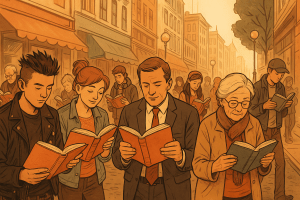
Illustration of a busy city street where people from all walks of life—students, businesspeople, pensioners, teens—are all reading books.The 1980s study also checked in with the children when they reached 16. At this point they asked about ‘reading culture’ at home. Only 43.6% reported that their dads read books, and 57.6% reported their mums reading books. Maybe if more of us allowed our children to see us reading (and enjoying) books, they might be more inclined to do it themselves.

The forty-year span of the one in thirteen non-readers may seem fairly inescapable. From the data we see, it would be easy to assume as much. However, I wouldn’t want to suggest that we go so far as to throw the baby out with the bath water.

Statistics such as these focus our attention on what matters to us as a culture. Do we want to promote literacy? Do we, as a culture, recognise its benefit?

Do we feel like we could (and should) encourage those final one in thirteen children to read?

If we answer yes to these (and it’s hard to find anyone who wouldn’t). If the end result of studies like the one conducted by the National Literacy Trust is more effort to get children reading. Then the study has done its job. Big headlines aside, the studies and stories themselves are there to remind us that, as a culture, we all want more children to feel the benefits of reading.

Starting small

If this post makes you feel inclined to buy a book for a young person you know, I would thoroughly recommend purchasing from a local bookshop. Your local bookshop will be able to advise you on great stories and appropriate reading levels, with marked expertise and you will also help support your local economy.

The range of children’s books available now is a vast, incredible cavalcade when compared to my childhood bookshelves. There are so many options that a child of any age and any interest might like. Your local bookshop will be able to guide you to the perfect book for the child you want to buy for.

What’s important to remember is this: even if all you do is share a love of reading, you’re already doing something fantastic. It allows you the chance to make a lasting impact on a young person’s wellbeing and learning journey.

Please don’t feel obligated

Alternatively, if you would like to buy one of my books, you could go to Fun Junction’s book section.

They deliver throughout the UK and have always been big supporters of my books, so I always like to return the favour where I can.

(Amazon is always there, and you can get my books on Kindle here, but I always personally prefer to support smaller, more independent online retailers).

Fun Junction also stocks a brilliant selection of toys, games, and puzzles for children and adults, so it’s well worth a visit to their website.

As always, thanks for reading, all the best, John

Write a novel… in one month?

‘Writer Twitter’ has once again begun to mention something in conspriatorial hushed tones. The closest thing to liken it to is the conspiritorial tone used in October when someone in the western world discusses the approaching Christmas season.

For writers, this ‘thing’ is something that can bolster the hopeful among us and leave the others feeling unprepared and riddled with doubt (a bit like mentioning Christmas early can do too).

What in the world am I talking about? Why it’s NaNoWriMo day of course!

As the nights draw in, as the fires are lit, as the tea pours like a hot nourishing river, and the muse is fed copious quantities of sweet treats and other indulgences, we writers settle down and enjoy… a grueling month-long writing session.

An epic writing journey that, if we work hard (and we’re lucky), will leave us holding the first draft of a brand new novel. That’s what NaNoWriMo stands for: National Novel Writing Month. You write a novel in a month.

That’s the plan anyway, and for the past eight years it’s what I’ve done. This year will be my tenth NaNoWriMo project (I took part in one of their ‘summer camps’ a few years back).

I still don’t feel like an expert but this year I’ll hit my 500,000 word total, so I feel a lot more confident than I did when starting my first (they tally your projects as well as your total wordcount).

If you’re reading this and you’ve never participated in NaNoWriMo before I thought I’d share a few short tips which have helped me to complete my 50,000 word target each November for the past eight years.

Tip One: Get out of your own head

To an extent this can be about not letting yourself overthink your project. However, there’s a more practical day-to-day component to it.

Whether you plan ahead or write in a wandering flow, do as much as you can to get those thoughts out of your head and on the page.

Put it all in your working document. If you have notes on a character, write it in a headed section at the end of your document marked as ‘character notes’. If you have ideas for future scenes, write the roughest plan for them under ‘scenes’ or something similar.

Basically, wherever possible, do not let your novel take place in your own head. Get every detail written down as they come to you because you will forget them if you don’t.

As an extra bonus, some of your scenes will already be planned out with a skeleton so on less inspired days you can potter around adding more meat to them, adding to the story, and increasing your word count.

Tip Two: Turn Up

In the early stages you may find that you get ahead of your totals. This may incline you to take a ‘day off’ in the first week or so… Please DON’T!

Instead, if you really feel the need for a break, then simply slow down and do less for a couple of days. If you’re 2-3000 words up it may feel like you could risk a day off but you’ll stay consistent and still feel the benefit if you simply write 5-700 words (about a scene’s worth) per day for three or four days. Days off get you out of the habit and steal your momentum.

Falling behind is hard to recover from, don’t risk that extra sly day off as you’ll potentially spend the better part of the following week catching your tail. Please trust me, lazy days are fine, “days off” are rarely worth the risk. I’ve done it more than two or three times over the years and regretted it every time.

Tip Three: Connect to the community

NaNoWriMo has a phenomenally supportive community and you can access them on pretty much any major social media platform, as well as connect in real life.

It’s a worldwide event but it has a strong local component as well. Simply go to the ‘community’ section in your NaNoWriMo dashboard and you’ll see a section marked ‘home region’. Here you can connect virtually. On top of this, depending on your local group, you can even arrange to meet as a group in a coffee shop for an epic writing session on your day off work.

Don’t feel obligated to participate in every NaNoWriMo activity but be sure to have a go at something. You’re really missing out if you don’t connect with others in the same boat. The odd mixture of support and a little healthy competition has helped me in countless ways in previous years.

One of my favourite components of the NaNoWriMo community has been the ‘sprints’. I use Twitter as my primary mode of contact with others during NaNoWriMo and the hashtag #nanowordsprints is connected to a particular activity within this community.

‘Word Sprints’ are short clips of time where the hosts set a timer and you write as much as you can during that time. You then take the designated break, congratulate one another, regroup, grab a beverage, then sit down for the next one.

Typically I find that my own first two or three sprints of the day will be pretty low in word count, but once I’m warmed up the next two or three can get me to (or even over) my target word count for that day. It’s a great way to punch up your wordcount if you’re short on time that day.

Typically, I can’t keep up with sprints every day. It’s a tiring activity, and is also not easily paired with research or planning time. Often only one or two of my weekly writing sessions will include a sprint. However, the usefulness and efficiency is worth the mental exhaustion.

No more tips, just go register

You can already register for NaNoWriMo prep activities. These start in September and run through to the end of October. I’ve never done this myself but it does look like a useful way to go if you’re a planner and want to be thoroughly prepared for your first NaNoWriMo.

Alternatively, simply make a commitment to yourself to join on day one of NaNoWriMo. Go onto your calendar and add a reminder to sign up on the 1st of November. Then just mull over the core idea for your book.

My core idea is very basic at present but I’ve got time to let it grow and gestate. I might write a basic character summary for my main characters. I may note down ideas for scenes. However, I very much prefer to let the story take shape at the time, so personally my prep will be minimal.

Do whatever feels right for you, but if you want to have a book written on the 1st December this year, then be sure to do something right now to cement that commitment.

Hope you found this useful, and hope to catch up with you during our writing projects this November.

As always, thanks for popping over to my site, all the best, John

One Hundred Thousand Welcomes!

ceud mile failte a hundred thousand welcomes

The algorithm goblins have scoured this site and discovered that there has been a spontaneous jump in visitors (or so they informed me this morning). In light of this new surge in popularity (so far it’s a whole ten visitors per day over the past week and counting!) I thought I’d pop in a quick post to say hello and welcome.

As you’ll no doubt see, I haven’t kept up with my blogging lately. This is partly due to a busy schedule on my end (unfortunately books don’t write themselves, I asked the algorithm goblins but they answered in indecipherable ones and zeros then ran away). However, my blogging absence has predominantly come from an odd shift in the way people use the Internet in our (semi) post-pandemic world. Namely, people seem to be using it less.

I have no idea what brought all of you new visitors. I don’t know how old you are, I have no idea whether you are all avid readers looking for advice on good books, or whether you are a new/experienced writer trawling the Internet for tips.

Whatever brought you here… ‘ceud mìle fàilte’, that’s ‘one hundred thousand welcomes’ in Gaelic. (Gaelic was one of many new things which I took up during lockdown and have promptly forgotten more than ninety per cent of)

I’m an author based in Perthshire in Scotland. I primarily write children’s fantasy/ dark-fantasy books. However, my most recent first drafts have been teen and adult sci-fi and fantasy. This blog started off as a way to communicate with fans of my Jack Reusen books (and later, this would include talk, and samples of other writings too).

You can find a full draft copy of my dark fantasy book ‘Marcus’ in the menu above (for readers 10+). You’ll also find sample stories involving a tribe of ogres who wandered into our world from Fey as it appears in my ‘Jack Reusen’ books (these are suitable for children aged 5 years and up).

However, through multiple school visits and workshops, the content on this site has evolved to include book recommendations, writing tips, and information on the process of self-publishing (for those who might be interested).

As I say, I have no idea what brought you here but if you happen to read this post please pop a comment below and say hello. If you feel like asking questions as well, or if you’d like to request more of a particular topic, please feel free to add this too.

Thanks for stopping by,

All the best, John

setting a scene young writer children stories

Writing tips for kids: Setting the scene

An Example of a Two-hundred Word Short Story:

Photo by Ylanite Koppens on Pexels.com

She pulled the blanket around herself, steadying her hot chocolate and sinking into the soft cushions. She reached for her book and balanced it on her knee, creasing open well-worn pages. Both hands now free, she clasped her mug, enjoying the warmth as it flowed into her fingers.

The crash from upstairs was sharp. Sudden.

Chocolate stained her book and splashed over her blanket as she lept up.

She left the mess on the floor and crept to the door. A deep pounding, like ocean waves, thrummed in her ears.

Photo by George Becker on Pexels.com

She reached for the door handle, releasing her stifled breath.

The hinge squeaked. She stopped, dreading another sound from upstairs. Silence.

She entered the hallway. The gasping rhythm of her breath the only sound. Feet stretching in shaking tiptoes, she took the stairs.

A single creak. That traitorous step announced her, and a crash from upstairs answered the call.

She stopped in horror as more crashes followed. Then thumps. Fast, rhythmic beats.

Photo by Francesco Ungaro on Pexels.com

They grew closer. Her throat tightened. She could feel her pulse in every breath. Then she saw it.

A pair of huge ears popped up over the top step.

The rabbit had escaped from its cage again.

Share your Storytelling Talents and Win a BRILLIANT Prize

The above story is one hundred and ninety-nine words long. I chose this wordcount very much intentionally as I’ve been invited to judge a local short story writing competition for children (I live in Crieff, which is the largest town in Perthshire, Scotland).

The maximum word count for entries is two hundred words (hence my own demo). Entries can come from any child aged from five to fourteen. Entries are separated into three age categories (5-7, 8-11 and 12-14) and the deadline is this coming Monday. Click here to find more information about Crieff Hydro’s National Storytelling Week Competition.

Perhaps you are one of the hundreds of children looking to enter the competition or a parent of a child who intends to enter. Alternatively, you may simply have arrived here because you like telling stories and are looking for writing advice. Either way, I thought I might offer a few hints and tips to help you set the scene in your writing.

Setting a scene

There are tons of different ways to set a scene but today I’m going to concentrate on three: pace, mood, and direction. Strictly speaking, these things aren’t simply connected to setting a scene but knowing about these will help you understand good ways to make a scene more interesting and easy to follow.

Setting the Pace

As a writer, you are in control of a few unusual things outside of your story. One of these is the fact that you have a small amount of control over your reader’s breathing.

Even when someone reads inside their head, the placement of commas and full stops (and any other types of punctuation), controls how they will breathe while reading.

You can use this change in breathing to influence their feelings in relation to your writing.

Short sentences, fast pace

Photo by Sourav Mishra on Pexels.com

If time is passing quickly, then a short, sharp sentence will help move things along much better than a long one. You can still be descriptive but use description sparingly and concentrate on really powerful descriptive terms.

In the sample story above you feel the story’s speed increase partly by experiencing the shorter sentences. Even if you don’t read it out loud, a short sentence will make you think of breathing quickly. Short sentences are good for suspense, action, and excitement.

Long sentences, slower pace

Photo by David Dibert on Pexels.com

Longer sentences (like the paragraph at the start of the story) can be a good way to make a reader feel relaxed (though it can also be used to show off different emotions). Longer sentences slow the reader’s breathing. This can be relaxing, but really the sentence length is a simple way of helping a reader feel that time is moving slowly.

Be careful not to make a reader take too long on each sentence though, or they might get so relaxed that they lose interest in your story!

Not a hard and fast rule

As with so many things relating to anything artistic, rules like these don’t always work. People can always find interesting ways to break rules or simply bend them.

However, it is hard to deny the influence that a writer has over a reader’s breathing, and it would be a shame not to remember this simple trick when writing. It’s a really easy and clear way to ensure that the pace of your story is the pace you want.

Setting the Mood

The mood of a story can be hard to show but there is one simple thing to look at when testing out a scene. What a character does is shown in the verbs you choose but there are hundreds of different ways of describing a movement. Take walking as an example:
A character can stride into a room. Right away we know that they are relaxed and confident.

Alternatively, they could slip into a room. In this case, we imagine that they are quietly trying to enter without being noticed. They may be shy, or scared, or both.

Another possibility is that they could creep into a room. This character sounds sneaky, but you would need to add other things in your sentence to help the reader understand whether they are being devious or careful in their movement.

With just one word you can help draw focus onto the mood that you want your reader to feel. Verbs are doing words but the right verb can also be amazingly descriptive.

Adjectives are the words we normally think of as ‘describing words’ (words like ‘blue’, ‘warm’, ‘smelly’). However, sometimes a sentence with one good verb and no adjectives can do a lot more for your story than a sentence with a basic verb and two or three good adjectives. This can be even more important when you have a small word count (like you might find with a word limit of two-hundred words).

Setting the Direction

Photo by Ekrulila on Pexels.com

You always know more about the direction or plot of your story than your reader does. This is yet another thing that gives you control over how someone will experience your story. You can choose to let a reader in on a secret that your main character doesn’t know or you can keep the reader in suspense alongside your main character.

In the story example above, the ending would be less impactful if the reader knew about the escaped bunny at the start of the story. they wouldn’t feel the fear and panic of the ‘intruder’ along with the main character if all along they knew that the noises were just a rabbit.

However, there are times when knowing more than the main character could help make the story more enjoyable.

Maybe your main character doesn’t know that they have a winning lottery ticket in their pocket and you tell the reader in line one of your story.

Now, every time your main character worries about how much something costs, or complains that they hate their job, you can let your reader enjoy knowing that lovely secret for the whole story until the big reveal at the end. It should still be fairly easy to get the reader to feel that excitement along with your character. In fact, they may even enjoy it more as they know how much the main character needed that money.

Go Write Your Story!

There are so many other factors that go into writing a story but hopefully, the tips in this post have helped you a little. Whether you are away to write your short story for Monday’s competition, or if you are simply reading this for general storytelling tips, I wish you the best of luck.

I would also love to hear about your stories so please leave a comment and tell me about what you’ve chosen to write. (Feel free to ask me questions too)

Thanks for popping by my site,

all the best, John


Help the universe that lives on your doorstep (shop with your local bookshop)

If reading a book takes you into another world then it goes without saying that your local bookshop is a universe right on your doorstep.
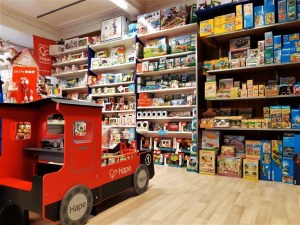
We can’t get into those micro-universes at the moment but right now, up and down the country, small shops are working to give us a glimpse of what they used to be able to offer. They’re working on social media profiles, youtube channels, and they’re either making their websites more functional or, in many cases, they are setting themselves up for online shopping for the first time ever.

These new web sites might be a little less glamorous than larger sites. They might not have every item you could possibly want. They might not be exactly what you’re used to. All the same, they are little windows into lovely places that are doing what they can to keep themselves relevant in a very odd new world.

If you take the time to visit you might be lucky enough to find some unique features too. There may be quirky copy to read, video tours of ‘Aladdin’s caves’ of wonders, crazy cat pictures, or they might link you up with communities you didn’t know were so close to home. These new sites are well worth a look.

A special shout out

One local shop that has always been good to me is Fun Junction. They have shops in Crieff and in Perth and both of them are in tier four lockdown at the moment.

They recently updated their website to include a small selection of books. They’re not exactly a ‘book shop’ but their Crieff shop is probably the only thing that counts as a ‘proper book shop’ in my immediate area right now.

If you’re looking to order any of my books I’d really appreciate it if you headed their way.

You’ll find ‘Jack Reusen and the Fey Flame’ here.

The second Jack Reusen book ‘Jack Reusen and the Spark of Dreams’ is here.

You’ll also find ‘Marcus’ my dark fantasy book for older readers here.

While you’re looking through their small selection of books you can also have a look at their magic tricks section, their games and logic puzzles, or even grab a few wee things from their pocket money section. They’re a lovely shop and well worth a (digital) visit. You can also find them on Facebook and on Twitter.

A few other shout outs

Some other books shops that I’ve really enjoyed visiting in the past/ wish I’d been able to visit before lockdown happened are:

The Watermill (Aberfeldy)

Not that these guys really need advertising (they’re a very well known secret among book-lovers throughout Scotland) but the Watermill is one of my favourite days out. In fact, their cafe was the first place I went for a coffee after the last lockdown ended.

The book shop is really unique with a brilliant range of books, a really cosy cafe (with a real wood stove in situ), and a fantastic homewares shop right next door (called ‘Homer‘).

Their Facebook page is loaded with book suggestions and an active reading community who also offer insights into these great reading suggestions. They’re also over on Twitter.

J & G Innes Ltd (St Andrews)

This bookshop is like something out of Harry Potter! A rustic outside that absolutely proclaims ‘bookshop’ (and has a really deep history linking it to modern printing). In the same spot since the late 1800s and now on its fourth generation of Innes (I don’t know the plural of Innes, Innesses? Inness? Inni?…).

You’ll find a slightly more modern experience on the inside (when you’re allowed back into book shops again that is). They also offer a huge and comprehensive range of stationery and art supplies as well, so my writerly/artsy side was absolutely hooked when I came across this place a couple of years ago when on holiday near St Andrews.

Their Facebook page is absolutely filled with fluffy cat pics at the moment and (when their doors were still open) it also had lots of info about books, gifts, and art available in store.

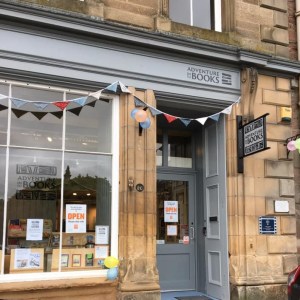
Adventure into Books (Blairgowrie)

I’m listing a shop I’ve never been to here. ‘Adventure into Books’ launched amid the multiple restrictions of 2020. I’m really looking forward to getting up to Blairgowrie and seeing the place as it sounds great. Unfortunately, that’ll have to wait.

In the meantime, they have a great wee website with book suggestions and information about their business and a Facebook feed full of a steady stream of new book suggestions.


Share your own favourites

I’ve put together a very small list so far on here but if you know of an indie bookshop that could do with a little shout out please feel free to tell me in the comments and I’ll be sure to add them too.

A last wee extra

I’ve missed sitting in a bookshop with a coffee, a book (and some time to kill), so much during lockdown. If you feel the same, this ambience video might help you. Pop it on, get a coffee in that favourite mug, and grab your book. Instant book shop experience.

Getting Serious about Writing (wk11&12): There is no ‘normal’ any more

Our world has changed. If we’re honest with ourselves it will probably never return to normal. Even if this virus disappeared tomorrow we’ve all had a rare chance to take stock and rethink the way we live. That sort of objective look at our lives can’t be unseen.

Businesses and other organisations are considering closing offices and allowing staff to work from home in the long term. Schools, colleges, and universities are implementing strategies for distance learning. The nature of how we do business, how we learn, how we communicate, how we socialise, it’s all different.

For some, these changes will be costly and difficult, for others their lives will improve. For most of us, we’ll have experienced a mixed bag so far.

What is different for a Self-Published Author?

Over the past few months, my experiences have been mixed. Financial issues which are probably pretty common have risen and fallen back. The work I do when I’m not being a ‘proper writer’ has changed a lot too. Behaviours are different. The rhythm of the year is different. I’m different.

For a long time, I’ve been aware of just how much my life outside of writing has changed but I kept thinking that my writing itself hadn’t really been affected.

Being stuck inside in front of the computer is hardly a change from the ‘normal’ day of a writer. However, my motivations for writing have been changing in subtle ways and a bit of self-reflection has led me to understand that I really am the sort of writer who writes for an audience.

I used to look down on this approach a little. After all, your ‘authentic’ story can’t be pulled every-which-way by your concerns about how someone ‘might’ react. However, while I still see the importance of story integrity I have to confess that it can be hard to motivate writing when you can’t at least imagine some reader at the end of all of it.

I write most of my books for kids and I know that school author visits and workshops (the way I normally connect with my audience) are going to be deeply affected by what’s going on. In short, I’m currently working on a book with the niggling worry that the only person who will ever read it will be me. This is a big step backwards from the ‘proper writer’ I have come to see myself as.

What do you do when you can’t see your audience?

Photo by Alan Cabello on Pexels.com

So what do I do? My first effort to reconnect with my audience was a website where children can share their stories with the world. A place to vent and communicate with one another. They can write what they like (though any content for older readers should be tagged as such).

I launched this initiative after about two or three weeks of solid work back in March. The site isn’t perfect but I can make more improvements once I see it in use and understand what needs to be fixed. It’s free to use and all it takes is joining as a contributor (I made it sign-in only in an effort to increase security and safety).

I publicised it on my social media platforms. I told teachers about it, in the hopes that they might share it with their classes during virtual lessons. I messaged parents I know to see if their kids might be interested. I did a lot to tell the world it was there. Other than my kids, one person signed up.

The tougher side of Self-Publishing

free creative writing course for kids celebrating stories literacy scottish curriculum for excellenceI’m going to stop here and point out that this isn’t a ‘poor me’ post. This is an effort to highlight the reality of life as a self-published author. All you can do is play to your own strengths but sometimes you have to realise when something isn’t working.

Take two: I went back to a writing course for children which I had put together back at the start of the year. It’s the product of a month of work and is linked in as many ways as I can to the Scottish Curriculum for Excellence (the curriculum utilised in Scottish state schools).

This course was originally designed for use in classrooms but I took another pass at it and tried to change it to cater to virtual learning environments too.

Another fortnight went into these updates, and finally, it was ready to launch as a weekly series of e-mails. E-mails would appear in a teacher’s inbox and contain both the teacher’s guide (highlighting outcomes and other curriculum features covered) and class printouts for the kids (for use in class or at home).

I launched this back in August. Sharing it on social media and directly with teachers. To date, no one has signed up.

Keeping track of the things you have control over

Photo by Roman Koval on Pexels.com

Again this is not a ‘poor me’ moment, this is the raw edge of self-publishing. If no one is enjoying what you are doing you don’t have the buffer of an agent, or a publicist, or even a PA between you and this fact. You instantly know that it didn’t work. You need to be able to rally when this happens.

This week I will be contacting teachers and schools to offer free (virtual) book talks with their classrooms. Scottish book week is coming up in November and I normally book in at least a couple of in-person talks in the week.

Will the virtual alternative be well received? Will I be able to book virtual events like this (having never really done anything like it before)? I have no idea. It might fail. I might get no response to this as well. Or it might all go brilliantly. The reception is not in my hands.

What do I do if this effort too goes pear-shaped? For starters, I don’t blame the teachers/schools. Their world is in considerably more of a mess than mine is at present so it would be churlish for me to get annoyed at them for the failure.

Instead, I have to step back and look at each initiative as a product. This is where I fall back on my retail background:

  • Does this product (school talks/ 10-week free writing course/ story-sharing website) satisfy a need?
  • Is it a good in itself or does it bring about a good in a way which can’t otherwise be achieved? (e.g. food may be a good in itself, exercise is only good in that is leads to improved health)
  • Is the timing of the release of this product offering someone a way of making life easier for themselves or a significant other?

The checklist could go on for miles but the point is that each free initiative I have offered so far can’t win purely on the fact that it’s free. It needs to serve a purpose or bring about some good that my target audience needs/wants.

If no one goes for it then something about it didn’t catch. I have to drop it or rework it until it better serves its purpose. The problem could be as simple as the fact that our teachers are currently wildly overworked.

Perhaps nothing I’m offering helps with that. Instead, a 10-week writing course might be perceived by teachers as more work, rather than as fulfilling it’s intended purpose (an effort to lighten the load for teachers planning a week’s lessons).

Find the solutions within

Being self-published (sometimes) is a million miles away from sitting at the desk and writing. This can be disheartening at times but my personality type deals with this sort of thing analytically. I find my way forward by analysing factors, amending variables, and trying again.

Your own strengths may be very different. If you are more expressive perhaps a more active social media/YouTube presence might benefit the sales of your books. If you have a more PR/advertising mind you may have the fortitude to fire through several dozen calls in a day, drumming up interest in what you do (I personally find phone calls to be one of the most daunting of all the PR type jobs).

There might be no such thing as ‘normal’ life anymore but none of us is ‘normal’ anyway. Play to your strengths and push on. It’s a strange new world and the next big idea you have might well be the thing that gets your book(s) noticed.

I hope this week’s post hasn’t been too much of a downer. On a more positive note, my newest book is now back on. I had a blip for a few weeks there but the sleeves are rolled up again and I’m getting back into it. I had a deadline in mind for this book but missing a deadline shouldn’t be a reason not to finish what I started. This book will get out into the world.

In the meantime please feel free to visit my author page on amazon to see the books which already made it out into the world (it never hurts to throw in a quick wee plug).

Hope you’re all doing great and, as always, thanks for reading (those reader stats make it all the easier for me to sit back down and get back into it. I really do appreciate you stopping by).

Comments below are more than welcome,

All the best, John

Getting serious about writing (wk 10): Stop thinking like a reader if you want to finish that book

When I turned thirty I made a promise to myself that before I reached forty I would have written ten books. I have to admit that even then it seemed a little ridiculous and within a few weeks, I had to admit to myself that I might have bitten off more than I could chew. Inevitably, as the months went by, the promise looked less and less likely to bear fruit.

I did try. I wrote as much and as often as I could, but by the time I reached thirty-two I had lost count of the number of non-starters and unintentional short stories that I had written. I just couldn’t leave a story alone for more than a few days without writing an ending and rushing to fil in the blanks. It was an odd state of affairs: like a war between my inner novelist and my inner reader.

Completing any large project is tough. However, writing a full book seems to come with its own complications.

What writing isn’t…

Photo by Luriko Yamaguchi on Pexels.com

Writing a novel is not the same thing as reading one. This may seem obvious but there are some important truths behind this.

After all, before we write our first book we will have spent our lives reading books. On top of this, we will also consume a host of other media (be that TV shows/ movies/ plays/ or any other story format). I can’t help but wonder whether consuming stories in this manner inclines us to grow too accustomed to the catharsis of endings and the drive to know ‘what happens next’.

Our minds often scream out for a sense of completion in the stories we read and I think this was the root of my problem; I thought the ending was the important bit.

It took me a while to notice this inclination in myself. Often when writing I yearned for the ‘ending’, and when I wasn’t rushing for the ending I was desperate to reveal the twist, or I wanted to play out the life-changing revelation for the main character. Nothing else mattered; I needed to reach that goal. In short, I was looking at my stories as a reader, not as a writer.

It’s an easy, possibly inevitable, position to fall into when you start writing. After all, we may have been writing stories for years (starting as young children), but our experience of ‘the novel’ comes first and foremost from our experiences as readers. We don’t notice (at least on our first reading) the small hints, the foreshadowing, the scene-deepening detail, which a well-sculpted book unpacks before us.

Photo by Zichuan Han on Pexels.com

With a very select group of exceptions, my experiences as a reader followed the path of opening that next chapter to ‘see what happens next’. Writing isn’t like this, it would be utterly bizarre if I sat down to write and was steadily surprised at the story as it unfolded. Looking back, I think that this really was at the heart of what held me up for those first two years.

I’d like to say that there’s a simple solution to changing your perspective but there isn’t a quick fix (not that I’ve found anyway). However, there are a couple of things that hindsight tells me may have contributed to my own changed perspective and both of them happened in November 2014.

Perspective shift 1: I know what’s going to happen

In November 2014 I joined an online writing community who offered support to each other as we tried to get fifty-thousand words written in one month. They call themselves NaNoWriMo (National Novel Writing Month) and they have a host of phenomenal resources to help you reach that goal. If I succeeded I would break my streak of unfinished work. I would get that book written.

I signed up five days late. The daily word count targets they set left me with thousands of words to write and I had no idea what to do to meet my target. However, having this much to catch up on forced me to get out of my own head and just write the first thing that came to mind.

A scene unfolded. I met my protagonist. I worked my mind around to see what I could do to add conflict in that first scene (conflict drives our writing, and usefully also drives readers to read on, win-win).

‘Pantsing’ with purpose

I was about to discover that the type of writing I was doing was what is known as ‘pantsing’; viz. writing ‘by the seat of your pants’, meaning that I was writing with no formal plan or structure in mind.

As I took a break and read tweets from others on as they discussed catching up on their own word counts, I came to find out more about ‘pantsing’ and how to make it work for you.

Writing with pen on paperMore experienced ‘pantsers’ explained that they keep a separate notebook and write notes as they write. These notes will contain plot ideas, possible endings, conflict-building scenarios, all that good stuff. In short, they do have a plan, they just unpack that plan in a different order than I expected.

So I started writing notes. I unpacked supporting characters pages before they appeared in the actual text. I had conflicts generate from small mistakes that we wouldn’t see until a chapter or two before the ending. In short, I got all that yearning for endings out in a separate document.

I got to have my cake and eat it too. I knew what was going to happen next but I also gave myself time to let those occurrences happen organically by keeping those ideas as separate notes.

In the years since I have moved away from the separate set of notes and made my manuscript into a working document. The notes go at the bottom. I set them in an end page, visually distinct from my main text.

As an added benefit this also gives me a ‘writing’ activity on hand for those days when inspiration is sluggish or absent. In my designated ‘writing time’, I can then sit down and organise my notes in order.

This is a very loose process but it helps set up an itinerary of sorts and as the book progresses it often morphs into a fairly coherent chapter plan. Pantsers might not plan in advance but they do plan and the book takes shape as a result.

Perspective shift 2: I don’t always know what’s going to happen (but someone does)

My second change in perspective happened at the end of my first week of writing, I was about five or six chapters in and something slowed. Despite having a plan (of sorts) in front of me I couldn’t get the next scene to play out properly.

I’ve since read about this phenomenon, and spoken to other authors about it but at the time I found it truly bizarre. I’ll backtrack for some context.

Prior to writing my NaNoWriMo project in 2014, I had never been able to finish a book. However, I had managed to reach chapter four, five, or six many times. I’ve now self-ascribed my problem as a mid-point obsession with backtracking; I know where I want to go but something drags me back and I start re-reading my first few chapters in search of what I can do to move forward.

My ‘pantsing’ notes told me otherwise; my answers were not in stuff I had already written, I was wasting time, instead, I leaned in a strange direction. By this point, I had a number of secondary characters with more notes about them than appearances in the text. One, in particular, jumped out at me and basically ‘told’ me what we were going to do next.

Obviously, this character is still part of my own mind but as I said earlier, I’ve spoken to other writers and this doesn’t seem to be a unique experience. Basically, your characters are a subconscious means of propping up and filling in the story. With years of reading experience we know what we like in a book, we know what we want to see. If we write a note about a character then it’s for a reason.

Somewhere deep inside we can feel something unbalanced in the story, or we may simply recognise a missed opportunity. When we write a secondary character (or even when we include secondary locations, objects, or other features) we give ourselves an additional tool which can be used in building the story and moving it forward.

These secondary characters are not just objects we use to fill a scene, they’re pockets of personality that we can use to move a story forward in ways in which our protagonist, antagonist, or any other primary character can’t. Derek Landy (who writes the fantastic Skulduggery Pleasant series of books*) is an absolute master of secondary character use.

I realised that, even with a plan in front of me, I sometimes didn’t know exactly how we were going to get from A to B. However, with well-rounded secondary characters in my notes, I had a new resource to draw from.

I never re-read during a first draft now. Those first-draft chapters will do nothing but slow you down. Instead, I always lean on my characters. When I don’t know how to move forward I look through my notes and ninety-nine percent of the time my characters have the answer.

Unpack and relax

Every year I enter another NaNoWriMo event and with each new one, it gets easier. I know what I need my book to do, my notes fill in the gaps and then I simply unpack what I need to move the story along at a reasonable pace.

You might not be a fan of note writing but if you take that inclination to find out ‘what happens next’ and put it into note form, you tend to create a nice set of instructions which can be unpacked and fleshed out at your leisure.

I had to stop thinking like a reader before I could think like a writer. I’m still not a hundred percent there but my writing gives me considerably fewer headaches with each new book.

Don’t stop reading

Photo by Polina Zimmerman on Pexels.com

I feel like I should add a small disclaimer at the end here. I say that reading books puts us in a bad position when it comes to our perspective as writers. However, this doesn’t mean I quit being a reader, instead, I had to give up the notion that I could look at my own book in the same way in which I look at the books that I read myself.

In my own writing, I know what’s going to happen, and even when I don’t it isn’t to be found in the book itself. The story lies in my mind, but, where that fails it also resides in the notes I write for myself.

Write good notes, don’t look back during your first draft, and you’ll have a book under your belt in no time. None of this stops you from being able to enjoy reading (after all it’s probably what made you want to write to begin with).

Follow a new self-published book all the way from working document, to printing press, to bookshelves

Thanks to the changed perspectives I highlight above (and a lot of support from a lot of different people) I reached my goal early. I have 10/11 books written, three in full self-published editions, others in various stages of drafting, and one in its final stage of being turned into another self-published book.

I write about the journey of self-publishing this new book every week in this blog. You can keep up to date with this process by following the blog, joining my mailing list, or simply by following me on Twitter.

If you are in the early stages of self-publishing, or even if you’re about to sit down and write your first book there should be plenty of help to be found in my posts.

What’s more, I’m always happy to discuss (in as frank a manner as I can) exactly what’s involved in self-publishing and what to expect from it. You can leave questions in the comments below or message me over on Twitter. I’m always happy to talk to other writers.

Thanks for reading,

All the best, John


*Please note that some links on this site are affiliate links and I may receive a commission on purchases from Amazon.co.uk as a result

Getting Serious about Writing (Wk 6…&7, &8, &9!…): Turning a roadblock into your own personal fortress

Sorry for the VERY overdue post. Don’t worry, there’s a story behind the whole thing.

The whole family were isolated again a few weeks back. My youngest son developed a cough. Even in normal circumstances, this isn’t exactly a great thing but in our current situation, this was even more unwelcome than usual. We all got tested, mostly fine but something in his test wasn’t right. We got a home test. It was sod’s law but as we waited for the second set of results to come in his cough cleared up.

Photo by Andrey Grushnikov on Pexels.com

However, despite a seemingly healthy family we were now locked down and had to await the go-ahead to resume ‘normal’ life. Finally, after more than a week stuck in the house, we got the result which confirmed that it had been, as we thought, just a cold. It was obviously better to be safe than sorry but it was still frustrating to lose a week. However, as you’ll see, and entirely due to my own actions, we lost a lot more time than that.

It was a great big upside-down experience. Among other things, I took the week off blogging. That week turned into two, then three, and now here we are.

I say I ‘took the week off’ but what I really mean is that I am now the proud owner of what I call a ‘deconstructed office’. This consists of a pile of boxes, disconnected computer equipment, and a very dusty desk.

My deconstructed office came about under the misplaced hope that reorganising my working space would be a two or three-day thing. In my mind this was worth the lost time; I would become more organised, get more room, and set myself up in a better working space, but…well here’s the story.

Locked in…

Photo by Bich Tran on Pexels.com

For me and my wife, one of the more obvious side effects of being ‘locked in’ was that our home environment started to grate on us. After three or four days stuck inside, it was inevitable that some changes would have to be made. Our project of choice drifted around until finally settling on getting a ‘proper’ office space divided off in our room.

My office has always occupied a small corner of our bedroom and the plan was to shuffle things around and make the divide in room-use more pronounced. It was a simple plan, it was achievable, and most importantly it helped us both at once.

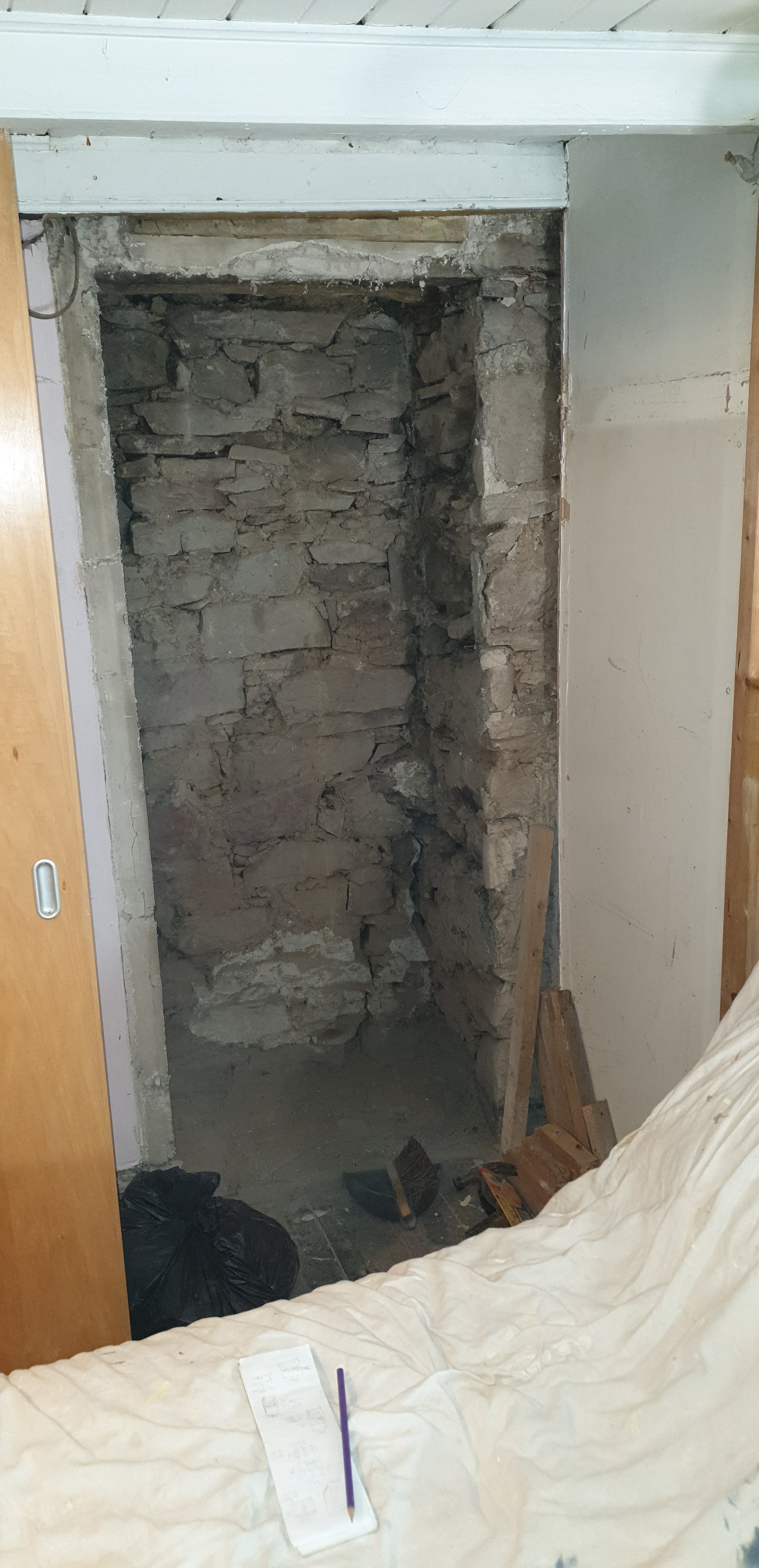
This ‘simple’ idea spiralled a little. It all started with one exploratory hole drilled in an oddly hollow patch of wall.

Taking a chance on writing

Before I go any further I should check in on what is so ‘writerly’ about this post. The short answer is that life happens (even to writers).

The longer answer is that sometimes we take a chance on things that will improve our ability to write, and sometimes that chance doesn’t play out exactly the way we thought it would.

For a long time, I’ve been contemplating the ‘long game’ in my writing career. Two big goals that are part of this are a podcast and a vlog. However, for both of these, I’ll need a more controlled environment and a more organised office space.

These seemed like distant ideas, something to do ‘when there was time’. That was until we got locked down and all of a sudden there was ‘plenty of time’.  No excuses.

“Just drill a hole…”

Photo by Caleb Oquendo on Pexels.com

Initially, I planned to reorganise the room. That was it. The desk would move to the window (nicer view than facing a wall), a new bookcase would be put up as a room divider, and a new delineated ‘office space’ would materialise where once there was none.

We set about moving things; packing possessions into boxes and doing a clear out of things that had lived at the bottom of a cupboard, serving no purpose, since the day we moved in.

At the time our shelves and cupboards spanned the entire length of our bedroom but about half of that was about to go. I had just finished clearing a built-in cupboard when I noticed how hollow its back wall sounded.

This cupboard had been built into the layout of the room years before we moved in. In fact, my parents used to live here, and it had been here before they owned it too. We thought we knew everything there was to know about the house, so hollow wall wasn’t to be ignored.

Desperate for any extra space we could get I wondered if it might be worth ripping back the plasterboard (‘drywall’ to American readers) for what looked to be an extra few inches of hollow space.

However, as I imagined the work that would take (and the fact that I couldn’t remove any mess/rubble while locked down) I almost gave up on the idea.

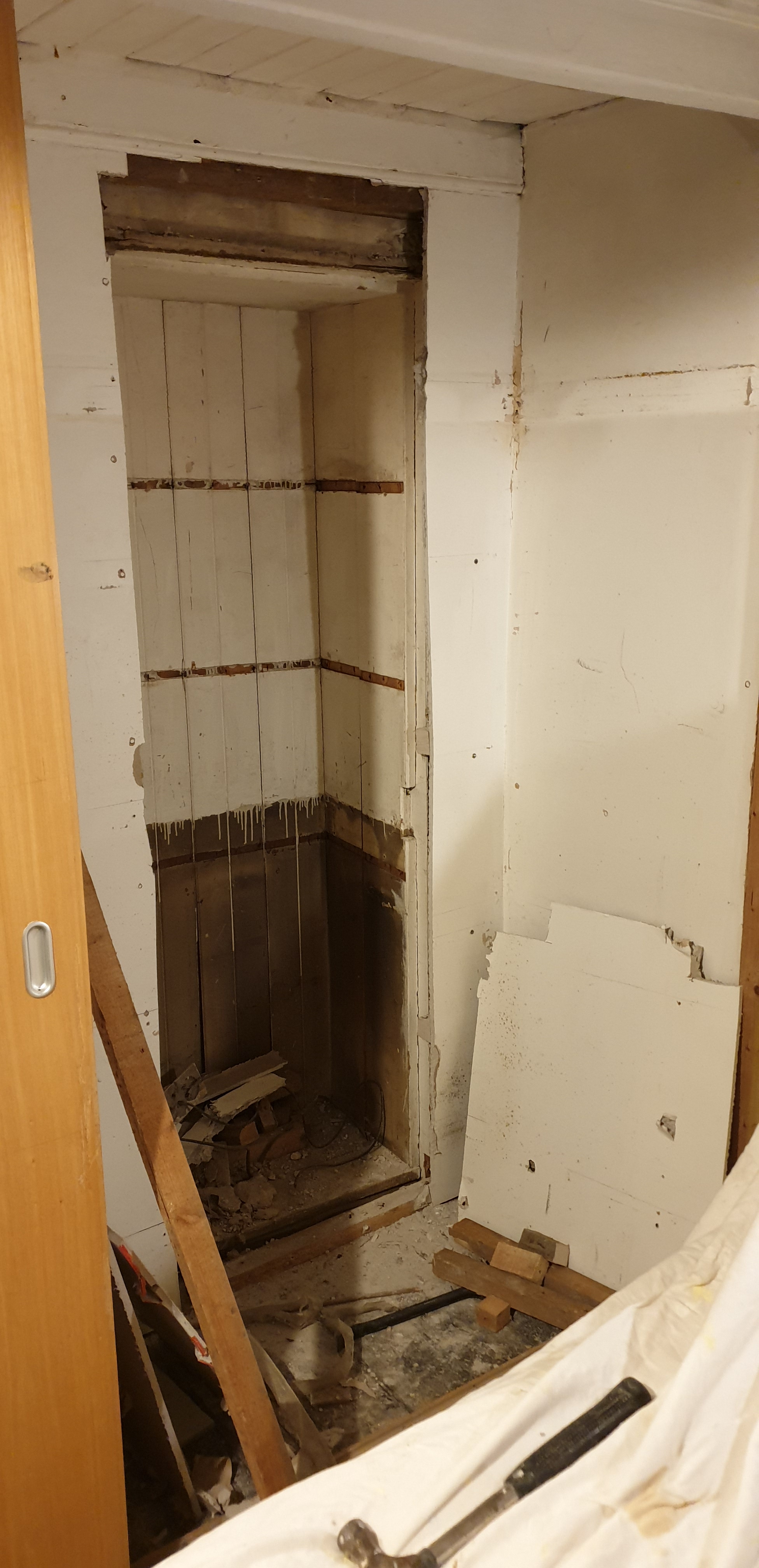
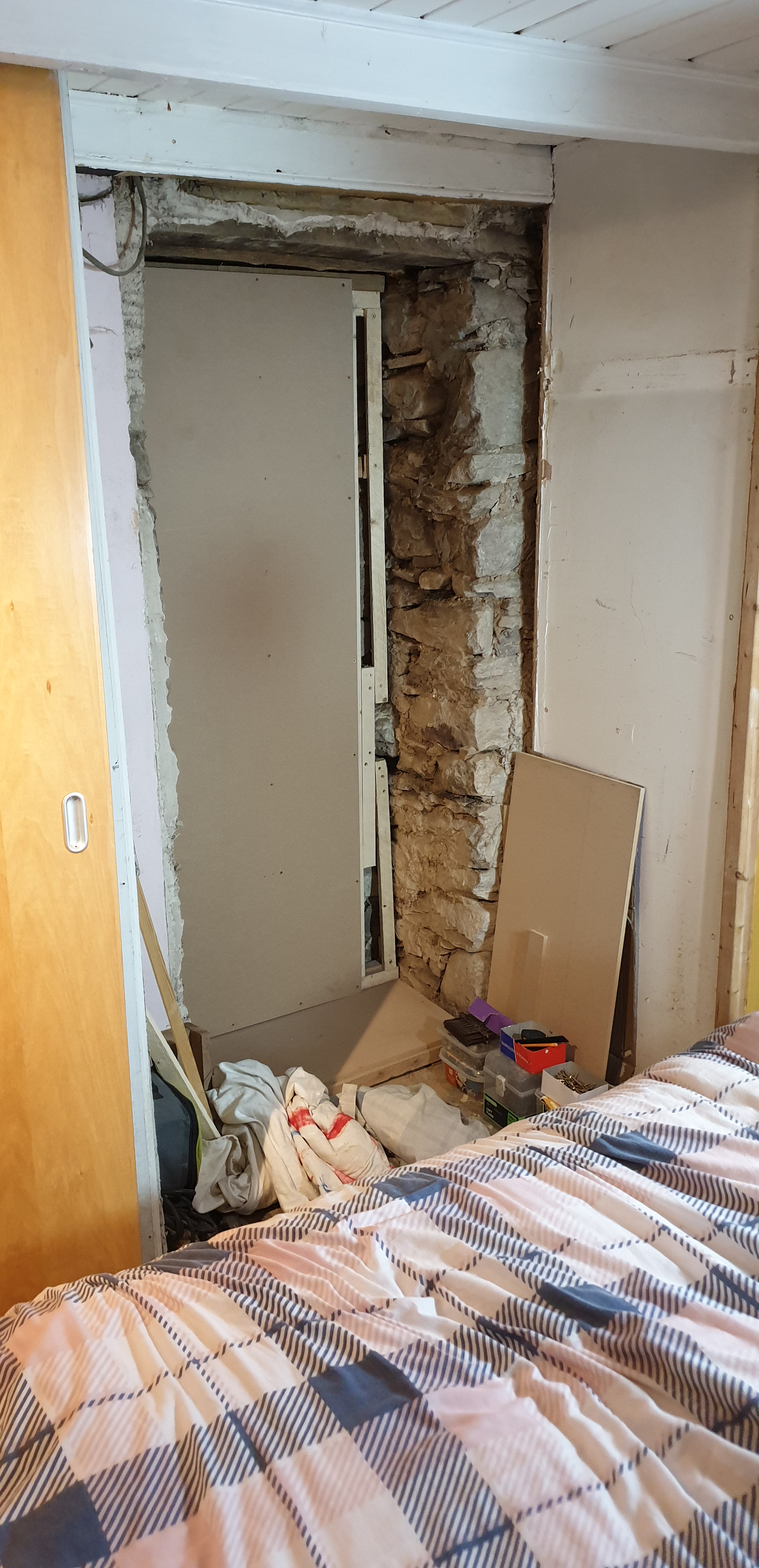
Then my wife suggested that I should drill a couple of holes to see what was in there. Maybe seeing the extra few inches would help us decide. I drilled the hole and here’s what I found:

So the wall came down.

A few inches could be debated, a few extra square feet of space was a whole other matter. As with most semi-structural work in an older building (our house is two-hundred/ two-hundred and fifty years old), there’s always a ripple effect.

We pulled down another wall. Then our planned room layout changed. This new layout necessitated moving the electrical sockets so that I could get my desk set up. I rewired that end of the room and installed new sockets. We noticed some areas where this new layout might lead to potential dampness/ poor air circulation so I added floor vents.

Then came the more recent discoveries like the fact that the old plaster on the brickwork needs to be repaired and, since we’re doing that we decided that we might as well decorate (I mean why wouldn’t you). That suggestion of ‘just drill a hole’ sort of got away from me…

I don’t have an office anymore. I barely have a bedroom. We basically live in a building site. Funny how a furniture move turned into a full room remodel (not ‘funny haha’ but you know…). We’ll get there eventually.

Plans change

I normally have my writing etc. scheduled out. All my weekly activities are laid out in a planner and I typically know what’s coming next. However, when you’re not allowed to leave the house you can get a lot of commitments cleared in surprisingly quick time.

Back in that lockdown week I dutifully got all of my most immediate commitments covered as I jumped into this surprise opportunity to improve my lot.

However, it has taken a lot longer than I anticipated so now I feel wildly behind on my writing. Sadly there’s no doubt that this will lead to a negative ripple effect in getting my next book ready in time and I can’t pretend that all of this delay isn’t affecting me. My anxiety levels are definitely high and I haven’t felt like a ‘proper writer’ for weeks.

However, I can’t miss the opportunity to jump ahead a couple of steps in my other writing plans.

I may sound a little negative at the moment but it will be amazing if this new situation works out. I can’t wait to start vlogging and getting my podcast up and running. Even a more dedicated writing space will be a solid payoff. Here’s hoping it doesn’t end up taking me till Christmas to do it.

It’s a gamble, I know it is. I’m going to have to double down on the ‘real’ writing work once I get my office back in order (I’m writing this blog post on my phone as I’m currently without a computer). However, I don’t mind that if it means an overall improvement in what I can do as a writer.

What changes have you made for your writing?

Still not done… ;P

This experience got me thinking about other writers and the sacrifices/ changes many of us have probably made in order to take our writing more seriously.

A few years back I made a commitment to put my writing first. This meant a drop in earnings, a move to being more of a ‘house husband’, and a host of other small but noticeable changes in my day-to-day life.

It’s not easy becoming a ‘professional writer’ and the ‘professional’ part is a much greyer area than it originally looked from the outside.

Since committing to writing I’ve helped run people’s social media accounts, written copy for a local distillery, I’ve set up full websites for people, all alongside the more ‘obvious’ writer jobs like school author visits and other author events. (I’ve written about how writers earn money in more detail here.)

As a writer, you become a Jack of all trades and somehow you tell yourself that it all falls under the banner of ‘writer’. However, I wouldn’t change it. My changes so far were all worth it in the grand scheme of things, and I’m sure that being without an office for almost a month will prove to have been worth it in the end as well.

I know I’m not the only writer to have flipped their life a little upside down to make their dream happen. I also know that this isn’t the only way that this story goes, so I’d love to hear about your own experiences.

What changes have you made in your life in order to take your own writing more seriously? In hindsight would you regard any of these choices as mistakes? What were some of the more advantageous changes you made?

I’d love to hear from you, please feel free to leave responses in the comments below or catch up with me over on Twitter.

As always, thanks for reading. Hopefully, there won’t be such a gap between this and the next time I get to post.

All the best, John

Getting Serious about Writing (wk5): Tools For Writing…

How much do you write outside of your work in progress? Do you make the most of digital opportunities to improve your writing?

The past four weeks of this series have been something of a deep dive into particular aspects of writing so I thought I’d step back and do a light skim over some important tools which I use regularly in my writing.

This post will look at a writing improvement tool, a tool to turn your book into an e-book, a facility for sharing snippets of your writing/day-to-day thoughts, and a facility to help increase your social media engagement.

However, the key takeaway is that the more we concentrate on all of our writing (even instant messages), the better our writing will become. (Key points in each section are in bold)

NB: All tools described are free to use (though some offer more advanced features at a cost) and I am not affiliated with any of the services described.

A Robot to help you write better?

Photo by Alex Knight on Pexels.com

The first tool I’d recommend is Grammarly. On the face of it, you might assume that Grammarly is little more than a spell-check tool. Lots of word-processing programmes and even web browsers have these built-in, what makes Grammarly different?

When you install Grammarly on your browser you’ll see a small set of symbols on the bottom of any writing input window you use on the internet (it even shows up in chat windows). One of the symbols will be an emoji, this is Grammarly’s take on the tone of what you’re writing.

For example, this post is currently registering as 4/5 joyful and 2/5 informative. It’s a nice feature and one I’ve come to use regularly in my copywriting work (the less discussed bread-and-butter end of a writer’s life). I’ve never seen another spelling/grammar check that does this and it can really make a difference in your writing.

Grammarly also looks at ways of improving your writing in general. You can insert text into their web-based checker or you can even download their own version of a word processor. Not only will Grammarly tell you when something isn’t right, but it will also explain why it isn’t right.

You’ll find your knowledge of grammar, in particular, will improve dramatically once you use Grammarly regularly. What’s more, Grammarly will make you more aware of your own writing style on a day-to-day basis. I have a bad habit of becoming formal in my writing (probably from writing so many essays etc. in the past). Literally, at this moment, Grammarly has told me that this post has become ‘formal’, which was not my plan, so I now know it’s time to rein it back in.

The quick simple take-away on Grammarly is that you should use it regularly. The level of awareness that Grammarly offers you will allow you to produce step-by-step improvements in your writing. However, this will only work if you apply it in all walks of life (it’s not simply for use when you sit down to work on your WIP).

Here’s a link to Grammarly’s website.

Get your book out in the world in moments

Photo by freestocks.org on Pexels.com

This next tool was an absolute life-changer. There’s no doubt that self-publishing can leave you in some very muddy waters at times. Your inexperience in a particular area can occasionally make that into a bigger stumbling block than it needs to be.

That’s where I was about five/six years ago. I had a book, I wanted to put it on Kindle, but I had no idea how to do that. Then I found Calibre.

Calibre is a free piece of software which takes your text file (no matter which word-processing programme you use) and converts it in moments into an e-book. It creates the type of files used by most major e-book stockists and allows you to get a look at how that book will look in its e-book form.

I’ll do a more in-depth post about the process of publishing an e-book when I’m closer to that point with my newest book. However, for the time being, I would thoroughly recommend downloading Calibre and playing around with it (here’s the link).

You’ll learn a lot about formatting and visuals in e-books as you do. Images may not display the way you expect in an e-book. Certain fonts may not work as planned. It’s good to see these problems long before you launch your e-book.

The last thing you want is for reviews of your book to talk about the formatting mistakes more than they talk about your actual story. Playing around with Calibre now could prevent headaches later on.

Get weekly experience with a solid bit of writing (and meet new people)

Photo by Pixabay on Pexels.com

This next tool/resource is a little different. You may already use it yourself but even if you do I’d suggest you might want to make it into something like a habit.

I started using WordPress in June 2012. WordPress is a website builder, but I have always leaned on it’s blogging capabilities. Back in 2012, I was a store manager in a toy shop and I used my experiences from the shop (and as a parent) to blog about toys.

I blogged every week (or at least tried to) and the blog got so much interest that within a year a local newspaper had me write a regular feature on toys. During the course of that blog I also wrote an article for a well-known toy industry publication, my viewership went up massively (five years after writing my last post I still get around thirty views a day on it), and a couple of my posts actually went mildly viral.

Overall it was a great introduction to the nature of blogging, but it also forced me to improve my writing on a regular basis. To be honest this was probably the most important personal takeaway from that experience.

I don’t think that it’s a huge coincidence that I started taking writing seriously again during the heyday of my toy blog. After years of dabbling and procrastinating in my fiction writing, I started to feel more confident in myself and within a couple of years I had completed my first book.

Blogging isn’t just a way to journal your life. If you listen to your audience and try to see what works for them you’ll begin to develop a feel for which aspects of your writing are going to sit well. Blog about whatever you like but do it passionately, do it regularly, and do what you can to make each post your best. The more you do it, the better your writing will get. Here’s the link to get started (if you don’t have an account already).

Let the robots share your thoughts

Photo by Lenin Estrada on Pexels.com

This last tool might be a little controversial but it harkens back to what I was saying about building a community of readers/potential readers last week.

If you are busy, if you have a day job, family, various other commitments, you might find it hard to engage with your audience on social media regularly. It can be difficult to keep yourself visible and relevant on social media if you only post every other day. However, with the help of robots, you can get your ideas out there much more regularly and spend your own time responding to the responses those ideas get.

I use a facility called Hootsuite to schedule regular posts on Twitter (though it can schedule to Facebook, Instagram, and lots of others too). Here’s a link to their site.

I make sure that I still respond to comments etc. myself but the scheduled posts force me to think about new topics that I can use to start a discussion.

I schedule a post once every few hours (not wanting to bombard people with posts). Normally these take the form of talking points linked to blog posts from my site. I’ve been a little lax in this in previous months but over the past few weeks I’ve made sure that I have a bunch of posts set up for the week by Tuesday.

You can write up a week’s worth of posts in a few hours then sit back and let Hootsuite share them on Twitter at your appointed times. This way you know that you are participating in your community regularly. Your posts will go live and you’ll be plunged into the discussion as they do.

There may be a slight sense of artificiality to scheduling posts but I find that it simply helps to remind me to stay engaged. If you choose to do the same thing just be sure not to step back and forget about it. Please remember that social media is about engagement so be sure to keep it that way or your account will quickly start to look like a robot.

Weekly advice for self-published/ soon-to-be self-published authors

Every Monday you’ll be able to pop over here for another post about the self-publishing process and/ or the day-to-day life of a self-published author.

Each post I publish uses my activity from that week to take an in-depth look at a topic that’s important to the self-publishing process. (You can find all of my ‘Getting Serious About Writing’ posts by clicking this link)

As the weeks go on, and as we approach the launch of my newest book, you’ll follow me through final edits, formatting, printing, and digital publishing, along with the other essential aspects of self-publishing.

If you want to make sure you don’t miss a post you can subscribe to receive each post on Monday by e-mail, simply click this link to subscribe to my mailing list via Mailchimp (it’s just me so don’t worry, you won’t be getting a dozen e-mails a day).

As always, thanks so much for reading, please feel free to add a comment/ question here or over on Twitter (you can find me at @Johntoyshopguy).

All the best, John

3 easy ways to make reading fun for kids

I’ve now been on bedtime story duty for twelve years. We’ve been on adventures in day-to-day worlds, trailed through fantastical realms, crept through sinister space ships, been on arctic expeditions, and much more besides.

It’s great to read to your kids, it offers lots of benefits. I’ve written before about the importance of reading to children. If you’d like to check that out just click this link.

If you are an adult in the UK who struggles to read but would like to get better you can get help from ‘The Big Plus’. You can find out more by clicking this link or phone them on 0800 917 8000.

Make Storytime Fun

In the past twelve years of bedtime stories, I’ve explored as many different ways of holding a child’s attention as I could think of. Some of these didn’t work, some had the opposite effect, and some were downright ridiculous.

However, in among all of the experimentation I’ve found at least a few things that definitely helped keep my kids enthralled enough for a half-hour or so of reading each night. This immersion in the story world has definitely helped develop their own love of reading too (to the point where I’m steadily being made redundant).

Giving the characters some personality

Photo by Gravitylicious.com on Pexels.com

The big thing that really caught their attention in the early days of story reading was something that might make many feel self-conscious, but it’s well worth the effort…voices.

You don’t have to be perfect; your Winnie the Pooh doesn’t have to sound exactly like the Disney version, your Gruffalo doesn’t have to sound like Robbie Coltrane, and later on, your Hagrid won’t have to sound lie Robbie Coltrane either.

You’re not trying to win an award, your kids won’t be overly critical (especially if you start early). Just make an effort. Changing your voice, even a little, will encourage most children to pay attention.

At baby and toddler stage they’re keyed-in to notice even the slightest changes in your voice. The more you change your speech patterns, the bigger the interest will be (at least that’s what I found).

I’ve always included voices when reading. They haven’t always been perfect but when we moved on to books without pictures it almost became a necessity. With a larger group of main characters, it helped a lot to have different voices so my kids could keep up with the story.

This has apparently had such an effect that my eldest son recently told me that when he reads by himself he hears different character voices inside his head. Good to know it was worth the odd sore throat.

Set the scene

Another important discovery in the early days of storytime was to add a bit of theatre to make ‘story time’ into an event.

We didn’t do this all the time but sometimes I felt it was necessary. One of the biggest changes was the move on to chapter books. Without pictures, it was sometimes necessary to do something to draw my kids deeper into the story. I had to think outside the box.

For example, we might build a fort in their room after tea, then read in it for bedtime. I sometimes set up special lights to make the room look different (cheap battery-powered fairy lights bought in the pound shop or other bargain shops were ideal for this).

Whatever made storytime stand out was worth a try. If we had time, it could be something big but most nights it was as simple as switching off the room light and using a reading lamp and some fairy lights. Here’s one tactic that I found really useful.

Let them pick

You should let them pick their own story. I won’t lie to you here; you may have to read the same picture book every night for a month if you do this. However, back at a time when their whole day was dictated by others (where they went, who they met, what they ate), this was one of the only ways my kids were getting to engage in making their own choices in life (albeit on a pretty small scale).

What’s more, it also gave me an early insight into their tastes and personalities. They’ve surprised me many times, especially at the library or book shops when looking for something new.

Let them look through and see what stories really stand out to them. This is actually a lovely experience, and it’s something I’m sure most parents will get a kick out of.

Try and enjoy it yourself

This is a sort of ‘bonus tip’ on top of the three mentioned so far I’d add this extremely important extra. Make sure you’re comfortable, happy, that you’ve got a good seat/beanbag/ whatever you like to sit on, and most importantly that you’ve got a wee cup of tea/coffee on hand to stop sore throats.

It can be hard to disconnect from things now. I know my phone beeps multiple times an hour, I’m guessing yours does too. I’ve come to see that half-hour as a welcome break in that constant stream of information. I put my phone away, I grab a cup of coffee, my kids get into bed (or sometimes sit with me) and we take a step away from our world for a little bit.

Reading to your kids doesn’t have to be a begrudging task that we do because we feel we ‘have to’. It can be a relaxing break from day-to-day life. Do what you can to enjoy the slower pace, the focussed time, the moments to catch up and laugh with your kids. Don’t get me wrong, I’ve had more than a few nights where I can’t believe we’re reading the Gruffalo AGAIN (for example), but most of my nights have been something brilliant.

I wouldn’t give up story night for anything and I hope these hints help you find ways to enjoy it more too.

Please let me know if you try any of these hints in the comments below and as always thanks for reading,

All the best, John