I got lost a week or so ago, it wasn’t writers block, I know what that feels like and this was very different. Exhausted, I had just reached the 30,000 word mark of ‘Jack Reusen and the Children of Fate’ and the end was in sight. I even wrote about how much I enjoy writing endings, I was psyched up and looking forward to writing, then one night whilst writing I was caught almost mid-sentence like a deer in the headlights.
I could still write but it was like the part of my brain that kept a hold of my characters started to unravel, scenes were easy but I started to lose track of how characters would react. I wrote one particular scene that felt pretty good at the time but when I looked back on it I really wasn’t happy.
Marathon runners encounter something called ‘the wall’ at the twenty mile mark; their body and their mind start battling for the last remaining dregs of energy and it becomes difficult for their mind to stay in control of their increasingly lethargic body. They start to make bad decisions, they find it hard to remember why they’re running in the first place, stripped bare of the mental support structures they’ve built up during training they are left to encounter the raw character of the person they are underneath.
I don’t doubt for a second that what I went through was something like a writers version of ‘the wall’, my motivation and capacity to write was still there, I even had ideas for storylines but the tools of the trade, the things that help me tell a story, seemed dulled.
I plodded on but couldn’t keep a grip on the road, I stumbled, tugging at plot lines from earlier in the book for support but still I fell. Unlike a marathon runner, I had time to let my mind recover. I had been on some hard-slog writing and paced myself very badly. I took some time to get my head back into magic and adventure, and enjoy a bit of family time.
One day later I felt rested but I still knew that I wasn’t ready to write, I needed to warm up those imagination muscles. I watched videos of magic on youtube, searched for mystical images on google, I watched the Turtles movie (OK that was kind of frivolous but it reminded me to have fun with what I was writing). On day two I got the laptop out, deleted a day’s worth of scenes, and I wrote some to replace them, then I wrote a couple more scenes, and before I knew it ‘Jack Reusen and the Children of Fate’ was finished! (it’s still a very basic first draft though)
However, my word count is still short of my 50,000 word NaNoWriMo target, so work has started on a little (almost side-) project that I’ve been thinking about for a while. I won’t share too much at the moment (it a long way off being seen in print) but I can tell you that it’s a wee mini book that I’ll be releasing for Christmas.
It’s a simple little story that I’ve been wanting to write up for a while. It was too big to turn into a short story on here but too short to make into a full Jack Reusen book. It has lots of snow and to be honest the cold weather over the past few days has been a blessing for me as it’s been easier to get into the mindset of warm drinks, cosy blankets, and powdery snow.
Finally I feel like I’m back on track, but it’s going to be hard, I’ve got two days to write 10,000 words. I’m off to plunge back into a land of snow, enchanted Christmas trees, and ‘war chickens’, wish me luck! Thanks for reading, All the best, John
I’ve been asked a few times about Mick’s cabin. It’s described it as having the wood growing out of it and I imagined a really natural feel to the whole place. In my mind I wanted to give the impression that Mick had camped in the woods and then just decided to just extend his stay indefinitely.
I didn’t really imagine Mick’s cabin being so modern but this one is still really cool. You can click through on the link (just click the image) to see more pictures of this amazing home.
Ordinarily a writer would research these sorts of pictures before writing but I already had a pretty clear image in my mind when I started. All the same it’s nice (and a bit weird) to be able to find pictures that feel like they’ve somehow poured out of the books. I hadn’t really expected something like Mick’s cabin to be real.
The open fire is one of my favourite mental pictures; thinking of Sparky napping on a thick cosy rug beside the fire while the others discuss their plans. I found this image and instantly thought it captured the feel of that part of Mick’s cabin, even though I pictured a chimney hanging above it it’s still amazingly close to what I had in my head.
Other than that there was the tricky issue of how to deal with trees inside a home. These images are pretty close to what I was thinking.
When I thought of trees growing everywhere one of the more unusual things was how a kitchen would work with branches in the way. This picture is very similar to the idea I had for Mick’s kitchen and it’s nice and neat (no banging your head while you make a coffee) whilst feeling really natural. This is a good match for the site of Fynn’s growing coffee addiction and Tam’s (slightly aggressive) introduction. By the way the link I’ve attached to the image file takes you to a really cool page about ‘grown-up’ tree houses (it’s well worth a look).
Here are some more ‘forest in the cabin’ pictures from the moonworkshome site. Just to close off this wee post. Let me know if this is similar to what you pictured when reading the books. All the best, John
At the moment our house is enjoying a full-on adventure with the wee free men and their ‘Hag’ Tiffany Aching. Terry Pratchett’s ability to create a world filled with humour, excitement, intelligence, and heart is not compromised by writing for children. The Tiffany Aching series includes four (soon to be five) books, set in his iconic Discworld, and each book focusses on a young woman called Tiffany as she grows into a fine upstanding witch.
Out of my two my eldest is especially enthralled with the books. The first book (The Wee Free Men) went down a treat and he really got a kick out of the violent, loud, yet loyal and caring ‘Nac Mac Feegle’ (or ‘wee free men’). It’s a book series that I enjoyed myself years before I became a parent and there’s something really special about being able to share it with my kids now.
The thing that impresses me most is one simple fact that, in itself, shouldn’t be impressive: the main character is a girl. Every book follows Tiffany, sure the wee free men are there too, as are a few other male characters, but the character we follow through every page is Tiffany. This shouldn’t be a big deal but it is. So many books for children (my own included) focus on the adventures of a boy as the main character, and in most cases he’s also cast as the hero. It makes a refreshing change to see that a girl can be just as heroic, just as relateable for two young boys as any male protagonist (I feel I redeemed myself a little with Spark of Dreams, you’ll see Thea’s heroics near the end of the book).
Not once have my kids asked ‘but why is a girl doing everything?’ not once have they complained. Both my six (soon to be seven) year old, and four year old sons have barely noticed that they’re following the adventures of a girl. Perhaps it’s because this is one of the first chapter books I’ve read to them (smaller frame of reference), or maybe their generation has different expectations than mine did. Whatever it is, I’m getting a lot of enjoyment out of knowing that my two kids clearly know how brave, clever, and heroic girls can be.
I’ll be rectifying my own lack of a central female character in my books next year as I delve more into Thea’s story, and follow her on a voyage around the world of Fey. It’s in the planning stages at the moment, so very little is concrete, but I can’t wait to delve into the world of legends, mythological animals, and the downright made-up stuff that I’ve got planned for next year’s batch of books.
In the mean time I heartily recommend Pratchett’s Tiffany Aching books (‘The Wee Free Men’, ‘Hatfull of Sky’, ‘Wintersmith’, ‘I Shall Wear Midnight’, and Pratchett’s soon to be released, final Discworld book ‘The Shepherd’s Crown‘). In the first book you’ll follow Tiffany as she meets strange little blue men, discovers she might well be a witch, and has to fight the Queen of the Fairies. I’m sure you’ll enjoy them as much as we are. All the best, John
In just a few days I, and thousands of others, will embark on the beginnings of a mindboggling cacophony of stories. July is the month for Camp NaNoWriMo (National Novel Writing Month), where you pledge a word goal and a genre and then look forward to the weirdly competitive edge that your writing has been missing.
I say ‘weirdly competitive’ because there’s no sole winner, and you find yourself routing for precisely the people who are doing better than you. In a slightly masochistic way, you’ll find yourself enjoying the successes of those who challenge you challenge you the most. As you push yourself to smash your daily recommended word count, there they are, always a couple of hundred words ahead, but without them you’ll drop back to a hundred and fifty words a day with an ‘at least it’s something’.
NaNoWriMo gives you results; do it right and you’ll finish the month with a solid, real, piece of work but it doesn’t work without a couple of ‘spotters’. Thank goodness it’s virtual, allowing you match your wits with people on other continents just as easily as you can with someone you can meet with for a coffee and a ‘word sprint’ (where you write as much as you can in a set period of time, basically racing each other). I already have a friend in the states set to join me on the adventure, and I welcome any other writers or would-be writers who fancy getting that book finished once and for all.
Please consider signing up, it’s a genuine rush watching that word count go up by significant leaps each day. It’s the movement that pushed me on to launch the Jack Reusen series, and absolutely anyone can do it. Sign up in readiness here, set your word count goal, pick your genre (by no means does it have to be a children’s book) and get cracking. Honestly, if you do it right you will have that first draft done by August.
If you fancy some support along the way, feel free to follow and chat to me on my personal Twitter account. I look forward to sharing the highs and lows of writing a book with whomever of you feels up to it. All the best, John
It’s not as bad as it sounds, please read on to find out more. I was first told about the boy wizard in high school, it would have been about 2000/2001, and I point-blank refused to read it. I even laughed at friends who were recommending it. You see the problem was that Harry Potter was a kid’s book, and seventeen year old John was no child.
I had my mind set on becoming an author and was sure that truly engaging writing (the kind that I could learn from) could only be found in books aimed at adults. I read magical realist authors like Rushdie, de Berniere, and Garcia Marquez. I also Immersed myself in classic literature and edgy new work. In short I thought of children’s literature as something of an oxymoron. Instead I was simply a moron.
Reality hit me at Stirling Uni in 2002 when I headed down to the MacRobert Cinema to watch Harry Potter and the Chamber of Secrets with a friend. The film left so much unsaid, so many questions unanswered, that I borrowed copies of the first two books from her to catch up with what was going on. Then I borrowed another (you know, just to see what happened next), and then another. Then I ran out.
On the 22nd of June the following year I was queueing outside a Waterstones in Aberdeen at midnight. I patiently waited for them to open the doors and release copies of ‘the Order of the Phoenix’ to the street-load of waiting children dressed as witches and wizards (I wished I had come in costume too).
A good book transports you to another world, or offers a view of our own that you might not have considered. It opens up questions and makes you think, and if you’re lucky it takes you for an adventure. Magical realists can do that, classical literature can do that, gritty ground-breaking new fiction can do that, and (unbeknownst to my seventeen year old self) so too can a good children’s book do all of these things.
We can get stuck in a rut when it comes to what we read, fixating on just one genre, but we miss out by doing that. As students, a bunch of us traded favourite books, we all had widely different tastes and we decided we might benefit by shaking things up a little. To be honest I don’t think I’ll ever be a full horror, crime, or thriller convert (though I still like to jump into a good horror book as the nights start to draw in) but that wasn’t really the point of our experiment. Our wee book-swap gave me an insight into what qualities made these types of book so appealing to so many people, it made me realise just how hard it can be to pin down just exactly what counts as ‘good writing’.
I still cringe at the thought of how condescending I must have sounded as a teenager and I apologise to Adam for dismissing what truly was an amazing find, and I also thank Vikki for allowing me to see how rich and enjoyable children’s literature can be (even for adults).
Are there any ‘children’s books’ that you’ve found particularly engaging? Do you avoid popular authors because you think they’re somehow less remarkable because of their popularity? Feel free to have a chat about it in the comments below, or over at the facebook page or twitter account. As always, thanks for reading, Cheers, John
(This post is also available to watch and listen to as a vlog/podcast. You’ll find it on YouTube and Spotify down at the bottom of this post.)
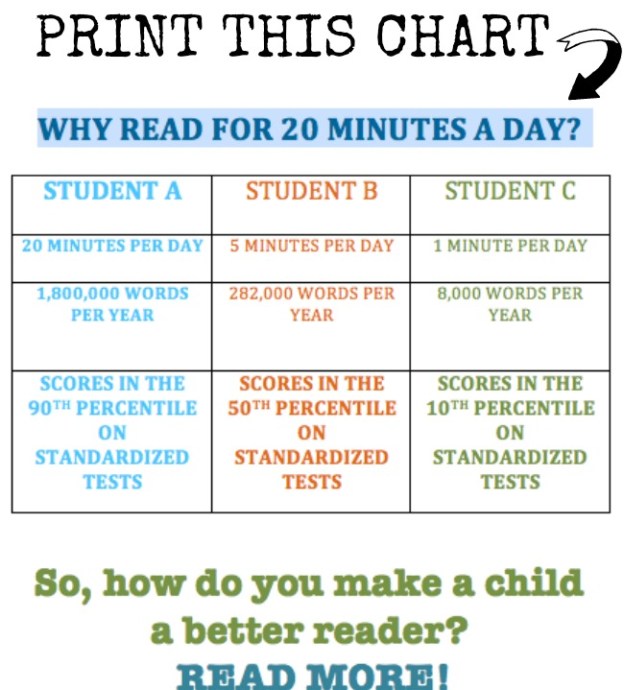
Read for 1 minute or less a day with your children and they may end up in the bottom tenth percentile! (But should you care?)
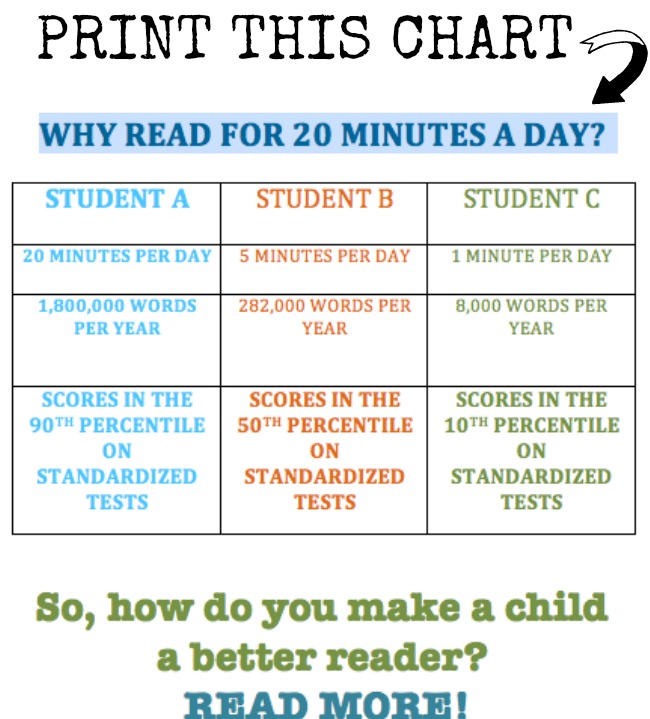
According to a number of educator resources and literacy advocates, children who read for around 20 minutes a day are exposed to as many as 1.8 million words per year, and this level of exposure is often linked to performance in the top 10% of standardised test scores. (phoenixacademyomaha.org)
While these figures reflect general trends rather than guaranteed outcomes, they do highlight the potential impact of regular reading habits.
Are test scores really the best gauge of childhood success?
I’ve seen this graphic (or something very similar) floating around the internet on a number of occasions. Often, the original context of these stats is lost and, instead, people (often parents) seem to see the higher test scores as the motivating call to action.
However, while I agree with the idea that reading with your children is a good thing, I’m not sure if I agree with the hefty role being given to word volume, or the assumption that parents should only care about test scores. It’s part of the growing inclination of so many to try and quantify childhood learning.
Of course, some skills are more quantifiable than others: vocabulary, memory, the ability to follow instructions (this list is far from exhaustive). In this sense, it’s easy to see how an increase in vocabulary and memory might improve test scores. However, there are so many more important skills that reading helps develop than the capacity to have great test scores.
Children who read find themselves exposed to other ways of thinking, other worlds, and other people, in a much more intimate manner than you find in any other medium.
“One in Five UK children don’t own a single book”
That said, for many children, access to books (or even the idea of owning a book) is far from guaranteed. In a related post, I explore recent headlines suggesting that one in five children don’t own a single book, and dig into the complex role that book ownership plays in childhood literacy. You can read that post here.
For families concerned about the cost of books or about limited living space, it’s also worth knowing that there are fantastic digital alternatives to physical books. In a separate post, I explain how you can access thousands of free books on almost any smart device (phone, tablet, even a PC). You can read that post here.
Reading does a lot more than improve test scores
The characters, ideas, plots, scenarios, and places found within the pages of a book do not stay there; they find a home inside your mind. It’s about as close to telepathic communication as we can get.
When a child reads a story where a character loses their memories, they aren’t simply exposed to a vocabulary-building exercise; they have been given access to some fairly complex notions about identity. This might lead them to ask questions about whether we are the sum of our memories, or something more. In essence, books (and perhaps fantasy books in particular) provide simple, digestible ways of thinking about some pretty big questions.
It kind of bothers me to see test scores held up as the pinnacle of childhood achievement. Test scores can be a great way of gauging a child’s engagement with their learning, but I’m a little dubious about regarding these scores as anything more than that.
A child’s ability to deal with the world outside of school will have a lot more to do with how much they understand, plus a host of skills that are even harder to quantify.
Academic skills are not simply the ‘Three Rs’
Many children will go on to opt for university or college at the end of their school career. Despite what they may assume, they may be surprised to discover how important it is to have a collection of skills that go beyond reading speed, vocabulary, and memory (the more testable skill set).
I tutored Philosophy undergraduates at Edinburgh University for four years (and was an examiner for one of those as well). It was amazing to see how often some students (who came in with less than stellar grades in high school) would somehow overtake their higher-scoring classmates. Often, this hedged on far less tangible/quantifiable skills than rote memory etc.
We wanted to see students demonstrate an understanding of the nuances of arguments; memorising facts and figures simply wasn’t enough (though it was, of course, valuable). What’s more, the ability to step outside rote learning and think for themselves enables students to create thought-provoking and insightful essays. I learned that high test scores aren’t always a clear indicator that someone will perform well, even in an academic environment.
Good teaching and the challenge of ‘soft skills’
The abilities of a teacher are often assessed based on the test scores of the children they teach, but this can leave little room for some truly vital skills; like bolstered inquisitiveness, social understanding, and the ability to ground ideas within a real-world backdrop.
Teachers do a phenomenal job at encouraging these traits, and many more beyond those. I’ve met a good number of these teachers on the various school talks I’ve done, and it always impresses me to see how well-rounded their pupils are in ways that go far beyond traditional testable academic skills. I’m not an expert on the curriculum, but I’m fairly certain that these essential skills will be hard to locate by looking at where a child falls within the ‘national percentile’.
If you’re a teacher looking for ways to spark those kinds of wider conversations, I offer free school author talks that tie reading into big ideas, imagination, and creative thinking. You can contact me to discuss a talk or workshop here. I’m also currently working on a new range of classroom resources that will provide free activity sheets (and more) to support classroom discussion.
Alongside my school talks, I write books that open up the kinds of big ideas I’ve discussed here: from friendship and imagination to questions about memory, morality, and identity.
The Jack Reusen series (for ages 6+) brings magical disruption into Jack’s everyday life, whilst Marcus (for ages 10–12+) explores darker themes of power and consequence, all through a fantasy lens grounded in familiar Scottish settings.
I’ll post new literacy resources here as soon as they’re ready, as well as other updates regarding books and literacy. To be the first to hear as soon as they’re available, you can subscribe using the box at the bottom of this post. Simply pop your email address into the box, click ‘subscribe’, and you’re good to go.
Reading is more important than test scores
Of course, we should read to our children for twenty minutes a day, longer if we get the time. For some of us, it’s part of the ever-shrinking portion of the day in which we can spend time together, without necessarily having to deal with some kind of screen.
Not only does it allow you and your child to discuss all kinds of topics and issues, but it also gives you a few moments in which to touch base and enjoy spending time together.
Reading, at least in this context, has much more to do with maintaining relationships and learning about the world we share, than it has to do with building vocabularies and assisting in academic scores.
Reading shouldn’t be marketed as a fast track road to success (even if the numbers suggest it); it’s an activity that opens dialogue, builds relationships, and encourages inquisitive minds. In short, reading opens us up to all of the fantastic skills that make us human. It doesn’t just help us test well.
If you have anything to share about any of the issues I’ve touched on in this post please feel free to share your ideas in the comments, or over on social media (here’s the Jack Reusen facebook account, and here is my Instagram account).
Want to read more on the topic of the deeper positive effects of extended reading? You’ll enjoy this fantastic post by teacher librarian Krystal Gagen-Spriggs about the great effects of developing a reading habit.
If you have a kindle (or something that can run the kindle reader app) then you can get hold of both of the Jack Reusen books (and a whole heap of books by other authors too) by signing up to a month’s free trial of Kindle Unlimited over at Amazon, here’s the link.
Once you’ve signed up you’ll see that both of the Jack Reusen books come up as free, so you can read the whole adventure so far, for nothing.
‘Jack Reusen and The Fey Flame‘ introduces you to the land of Fey, as creatures (and other things) make their way through to the ‘matter-world’ (basically our world). Jack and his family have to discover a way of closing a collection of ‘breaches’ between the two worlds to make their world safe again.
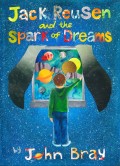
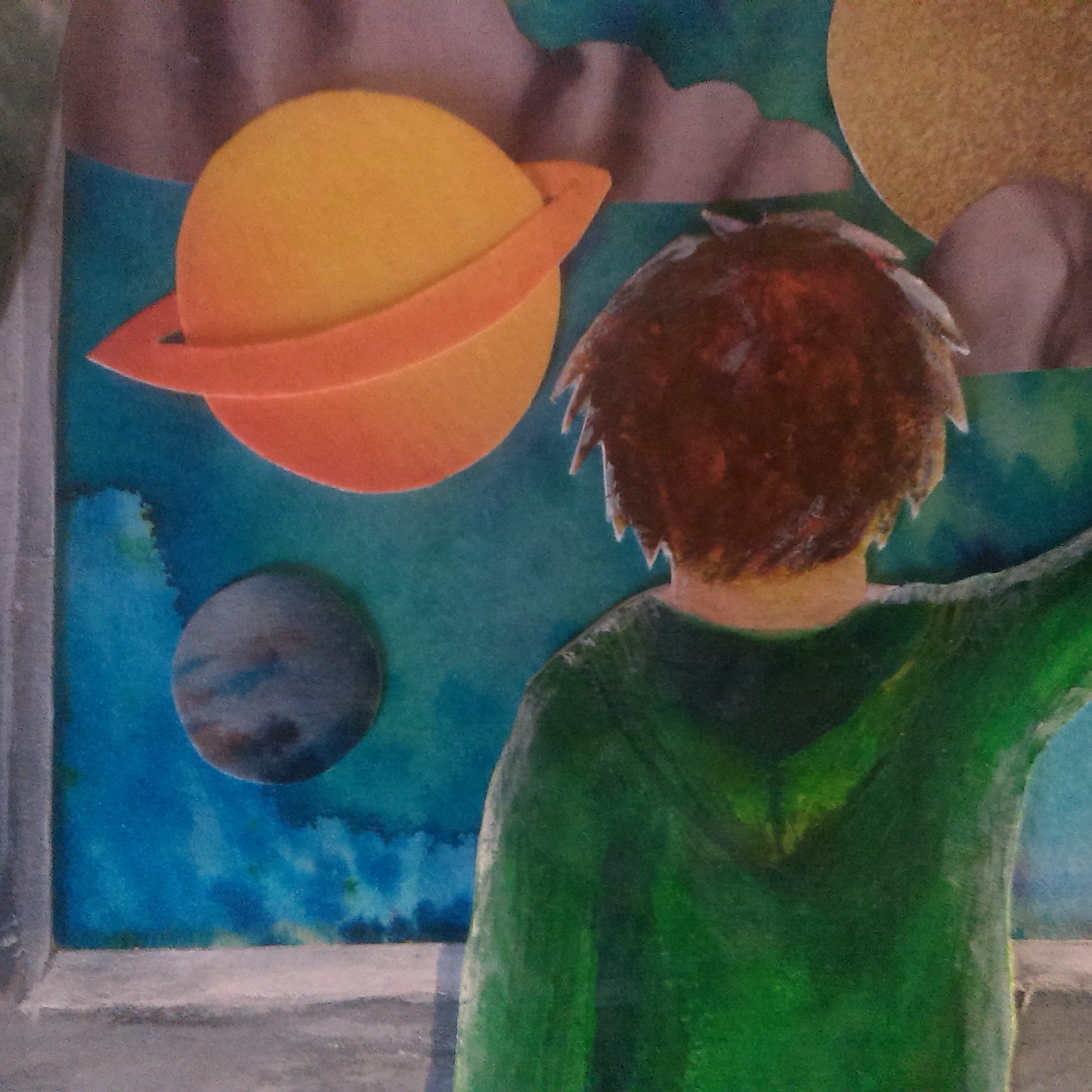
‘Jack Reusen and the Spark of Dreams‘ is a slightly different kind of adventure. People are losing their ability to dream. Every night more and more people lose the certain something that makes human beings so good at solving problems and creating things; the spark of dreams. Jack discovers that he could be the key to understanding what’s causing this change, and he may even be the only person who can solve it and bring back the dreams and imaginations of hundreds of people.
I hope that both of the Jack Reusen books give you and/or your kids something to enjoy over the summer holidays. Let me know what you think, all the best, John
‘Jack Reusen and the Spark of Dreams‘ is ready! The artwork is done, the text has been edited, all files have been sent off to the printers, and now comes the waiting. (Though the wait won’t be too long for the kindle edition, which I’ll have ready sometime tonight.)
The process for print editions is fairly simple; first they send me a digital proof (which I expect to receive sometime early next week). After this comes approval of the proof, which is kind of an odd thing to do actually; basically I send them an e-mail saying ‘yes I like my own book, send me lots’. Once I’ve told them I like my book it can take seven to ten working days for them to to print up a bundle and send them to me.
I’ll probably end up posting a lot of updates on Facebook and Twitter once I’ve got a tracking number, so if you follow either account expect to see lots of posts about UPS on the day the books head my way.
To be sure that you get hold of one of the first copies you can pre-order one by leaving a comment below (they’re £6.99) and you can either pick them up at Fun Junction, get me to deliver them to you personally, or if you’re further away I can post one out to you.
Writing this book has been a totally different experience than the last one. Knowing that people have read the first, that some readers might be emotionally invested in certain characters (no I haven’t killed anyone, nor do I plan to), and knowing that there are many more books planned, has meant that I’ve had to be very careful with this one.
There are some scenes that had to be big and dramatic and they change characters in ways that might take them a couple of books to recover from. That’s what all these big delays have been about (I originally planned on having the book out in April). The trickiest part has been the fact that two key story lines run from just one early scene involving Fynn and Thea.
They come out of the event changed, but getting the balance between developing a character in that way, and just all-out changing them is difficult. Every change I made to that one scene (you’ll see what it is soon) had a heavy ripple-effect throughout the book, at times it was like playing Jenga with a sledgehammer. After a lot of work I think I’ve got it right and I hope you guys enjoy the journey that both of these characters go on.
‘Jack Reusen and the Spark of Dreams‘ is darker than the Fey Flame (though not by a lot), my proofreader/editor left me a note about three quarters of the way through the book that simply read ‘this is freakin’ scary!’. Don’t let this put you off though. I’ve left a lot of the scarier scenes open in a way that lets the reader fill in the gaps with their own imagination. This way, readers at my eldest son’s age (seven in a few weeks) will likely find these parts a lot less frightening than their parents.
Overall the story is based around what the world would be like if people didn’t dream, imagine, or come up with new ideas. Some of this is a little scary but mostly I wanted to deal with how important imagination is for everyone. Jack has to navigate a city that doesn’t dream and it doesn’t look like a nice place to live.
I’ve said before that there are ‘zombies’ in this book, but they aren’t undead, flesh-eating monsters; they’re innocent people who are sleep-walking through life and have lost something important because of it. Jack goes through a crisis of confidence but we all know that in the end he’ll have what it takes to help them.
Thea hasn’t been left out either; she gets to be an action hero in this book. Her fight scenes were some of the most enjoyable things I have ever written (though you’ll have to get a fair bit through the book to see them) and I’m really looking forward to seeing what kind of girl she develops into in future books.
Sorry for the long post, as you can probably tell, I’m a little excited about launching the latest Jack Reusen book. I really hope you like it (when the books finally get here). I’ll keep you updated here and on the Facebook and Twitter accounts about when to expect them. In the mean time I’ve got a school book talk to prepare for. I’m off to Comrie Primary on Monday (my school between the ages of five and seven) and I’m really hoping the children there enjoy their introduction to Jack and his friends.
All the best, thanks as always for reading, cheers, John
Not a real post here (too busy editing), just sharing this word-jumble (from wordle) that features all the most popular words in ‘Jack Reusen and the Spark of Dreams’ (size=frequency). It might give you an idea about some of the content.
Running tally of progress: final edit=p132 of 275 (don’t worry this bit doesn’t take that long), cover is done (thanks to Karen) but I’ve got a couple of minor tweeks to do once I have finalised page numbers (matching spine to book width). Once these are done the book will be good to go. I’ll pop a wee update after tonight’s editing session to keep you posted. Off to edit now, wish me luck, John
As you all know the book is progressing; it’s on final draft, lined up for printers, and just being amended for corrections from proofreaders. I’ve been freaking out recently at the realisation that I’m creating a book series rather than just an individual story.
When I first started out writing the Jack Reusen books I had the most basic plan, intended to turn in to just one book, but as ‘Jack Reusen and the Fey Flame’ come together I realised that I’d gathered together a lot of information in the background that translated into other stories.
Having an entire world to create is obviously a lot of fun, however it’s also huge challenge. I hadn’t realised when I started how much I was going to have to know about my own world. Even at this stage I’m having to think ahead by quite a bit, to make sure I don’t make a mistake that closes off a good story later on. It’s hard leaving room for something to happen in future books without feeling vague or, worse still, leaving readers with too many unanswered questions.
Book one came with a few big questions but by the end of it most of them seem to have been answered. Book two is definitely a different animal as Jack’s world expands and we start to learn more about how the various kinds of magic he encounters work, a lot of questions arise that might not be answered for another two or three books.
When I think about it I realise just how many of the plots for later books rest on what happens in this book; not only am I leaving seeds for ‘Jack Reusen and the Children of Fate’, I’m coming to realise that ‘Jack Reusen and the Spark of Dreams’ has become something of a launching platform for an entire book series.
The formatting is done, some key issues are being debated over with my proofreaders, and the book is already in the kind of shape it needs to be to be send off to the Printers. It’s almost time and I’m sorry that you’ve all had to wait for so long, please bare with me, there really isn’t much left to do.
If you have any questions about the books, or about the writing process in general feel free to leave a wee message in the comments below. All the best, John

 I got lost a week or so ago, it wasn’t writers block, I know what that feels like and this was very different. Exhausted, I had just reached the 30,000 word mark of ‘Jack Reusen and the Children of Fate’ and the end was in sight. I even wrote about how much I enjoy writing endings, I was psyched up and looking forward to writing, then one night whilst writing I was caught almost mid-sentence like a deer in the headlights.



 However, while I agree with the idea that reading with your children is a good thing, I’m not sure if I agree with the hefty role being given to word volume, or the assumption that parents should only care about test scores. It’s part of the growing inclination of so many to try and quantify childhood learning.
 When a child reads a story where a character loses their memories, they aren’t simply exposed to a vocabulary-building exercise; they have been given access to some fairly complex notions about identity. This might lead them to ask questions about whether we are the sum of our memories, or something more. In essence, books (and perhaps fantasy books in particular) provide simple, digestible ways of thinking about some pretty big questions.
 The abilities of a teacher are often assessed based on the test scores of the children they teach, but this can leave little room for some truly vital skills; like bolstered inquisitiveness, social understanding, and the ability to ground ideas within a real-world backdrop.