For over a year I’ve struggled to get my eldest to read independently. To be honest that’s not entirely true as he’d happily jump into reading Star Wars encyclopaedias at the drop of a hat. However, with the encyclopaedia, he’d put them back down after a page or two. It was pretty clear that we needed to track down a book that really spoke to him.
With p4 and the step-up in reading it brings on the horizon I realised that he’d need to get more accustomed to longer stretches of reading than he had before. I hunted for books that would pique his interest but every time we simply find another story for me to read to him and his brother (not that that’s necessarily a bad thing).
We hunted and hunted, I trailed him through a serious number of bookshops over the past few months. Then, about a month ago we took a trip to Glasgow, walked into Waterstones, and with the promise of a comfy seat and a hot chocolate he finally reached a decision; George’s Marvellous Medicine.
Picking the book in person had its own charm to it and I think the setting definitely helped. However, the general idea of a boy messing with a grouchy granny seemed to catch him straight away.
It was a favourite of mine when I was his age but I’d forgotten how good it was. George is precocious and empathetic, and also a bit of a chancer. To be honest I think it was a good match for my son’s personality. On top of this the granny (the recipient of the medicine) is a whole new character once you look at her from an adult’s perspective.
My son read the first few chapters aloud but he’s starting to just grab his book, curl up, and read. Last night he skipped bedtime story and just brought the book into bed with him to read by torchlight. The book geek in me couldn’t be happier, but on top of this, I know that what he’s doing will make the change in reading level this year all the easier to keep up with.
It’s a simple book that has been expertly crafted by one of the greatest storytellers I’ve read. Our new challenge will be to find the right book to follow it, but I’ve a feeling that the Roald Dahl back catalogue will keep him occupied for a while.
What were your favourite books when you first started reading? Can you remember any of them still? Let us know in the comments below.
I think we may now have officially hit the point where all local school children have returned from their holidays (or thereabouts). In light of this I thought I’d put out a quick reminder to any teachers reading about school visits. I’m available for book talks and writing workshops and I currently have a fairly clear calendar (though it is starting to fill up with other things).
I’ve never charged for school visits but I do normally bring along books for sale at a special price (I’ll figure out pricing long in advance of a visit to leave teachers time to get information out).
In the past I’ve hosted book talks for whole schools, for individual classes, and for middle-sized groups sorted by age. I’m also happy to spend a little more time with older children who might want to learn more about the writing process in a workshop setting.
If you think you’d be interested please get in touch. For those who want to do a more focussed book talk I can provide class copies of the Fey flame to give you/ your students a chance to read it in advance (either to review it or to let pupils get to know about the books before I come along).
If you are interested in arranging something please get in touch by e-mail (click this link) or by messaging below. I hope to hear from you soon,
Today I passed 12,000 words of ‘Thea’s Quest’. Chapter six is done and I’m close enough to my word-count target to feel fairly comfortable. It was a hard slog today (wrote almost 4,000 words) but I really feel like it was worth it.
It’s a lot of fun experimenting with what Thea will do in different situations, it’s telling me so much more about who she really is and what the tone of the other books in her series will have.
As I said in my previous post, I won’t have much time for blog posting during all the other writing madness this month but when things go right it’s nice to share. Hope you’re all well, and as always thanks for reading (and for stopping by). All the best, John
It’s not as bad as it sounds, please read on to find out more. I was first told about the boy wizard in high school, it would have been about 2000/2001, and I point-blank refused to read it. I even laughed at friends who were recommending it. You see the problem was that Harry Potter was a kid’s book, and seventeen year old John was no child.
I had my mind set on becoming an author and was sure that truly engaging writing (the kind that I could learn from) could only be found in books aimed at adults. I read magical realist authors like Rushdie, de Berniere, and Garcia Marquez. I also Immersed myself in classic literature and edgy new work. In short I thought of children’s literature as something of an oxymoron. Instead I was simply a moron.
Reality hit me at Stirling Uni in 2002 when I headed down to the MacRobert Cinema to watch Harry Potter and the Chamber of Secrets with a friend. The film left so much unsaid, so many questions unanswered, that I borrowed copies of the first two books from her to catch up with what was going on. Then I borrowed another (you know, just to see what happened next), and then another. Then I ran out.
On the 22nd of June the following year I was queueing outside a Waterstones in Aberdeen at midnight. I patiently waited for them to open the doors and release copies of ‘the Order of the Phoenix’ to the street-load of waiting children dressed as witches and wizards (I wished I had come in costume too).
A good book transports you to another world, or offers a view of our own that you might not have considered. It opens up questions and makes you think, and if you’re lucky it takes you for an adventure. Magical realists can do that, classical literature can do that, gritty ground-breaking new fiction can do that, and (unbeknownst to my seventeen year old self) so too can a good children’s book do all of these things.
We can get stuck in a rut when it comes to what we read, fixating on just one genre, but we miss out by doing that. As students, a bunch of us traded favourite books, we all had widely different tastes and we decided we might benefit by shaking things up a little. To be honest I don’t think I’ll ever be a full horror, crime, or thriller convert (though I still like to jump into a good horror book as the nights start to draw in) but that wasn’t really the point of our experiment. Our wee book-swap gave me an insight into what qualities made these types of book so appealing to so many people, it made me realise just how hard it can be to pin down just exactly what counts as ‘good writing’.
I still cringe at the thought of how condescending I must have sounded as a teenager and I apologise to Adam for dismissing what truly was an amazing find, and I also thank Vikki for allowing me to see how rich and enjoyable children’s literature can be (even for adults).
Are there any ‘children’s books’ that you’ve found particularly engaging? Do you avoid popular authors because you think they’re somehow less remarkable because of their popularity? Feel free to have a chat about it in the comments below, or over at the facebook page or twitter account. As always, thanks for reading, Cheers, John
(This post is also available to watch and listen to as a vlog/podcast. You’ll find it on YouTube and Spotify down at the bottom of this post.)
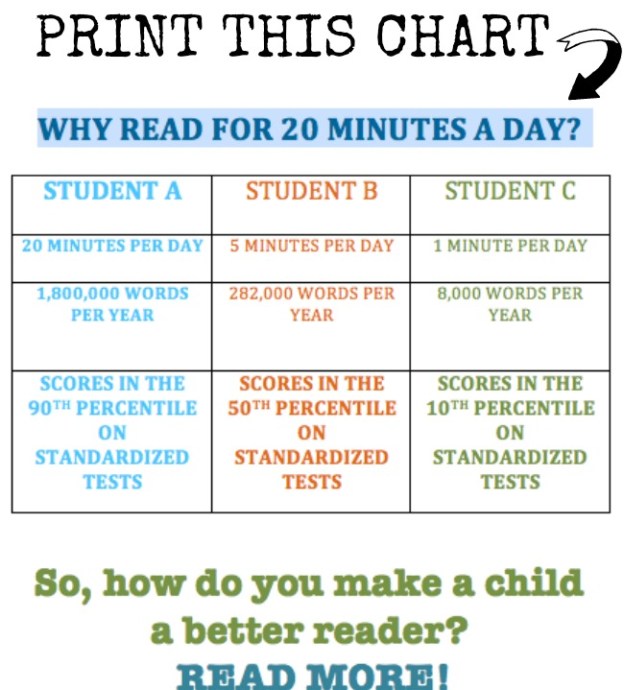
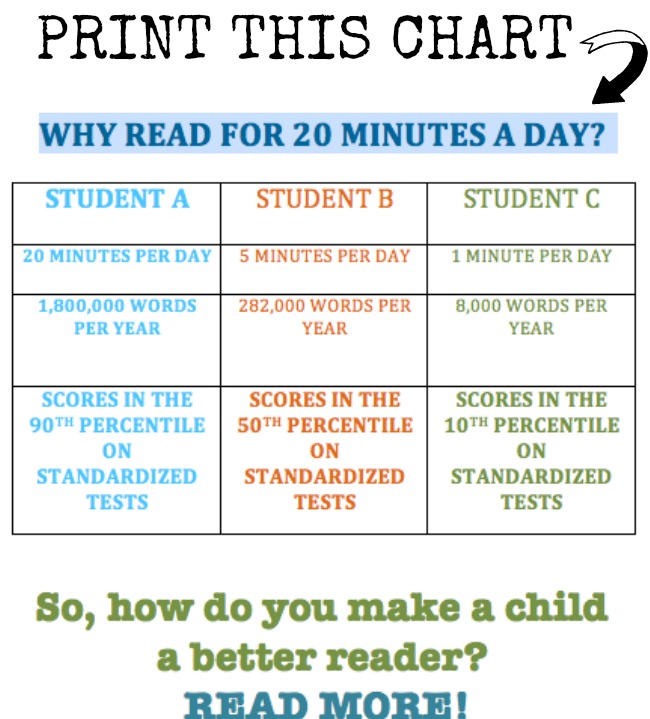
Read for 1 minute or less a day with your children and they may end up in the bottom tenth percentile! (But should you care?)
According to a number of educator resources and literacy advocates, children who read for around 20 minutes a day are exposed to as many as 1.8 million words per year, and this level of exposure is often linked to performance in the top 10% of standardised test scores. (phoenixacademyomaha.org)
While these figures reflect general trends rather than guaranteed outcomes, they do highlight the potential impact of regular reading habits.
Are test scores really the best gauge of childhood success?
I’ve seen this graphic (or something very similar) floating around the internet on a number of occasions. Often, the original context of these stats is lost and, instead, people (often parents) seem to see the higher test scores as the motivating call to action.
However, while I agree with the idea that reading with your children is a good thing, I’m not sure if I agree with the hefty role being given to word volume, or the assumption that parents should only care about test scores. It’s part of the growing inclination of so many to try and quantify childhood learning.
Of course, some skills are more quantifiable than others: vocabulary, memory, the ability to follow instructions (this list is far from exhaustive). In this sense, it’s easy to see how an increase in vocabulary and memory might improve test scores. However, there are so many more important skills that reading helps develop than the capacity to have great test scores.
Children who read find themselves exposed to other ways of thinking, other worlds, and other people, in a much more intimate manner than you find in any other medium.
“One in Five UK children don’t own a single book”
That said, for many children, access to books (or even the idea of owning a book) is far from guaranteed. In a related post, I explore recent headlines suggesting that one in five children don’t own a single book, and dig into the complex role that book ownership plays in childhood literacy. You can read that post here.
For families concerned about the cost of books or about limited living space, it’s also worth knowing that there are fantastic digital alternatives to physical books. In a separate post, I explain how you can access thousands of free books on almost any smart device (phone, tablet, even a PC). You can read that post here.
Reading does a lot more than improve test scores
The characters, ideas, plots, scenarios, and places found within the pages of a book do not stay there; they find a home inside your mind. It’s about as close to telepathic communication as we can get.
When a child reads a story where a character loses their memories, they aren’t simply exposed to a vocabulary-building exercise; they have been given access to some fairly complex notions about identity. This might lead them to ask questions about whether we are the sum of our memories, or something more. In essence, books (and perhaps fantasy books in particular) provide simple, digestible ways of thinking about some pretty big questions.
It kind of bothers me to see test scores held up as the pinnacle of childhood achievement. Test scores can be a great way of gauging a child’s engagement with their learning, but I’m a little dubious about regarding these scores as anything more than that.
A child’s ability to deal with the world outside of school will have a lot more to do with how much they understand, plus a host of skills that are even harder to quantify.
Academic skills are not simply the ‘Three Rs’
Many children will go on to opt for university or college at the end of their school career. Despite what they may assume, they may be surprised to discover how important it is to have a collection of skills that go beyond reading speed, vocabulary, and memory (the more testable skill set).
I tutored Philosophy undergraduates at Edinburgh University for four years (and was an examiner for one of those as well). It was amazing to see how often some students (who came in with less than stellar grades in high school) would somehow overtake their higher-scoring classmates. Often, this hedged on far less tangible/quantifiable skills than rote memory etc.
We wanted to see students demonstrate an understanding of the nuances of arguments; memorising facts and figures simply wasn’t enough (though it was, of course, valuable). What’s more, the ability to step outside rote learning and think for themselves enables students to create thought-provoking and insightful essays. I learned that high test scores aren’t always a clear indicator that someone will perform well, even in an academic environment.
Good teaching and the challenge of ‘soft skills’
The abilities of a teacher are often assessed based on the test scores of the children they teach, but this can leave little room for some truly vital skills; like bolstered inquisitiveness, social understanding, and the ability to ground ideas within a real-world backdrop.
Teachers do a phenomenal job at encouraging these traits, and many more beyond those. I’ve met a good number of these teachers on the various school talks I’ve done, and it always impresses me to see how well-rounded their pupils are in ways that go far beyond traditional testable academic skills. I’m not an expert on the curriculum, but I’m fairly certain that these essential skills will be hard to locate by looking at where a child falls within the ‘national percentile’.
If you’re a teacher looking for ways to spark those kinds of wider conversations, I offer free school author talks that tie reading into big ideas, imagination, and creative thinking. You can contact me to discuss a talk or workshop here. I’m also currently working on a new range of classroom resources that will provide free activity sheets (and more) to support classroom discussion.
Alongside my school talks, I write books that open up the kinds of big ideas I’ve discussed here: from friendship and imagination to questions about memory, morality, and identity.
The Jack Reusen series (for ages 6+) brings magical disruption into Jack’s everyday life, whilst Marcus (for ages 10–12+) explores darker themes of power and consequence, all through a fantasy lens grounded in familiar Scottish settings.
I’ll post new literacy resources here as soon as they’re ready, as well as other updates regarding books and literacy. To be the first to hear as soon as they’re available, you can subscribe using the box at the bottom of this post. Simply pop your email address into the box, click ‘subscribe’, and you’re good to go.
Reading is more important than test scores
Of course, we should read to our children for twenty minutes a day, longer if we get the time. For some of us, it’s part of the ever-shrinking portion of the day in which we can spend time together, without necessarily having to deal with some kind of screen.
Not only does it allow you and your child to discuss all kinds of topics and issues, but it also gives you a few moments in which to touch base and enjoy spending time together.
Reading, at least in this context, has much more to do with maintaining relationships and learning about the world we share, than it has to do with building vocabularies and assisting in academic scores.
Reading shouldn’t be marketed as a fast track road to success (even if the numbers suggest it); it’s an activity that opens dialogue, builds relationships, and encourages inquisitive minds. In short, reading opens us up to all of the fantastic skills that make us human. It doesn’t just help us test well.
If you have anything to share about any of the issues I’ve touched on in this post please feel free to share your ideas in the comments, or over on social media (here’s the Jack Reusen facebook account, and here is my Instagram account).
Want to read more on the topic of the deeper positive effects of extended reading? You’ll enjoy this fantastic post by teacher librarian Krystal Gagen-Spriggs about the great effects of developing a reading habit.
My teachers were fantastic but there were limits to what we could do in the old curriculum. Things have changed a lot since I was a kid and, though I might be in the minority, I’m happy to see it.
There’s a lot more creative expression and personal engagement between children and their work. I’ve seen this at my son’s school and at my book talk at Our Lady’s in Stirling too. Across the board children are being encouraged to interact with their subjects on a personal level.
Not only are kids producing class demonstrations and talks but they’re also engaging with media via technology which offers a broadening of knowledge of their subject.
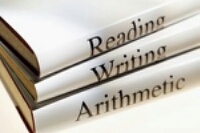
I have never been the biggest advocate of ‘three Rs’ learning (reading, writing, and arithmetic). For starters, whoever named the program clearly didn’t know how to spell (it’s r, w, and a, anyone with a basic capacity for anagrams could get ‘RAW’ from that).
Anyway, I think ‘RAW’ should be taught in the way that it’s used, viz. in the act of expressing ideas and investigating the world. Every time a new challenge arises that highlights concepts in maths or English this provides an opportunity for a deeper learning experience with much higher chance of retention.
Probably more important is the function that education is supposed to perform. Most people agree that education is intended to provide a degree of preparation for adult life.
The new skill set needed in the world our children are going to is radically different than it was when I was in school. Presentation and information processing skills are becoming vital components of so many careers, if we tried to teach this on top of the three Rs then they’d be on an eight hour day. Something had to go.
What do you think? Would solely concentrating on the three Rs in this new information orientated world be misguided? or do you stand by the more rigid education methods of the past?

 For over a year I’ve struggled to get my eldest to read independently. To be honest that’s not entirely true as he’d happily jump into reading Star Wars encyclopaedias at the drop of a hat. However, with the encyclopaedia, he’d put them back down after a page or two. It was pretty clear that we needed to track down a book that really spoke to him.
 Today I passed 12,000 words of ‘Thea’s Quest’. Chapter six is done and I’m close enough to my word-count target to feel fairly comfortable. It was a hard slog today (wrote almost 4,000 words) but I really feel like it was worth it.
 However, while I agree with the idea that reading with your children is a good thing, I’m not sure if I agree with the hefty role being given to word volume, or the assumption that parents should only care about test scores. It’s part of the growing inclination of so many to try and quantify childhood learning.
 When a child reads a story where a character loses their memories, they aren’t simply exposed to a vocabulary-building exercise; they have been given access to some fairly complex notions about identity. This might lead them to ask questions about whether we are the sum of our memories, or something more. In essence, books (and perhaps fantasy books in particular) provide simple, digestible ways of thinking about some pretty big questions.
 The abilities of a teacher are often assessed based on the test scores of the children they teach, but this can leave little room for some truly vital skills; like bolstered inquisitiveness, social understanding, and the ability to ground ideas within a real-world backdrop.