Tag Archives: reading

Neil Gaiman

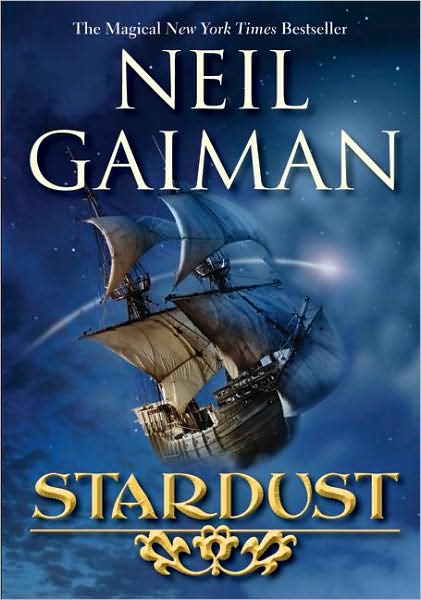
stardustDuring my wade through a world of words I somehow managed to finish Neil Gaiman’s book ‘Stardust’. To be honest I’m surprised that it took me this long to pick it up, it’s a fantasy book about a town that lies right beside an opening into the land of the fairies. Familiar as this sounds it’s miles away from my own books in plot, themes, characters, and most of all tone.

It’s a book that’s definitely not for kids and as fun as it was for me to read, at times it could be quite jarring to go from reading Gaiman’s work and then delving into writing the wold of Jack and Thea. Sure there’s magic, other worlds, odd creatures, etc. but ‘Stardust’ was so much more adult that I had to be careful to remember to tone down the themes in ‘Jack Reusen and the Children of Fate’.

I normally make a rule of not reading while I’m writing so that I don’t get caught up writing in somebody else’s style but I was half way through ‘Stardust’ when NaNoWriMo started and I found that I needed some type of diversion whilst writing this time. I think I managed to keep the books separate in my mind probably first and foremost because of the main theme of each. Where ‘Stardust’ is a stand-alone adventure into a slightly Victorian take on the fantasy genre, ‘Jack Reusen and the Children of Fate’ is a modern disaster novel set in a fantasy setting.

I feel like I’ve had a chance to play with some of my favorite movie genres whilst writing the Jack Reusen books. ‘The Fey Flame‘ is a world building book with a big villain but beyond that I’ve had a chance to play around with some other ideas. ‘Spark of Dreams‘ was my take on the zombie genre (but toned down a lot to cater for children of seven or eight years old and up). Next, in ‘Children of Fate’ we get an ‘end of the world’ themed story (don’t worry, everything is kind of alright in the end), after that we have what I’m thinking of as book three and a half, it’s a Christmas/Yule story and for now that’s all I’ll say about it.

Book four is all Thea’s, in many ways (and yes I know this sounds totally nuts) she seems to be helping me write it but overall it will be a quest, one that takes her through many of the other nations to be found in Fey, it’s a strange place and it’s becoming a huge pile of fun to research.

Anyway back to Stardust, if you’re a fantasy reader like myself I imagine you’ll get a kick out of Stardust. The one unusual aspect I noticed about it was just how rigidly Gaiman sticks to the ‘show don’t tell’ rule for writers. Basically we’re supposed to explain the worlds we create using the characters reactions and by highlighting that world using carefully described action sequences.

Ordinarily writers do a good job of this but in fantasy the rules are often relaxed. It’s not easy to build a world in the first chapter or two of a book without having to occasionally allow the narrator to explain what’s going on. J. R. R. Tolkien basically writes a history of Middle Earth in the first few chapters of ‘The Fellowship of The Ring’. It helps you get to know where you are but it’s not the easiest thing to get through.

To be fair to Tolkien he was writing his books at a time when the modern fantasy genre was in its infancy (Tolkien being it’s godfather after all). A lot of modern fantasy harkens back to Tolkien so in a way he was doing a lot of world building for all of us. That said we don’t all deal in elves, orks, dwarves etc. and even if they did there’s still a sizable chunk of the population who still wouldn’t know what these races are. As a result many modern fantasy writers still have to explain the people of their worlds and describe what they can do.

Gaiman doesn’t really do that, you simply see the characters do what they do and it’s up to you to gauge what they are capable of and to establish what power level they have. Sometimes when two characters meet for the first time it can be surprising to realise that you may have misjudged just what that character is. ‘Stardust’ is a fantasy book but if you’re expecting a big expository element in the first chapter or two you’ll be waiting a while, the story just starts and it’s up to you to keep up. It’s an unusual yet refreshing experience for a fantasy reader and I definitely recommend it (I should also point out again one more time: ‘STARDUST’ IS NOT FOR KIDS).
a-burden_cover_smlAnyway, thanks for reading, and feel free to add suggested reads in the comments below (I’m editing now so the ‘no reading’ rule has been officially dropped). Next up for me is Hiraeth: a Burden (the second book in the Hiraeth trilogy), again not for kids but definitely worth a read, it ‘s a modern-day fantasy set in Wales, Ireland, England, (and a wee bit of Scotland too), and focuses on an underground (not literally) group of Druids who hide their true nature by means of working for the lifeboats service.

Let us know if you’ve come across any particularly good reads, after all the nights are fair drawing in (I don’t really remember having a summer) and nothing completes a chilly night-in better than a good book. All the best, John


Well that was intense!

Camp-Winner-2015-Twitter-ProfileLast night I wrote a bundle of words, they were all in an arrangement that I liked and for people who read English they will hopefully make sense. However, probably the most important thing about those words (at least for the time being) is that one of them happened to be the 50,000th word I wrote last month!

Once again I’m a NaNoWriMo winner and now I have a third Jack Reusen book, a Jack Reusen Christmas special, and there’s even a first chapter or so drafted for the first book in Thea’s trillogy (though I was so tired by that point that I’m fairly certain I nodded off pressing keys so I’m not sure what that’s going to look liiiii8iuijjjjiiujujuijke).

Once again National Novel Writing Month was an even mixture of a total blast and ‘that thing that makes me feel like my brain is about to melt out of my eyes’. What’s more I’m now going to be fairly confused if someone tells me they like my new book. I may accuse them of hacking my laptop to get at one of these new early drafts.

I now know what happens to Jack and co. next, and after that, and even a little after that, so expect some mini spoilers and short stories set after Spark of Dreams to be appearing on here in the coming weeks.

Speaking of short stories, I’m also running a competition in conjunction with Fun Junction in the run up to the Crieff Arts Festival. If you know of any children who would like to create a character (either pictures, descriptions, or both) that has a chance of appearing in a Jack Reusen short story then keep an eye out on here for more details. The easiest way to stay informed is to either ‘like’ the Jack Reusen facebook page or follow the Jack Reusen account on Twitter.

Today I am alarmingly tired but happy. I hope the new instalments are a fun read when I get them out into the world. ‘Jack Reusen and the Children of Fate’ should be ready in October. Thanks as always for reading, all the best, John

Crieff Arts festival (Crieff Literary festival?)

crieff arts festivalI’ve just been asked to join an event at the Crieff Arts Festival on 22nd of August. By the sounds of it I’ll be first in a solid line-up of local authors and poets; starting at 10:30am with myself and culminating with one of our best known authors; Helen Grant. I’ll add the names of other authors and poets on here once I know more.

Helen has posted her own description of the arts festival, and what she’ll be up to, over on her blog if you fancy getting a bit of an insight (here’s the link). As for me I haven’t really decided what to do yet. The most obvious will be a reading but there’s a chance that there might be a few readers of the books along for the talk so I might split the talk between reading excerpts and answering questions.

My kids quite often get impromptu stories fresh out of my mind (some of them set in Fey) for bed-time but I’m not sure if I’m confident enough to do the same thing in front of a crowd just yet. Jess Smith (one of the other authors who will be talking at the event) is a live storyteller and I really admire anyone who can do what live storytellers do, there’s something really absorbing about that kind of storytelling. I don’t think this will be my storyteller début somehow, I’ll wait and see.

If you’ll be in the Crieff on the weekend of the 22nd and 23rd and fancy popping along to hear me blether away about Jack and Thea, and read a wee snippet from one (or more) of the books, then pop along to the Strathearn Artspace on the 22nd of August at 10am (that’s when doors open, my talk will be at 10:30). Hope to see you then, all the best, John

Crivens!

feegle3At the moment our house is enjoying a full-on adventure with the wee free men and their ‘Hag’ Tiffany Aching. Terry Pratchett’s ability to create a world filled with humour, excitement, intelligence, and heart is not compromised by writing for children. The Tiffany Aching series includes four (soon to be five) books, set in his iconic Discworld, and each book focusses on a young woman called Tiffany as she grows into a fine upstanding witch.

Out of my two my eldest is especially enthralled with the books. The first book (The Wee Free Men) went down a treat and he really got a kick out of the violent, loud, yet loyal and caring ‘Nac Mac Feegle’ (or ‘wee free men’). It’s a book series that I enjoyed myself years before I became a parent and there’s something really special about being able to share it with my kids now.

The thing that impresses me most is one simple fact that, in itself, shouldn’t be impressive: the main character is a girl. Every book follows Tiffany, sure the wee free men are there too, as are a few other male characters, but the character we follow through every page is Tiffany. This shouldn’t be a big deal but it is. So many books for children (my own included) focus on the adventures of a boy as the main character, and in most cases he’s also cast as the hero. It makes a refreshing change to see that a girl can be just as heroic, just as relateable for two young boys as any male protagonist (I feel I redeemed myself a little with Spark of Dreams, you’ll see Thea’s heroics near the end of the book).

Not once have my kids asked ‘but why is a girl doing everything?’ not once have they complained. Both my six (soon to be seven) year old, and four year old sons have barely noticed that they’re following the adventures of a girl. Perhaps it’s because this is one of the first chapter books I’ve read to them (smaller frame of reference), or maybe their generation has different expectations than mine did. Whatever it is, I’m getting a lot of enjoyment out of knowing that my two kids clearly know how brave, clever, and heroic girls can be.

I’ll be rectifying my own lack of a central female character in my books next year as I delve more into Thea’s story, and follow her on a voyage around the world of Fey. It’s in the planning stages at the moment, so very little is concrete, but I can’t wait to delve into the world of legends, mythological animals, and the downright made-up stuff that I’ve got planned for next year’s batch of books.

Tiffany-Aching-Poster-600x686In the mean time I heartily recommend Pratchett’s Tiffany Aching books (‘The Wee Free Men’, ‘Hatfull of Sky’, ‘Wintersmith’, ‘I Shall Wear Midnight’, and Pratchett’s soon to be released, final Discworld book ‘The Shepherd’s Crown‘). In the first book you’ll follow Tiffany as she meets strange little blue men, discovers she might well be a witch, and has to fight the Queen of the Fairies. I’m sure you’ll enjoy them as much as we are. All the best, John

The cavern keeper

8232497112_ddaba4ccc5_bHere’s a quick wee glimpse into a place that will be very important in book three. I hope you enjoy it:

These caves were his. It’s not like he actually owned them or anything, but in the same way that a town, a school, or a stadium can ‘belong’ to someone, these caves belonged to Magus Hypologismos (people called him Logi for short, you can see why).

Logi was no stranger to the outside world. As a young man he had toured the globe with a group of Lutin traders (we might call them leprechauns). They exchanged exotic wares from one country to the next, and Logi saw more of the world than he had ever expected. He had three favourite memories. There was the time he had been invited to hunt with centaurs in Laconia, riding onto their horsey backs and gripping onto their broad human shoulders for support.

Further east he had eaten a feast of spiced meats and rice with a genie, sitting in the desert sands around the fire-pits of Mishan. After the meal the genie had entertained him with displays of incredible magic making the sky dance with light and the moon change its colour to shine like a giant gold coin hovering in the sky.

Possibly Logi’s greatest memory was in fact the moment that began his adventure back home to the caves. Whilst sitting in a sanctuary in on the mysterious island castle of Por-Bajin, he was invited by a jadatski (rain master) to a modest dinner of pickled cabbage. They debated into the night, and right through to dawn about whether the golden scrolls of Kubai-Khotim were real.

The scrolls were said to be able to tell the future, and Logi had made it his mission to find them. Sadly in all the centuries that followed he had still never found them.

Logi had enjoyed a colourful life, but his travelling was over, and now these ancient caverns were his home. Books and scrolls weighed down the shelves that lined every wall. Orange lanterns added their flickering light, making the ancient texts appear to dance and move, almost as though they were alive. Logi often wondered if some of the movements really were just a trick of the light.

Logi took the stairs down to the deeper chambers, where the most ancient and powerful texts were housed. No one but the Magus (Logi himself) was allowed down here and he hadn’t had a request for any of these texts in centuries. All the same it was one of the most comfortable places available to him, and he often sneaked down here to sit in the huge throne-like chair and enjoy the peace.

Thick books with gilted spines surrounded him like dusty jewels, their leather dyed in all manner of colours. Logi sat back in the quiet, enjoying the rainbow of books flickering by the light of the lanterns. Then something moved, it didn’t just look like it moved; it really moved.

Logi stepped closer to inspect. It couldn’t be a creature of any sort; the enchantments protecting the library wouldn’t even let a dust mite down here without permission. All the same Logi knew what he saw, something had definitely moved.

In the silence Logi could even hear his shoes creak. A sudden ‘thwap’ echoed around the chamber as a thick scroll dropped onto the hard stone floor and began unravelling. Logi leaned in closer and was astounded to see fresh words appearing on the paper, as though being written from inside:

The families are reunited. The children of fate grow closer to learning their heritage but dark days are ahead and they may have to pay for the mistakes of their ancestors. One will return to claim these scrolls, and once again wield the knowledge of what is to come. He prepares even now.”

The writing stopped.

Logi sat down cross-legged on the polished stone floor and lifted the scroll, allowing a simple ‘Hmmm’ to escape his lips. All those years and the scroll had been right here under his nose the whole time. Whatever it had been up to seemed to be over for now. In the several hundred years that Logi had patrolled these tunnels (aside from the odd holiday), he had never once witnessed a book, or scroll, write itself. He didn’t have anything else planned that day, so he relaxed into a big leather chair, rolled out the scroll, and waited.

Hours passed, but Logi had centuries of experience in patience. The writing began again, it looked like some kind of heading this time:

What has come before…

After that the writing came quicker, Logi’s eyes struggling to keep up. As the story poured out in front of him, words escaped his lips: “What is a ‘TV’?” “Who is Tam?” and “This ‘macaroni cheese’ sounds amazing, I wonder where I might get some…”

Logi read on and on, getting more involved still. Perched on the edge of his seat he actually yelled out “Run Sparky! Run!”. He relaxed, things seemed better now, the characters appeared to be safe. He settled in and read on.

The writing slowed, the last few lines had been about three men getting on ‘motor-bikes’ (whatever they were), and heading for an underground library. Logi got the feeling he might find himself a lot more involved in the story very soon.

What Reading can do for you

(This post is also available to watch and listen to as a vlog/podcast. You’ll find it on YouTube and Spotify down at the bottom of this post.)

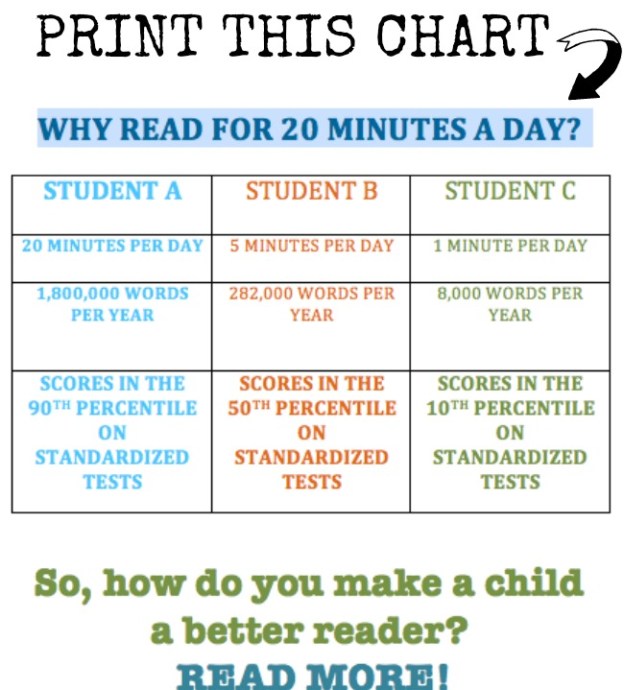
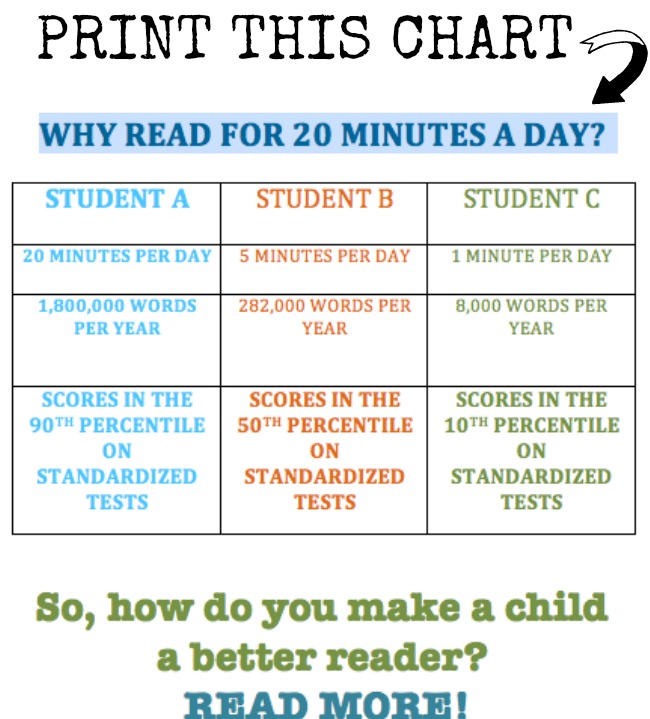
Read for 1 minute or less a day with your children and they may end up in the bottom tenth percentile! (But should you care?)

According to a number of educator resources and literacy advocates, children who read for around 20 minutes a day are exposed to as many as 1.8 million words per year, and this level of exposure is often linked to performance in the top 10% of standardised test scores. (phoenixacademyomaha.org)

While these figures reflect general trends rather than guaranteed outcomes, they do highlight the potential impact of regular reading habits.

Are test scores really the best gauge of childhood success?

I’ve seen this graphic (or something very similar) floating around the internet on a number of occasions. Often, the original context of these stats is lost and, instead, people (often parents) seem to see the higher test scores as the motivating call to action.

However, while I agree with the idea that reading with your children is a good thing, I’m not sure if I agree with the hefty role being given to word volume, or the assumption that parents should only care about test scores. It’s part of the growing inclination of so many to try and quantify childhood learning.

Of course, some skills are more quantifiable than others: vocabulary, memory, the ability to follow instructions (this list is far from exhaustive). In this sense, it’s easy to see how an increase in vocabulary and memory might improve test scores. However, there are so many more important skills that reading helps develop than the capacity to have great test scores.

Children who read find themselves exposed to other ways of thinking, other worlds, and other people, in a much more intimate manner than you find in any other medium.

“One in Five UK children don’t own a single book”

That said, for many children, access to books (or even the idea of owning a book) is far from guaranteed. In a related post, I explore recent headlines suggesting that one in five children don’t own a single book, and dig into the complex role that book ownership plays in childhood literacy. You can read that post here.

For families concerned about the cost of books or about limited living space, it’s also worth knowing that there are fantastic digital alternatives to physical books. In a separate post, I explain how you can access thousands of free books on almost any smart device (phone, tablet, even a PC). You can read that post here.

Reading does a lot more than improve test scores

The characters, ideas, plots, scenarios, and places found within the pages of a book do not stay there; they find a home inside your mind. It’s about as close to telepathic communication as we can get.

When a child reads a story where a character loses their memories, they aren’t simply exposed to a vocabulary-building exercise; they have been given access to some fairly complex notions about identity. This might lead them to ask questions about whether we are the sum of our memories, or something more. In essence, books (and perhaps fantasy books in particular) provide simple, digestible ways of thinking about some pretty big questions.
It kind of bothers me to see test scores held up as the pinnacle of childhood achievement. Test scores can be a great way of gauging a child’s engagement with their learning, but I’m a little dubious about regarding these scores as anything more than that.

A child’s ability to deal with the world outside of school will have a lot more to do with how much they understand, plus a host of skills that are even harder to quantify.

Academic skills are not simply the ‘Three Rs’

Many children will go on to opt for university or college at the end of their school career. Despite what they may assume, they may be surprised to discover how important it is to have a collection of skills that go beyond reading speed, vocabulary, and memory (the more testable skill set).

I tutored Philosophy undergraduates at Edinburgh University for four years (and was an examiner for one of those as well). It was amazing to see how often some students (who came in with less than stellar grades in high school) would somehow overtake their higher-scoring classmates. Often, this hedged on far less tangible/quantifiable skills than rote memory etc.

We wanted to see students demonstrate an understanding of the nuances of arguments; memorising facts and figures simply wasn’t enough (though it was, of course, valuable). What’s more, the ability to step outside rote learning and think for themselves enables students to create thought-provoking and insightful essays. I learned that high test scores aren’t always a clear indicator that someone will perform well, even in an academic environment.

Good teaching and the challenge of ‘soft skills’

The abilities of a teacher are often assessed based on the test scores of the children they teach, but this can leave little room for some truly vital skills; like bolstered inquisitiveness, social understanding, and the ability to ground ideas within a real-world backdrop.
Teachers do a phenomenal job at encouraging these traits, and many more beyond those. I’ve met a good number of these teachers on the various school talks I’ve done, and it always impresses me to see how well-rounded their pupils are in ways that go far beyond traditional testable academic skills. I’m not an expert on the curriculum, but I’m fairly certain that these essential skills will be hard to locate by looking at where a child falls within the ‘national percentile’.

If you’re a teacher looking for ways to spark those kinds of wider conversations, I offer free school author talks that tie reading into big ideas, imagination, and creative thinking. You can contact me to discuss a talk or workshop here. I’m also currently working on a new range of classroom resources that will provide free activity sheets (and more) to support classroom discussion.

Alongside my school talks, I write books that open up the kinds of big ideas I’ve discussed here: from friendship and imagination to questions about memory, morality, and identity.

The Jack Reusen series (for ages 6+) brings magical disruption into Jack’s everyday life, whilst Marcus (for ages 10–12+) explores darker themes of power and consequence, all through a fantasy lens grounded in familiar Scottish settings.

You can find out more about my books here, or read them on Kindle Unlimited (here’s my Amazon Author page).

Free Classroom resources as soon as they’re ready

I’ll post new literacy resources here as soon as they’re ready, as well as other updates regarding books and literacy. To be the first to hear as soon as they’re available, you can subscribe using the box at the bottom of this post. Simply pop your email address into the box, click ‘subscribe’, and you’re good to go.

Reading is more important than test scores

Of course, we should read to our children for twenty minutes a day, longer if we get the time. For some of us, it’s part of the ever-shrinking portion of the day in which we can spend time together, without necessarily having to deal with some kind of screen.

Not only does it allow you and your child to discuss all kinds of topics and issues, but it also gives you a few moments in which to touch base and enjoy spending time together.

Reading, at least in this context, has much more to do with maintaining relationships and learning about the world we share, than it has to do with building vocabularies and assisting in academic scores.

Reading shouldn’t be marketed as a fast track road to success (even if the numbers suggest it); it’s an activity that opens dialogue, builds relationships, and encourages inquisitive minds. In short, reading opens us up to all of the fantastic skills that make us human. It doesn’t just help us test well.

If you have anything to share about any of the issues I’ve touched on in this post please feel free to share your ideas in the comments, or over on social media (here’s the Jack Reusen facebook account, and here is my Instagram account).

Want to read more on the topic of the deeper positive effects of extended reading? You’ll enjoy this fantastic post by teacher librarian Krystal Gagen-Spriggs about the great effects of developing a reading habit.

Thanks for reading, all the best, John

The three Rs

image

My teachers were fantastic but there were limits to what we could do in the old curriculum. Things have changed a lot since I was a kid and, though I might be in the minority, I’m happy to see it.

There’s a lot more creative expression and personal engagement between children and their work. I’ve seen this at my son’s school and at my book talk at Our Lady’s in Stirling too. Across the board children are being encouraged to interact with their subjects on a personal level.

Not only are kids producing class demonstrations and talks but they’re also engaging with media via technology which offers a broadening of knowledge of their subject.

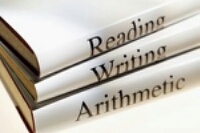
I have never been the biggest advocate of ‘three Rs’ learning (reading, writing, and arithmetic). For starters, whoever named the program clearly didn’t know how to spell (it’s r, w, and a, anyone with a basic capacity for anagrams could get ‘RAW’ from that).

Anyway, I think ‘RAW’ should be taught in the way that it’s used, viz. in the act of expressing ideas and investigating the world. Every time a new challenge arises that highlights concepts in maths or English this provides an opportunity for a deeper learning experience with much higher chance of retention.

Probably more important is the function that education is supposed to perform. Most people agree that education is intended to provide a degree of preparation for adult life.

The new skill set needed in the world our children are going to is radically different than it was when I was in school. Presentation and information processing skills are becoming vital components of so many careers, if we tried to teach this on top of the three Rs then they’d be on an eight hour day. Something had to go.

What do you think? Would solely concentrating on the three Rs in this new information orientated world be misguided? or do you stand by the more rigid education methods of the past?