Category Archives: reading and literacy

Story Ideas: Places

For the past few weeks, I’ve been adding a podcast to my range of content. This post is directly linked to this week’s episode titled “Story Ideas: Places”, where we look at a quick and easy way to jump-start your creative juices.

By the end of the activity, you should have a full story written up, and we’re also encouraging pupils to submit their stories to be read on the podcast (details on how to do that will be available below). With this in mind, I hope you enjoy this writing activity and read to the bottom to find details on how to submit your story to be read on the podcast.

Writing Activity Resources

Teachers
This week’s writing activity is pretty simple, but it should prove useful for those moments when a story simply isn’t coming to you. There are classroom sheets to go along with this activity. You can click here for a direct link to the Canva presentation, or download a PowerPoint version here.

Pupils/ Students
The activity sheets for this writing activity are pretty simple, and are designed with the expectation that there will be additional jotter or digital writing as well. A black and white version is available here, a colour one is available here, or you can get access to a Canva project edition (that you can edit) here.

Play along podcast episode (if you prefer)

You can play the accompanying podcast episode alongside the classroom presentation. I’ll call out the next section so you know when to change slides. (In future episodes, I’ll try to be more direct about this with something like ‘turn to the next slide’ after each section).

You can also pause at the end of the prompt on each slide to leave time for writing. All in, this will probably add up to about a 1-hour classroom activity. You’ll find the Spotify version of the podcast below, and links to it on other podcast platforms in this linktree.

On With the Activity (From here on out, this will match the content of the podcast)

Today, we’ll be looking at a writing exercise that focuses on setting and place in your storytelling. With this in mind, I thought I’d try something a bit different and begin the episode by reading the first chapter of my first book, “Jack Reusen and the Fey Flame”.
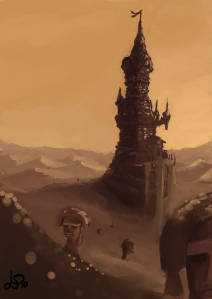
In this chapter, I played with the idea of setting. First, we look at how familiar places can become uncomfortable when we notice things that we don’t remember seeing before. Then, we look at what it feels like to feel lost, truly lost, and what our reactions to this feeling can tell us about ourselves.

You’ll see the meaning of the setting change a few times in this chapter. I hope you enjoy listening to the sample chapter, but whilst you listen, keep an eye (or ear) out for any times where the setting is moving the story forward.

(You’ll get the full chapter reading in the podcast episode. If you’d like to read the rest of the story with your class, you can also pick up a Kindle copy by following the links at the bottom of the page for purchasing, or reading for free through Kindle Unlimited, on Kindle in your country.)

The Writing Challenge

You’ll have seen a lot of focus on setting in the little excerpt I’ve just read, and now it’s your turn to experiment with a story setting.

You’ll have a full story by the end of this activity, but the direction we take may be a little different from the way you normally set up a story and I hope you enjoy it.

Story Ideas: Places

Being creative is a really useful skill in life (not just for storytelling) so learning tricks and techniques to get your creative side working is never a bad thing.

Today, we’re going to look at a quick technique that I use. It should help switch on that creative part of your brain and prepare you to create a fantastic story.

We’ll start with place as it’s sometimes neglected a little in storytelling. Starting with the place can sometimes launch you into a new story in unexpected ways.

Part 1: Somewhere different

Think of where you’re writing right now. Is there a place that could be the most opposite you could possibly imagine? Somewhere absolutely nothing like where you are sitting at this moment?

What is that place like?

What’s the weather like there?

Is it a safe place, or is it somewhere perilous?

If you were to sit down and write in this new place, what would you be writing with?

Would it be a scroll of paper with a feather quill and a bottle of ink, or would you be writing on a futuristic tablet with an AI that talks to you as though they’re the cleverest being in the galaxy?

Part 2: A stranger

OK, now you know a lot about this new place, so let’s take a look around and see if there’s anyone there.

Who are they? Are they a human/ an animal/ an alien/ or something else?

What are they doing?

What mood are they in?

You now should have a setting and your main character. This isn’t everything you need for a story, but it’s a good start.

Part 3: Getting to know people
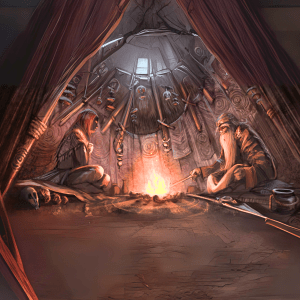
Now ask your character a few questions. What are their interests? What are their skills? What are their main fears? What would they like to be doing this time tomorrow?

Take your time with your character. Ask weird questions, but even ‘boring’ questions can give you ideas for your story. What might your character eat for breakfast? Where do they sleep? You might be surprised at the direction their story takes.

Part 4: Go and write

You now have two out of the three basic parts of a story; the last one is called ‘plot’.

What will happen to your character next?

Will something surprising happen to them?

What will they do as a result?

Will they be happy in the end?

Write your story in a digital format, or in your best handwriting, or draw some amazing pictures to make up a ‘comic book’.

When you feel your story has reached a natural end, please be sure to share your stories on the Celebrating Stories portal.

As the weeks go on, we’ll start reading one or two of your stories on the podcast each week.

You’ll find links to share your story on the classroom slideshow, which you can download over on the website. Alternatively, you’ll find a link to it in the episode notes for this podcast episode.

Your story could be the next one we read on the podcast!

Go here for the Google Form to submit your story (click this link). You can share handwritten stories, digital text versions, or even pictures.

Thanks for popping by

As always, thanks for tuning in to listen to this week’s episode of Lit Up With Green Flame, and for coming here to read the more extended version on the website. If you haven’t already, please don’t forget to subscribe on your favourite podcast platform.

We’re on Spotify, Apple Podcasts, Audible, Amazon Music, YouTube Podcasts, and many more. Just go to your favourite podcast app and search for ‘Lit Up With Green Flame’ (click here for the linktree that lists how to find us on your favourite podcast platform, just click on ‘Lit Up With Green Flame Books Podcast’ button to find the link). Subscribing is free, and you’ll be sure to catch the newest episode as soon as it’s live.

I hope you pop back next week when we’ll be looking at the strange world, and wild life of Roald Dahl (since it’ll be his Birthday in just a couple of weeks, he would have been 109 years old this year on the 13th September).

Also, if you’d like another writing activity to try, you could look at the one we did on Magical Realism a few weeks ago. You’ll find a link to that here.

Thanks again for listening in, and I hope you don’t mind the slightly longer episode this week.

All the best, John

Illustration of a child learning empathy through reading, symbolised by a thought bubble with diverse characters.

Reading Fiction is Reading Minds

How Shared Stories Make Children More Empathetic Writers

(If you’d prefer to listen to this post you can find the corresponding podcast episode below)

Imagine I told you that there’s an activity that increases a child’s empathy, whilst enriching their job prospects and life satisfaction, and that this same activity can even positively influence their earnings later in life. Most parents would want to sign them up straight away.

It turns out that there is an activity like this. It has more impact than playing a musical instrument, or playing sports, and it’s probably easier to access than either of these: reading fiction.

In 2013, Claire Crawford and Jonathan Cribb analysed four decades of data following children from their early reading habits all the way into adulthood.

The data came from following those individuals as they grew and entered the workforce, all the while tracking their reading habits and their life experiences. (“The Link between Childhood Reading Skills and Adult Outcomes: Analysis of a Cohort of British Children”, Crawford & Cribb, The Institute for Fiscal Studies, April 2015)

Basically, they found that those who read fiction as children (and beyond) get statistically more out of life than those who don’t. Readers of fiction end up in better jobs, have better relationships, and feel generally better about their lives than those who don’t read fiction. This result is actually even more noticeable in fiction readers from lower-income backgrounds.

The results of the study are pretty interesting. I’ll try to avoid getting too into the weeds about the data here, but their findings could help inform the way that educators and parents look at reading, and the reading of fiction in particular.

The study found that children who read fiction regularly tended to show noticeably higher empathy and social intelligence than those who rarely picked up a story. Changes in soft skills like these don’t just impact school life, they can ripple through a child’s friendships, social confidence, and even their overall happiness as they grow. As the children aged, their answers showed that this was definitely true.

And it wasn’t just any kind of reading that resulted in this change either. It was the reading of fiction in particular that had the strongest and most consistent effect. An effect that exceeded that of reading non-fiction.

In 2018 two other researchers (Dodell-Feder & Tamir 2018) pulled together the results of fourteen separate psychology studies to get a more detailed view of the effects of reading fiction. Their results further confirmed that reading fiction has a noticeable effect on empathy scores. (Dodell-Feder & Tamir 2018, you can find a link to this paper here).

So what does this mean for young readers? A couple of weeks ago, in the podcast, we looked at  the multitude of benefits of reading (beyond simple test scores). Combining this with the data just discussed, I thought that this time, we could hone in on two interrelated benefits of reading fiction: empathy and community.

What do we learn from our reading journeys?

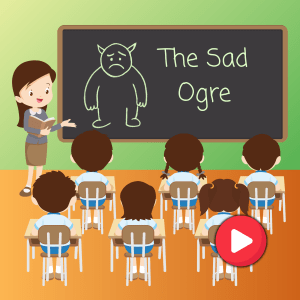
Teaching empathy through stories that challenge expectation, like a sad ogreIn what follows, you’ll see that writing from different perspectives typically comes more easily to those of us who read fiction. Possibly more than any other factor, reading has a huge ripple effect on both your ability as a writer, and on you as a person.

One skill that’s of vital importance to writers (young and old) is the ability to understand the lives of your characters. This is a lot easier when you’ve ventured into reading stories with a diverse group of characters first.

This is supported by the research as well. ‘Soft skills’ are one of the most noticeable gains from reading fiction. All of the research found links between reading and key soft skills like communication, teamwork, and creative problem-solving. These skills will make you into a better writer as well. The added bonus is that they give children tools they can use in every area of life, from conflict resolution to collaborative projects.

So, does being empathetic make you a better writer?

This is where I’ll have to become more anecdotal because it’s too hard to get people to agree on what makes someone a ‘good writer’.

What I can tell you, as a writer myself, is that the more you can empathise with other people, the easier you’ll find it to write your characters. What’s more, you’ll have the confidence to try telling the stories of people who may be quite different from yourself.

I love to people watch, and apparently, I’m not alone. It’s probably one of the most common shared traits that other authors have noted in conversations with me.

People-watching is a real-world behaviour that feeds into an author’s fictional ‘cast list’. You might see an authoritative mother at the supermarket with a crowd of high-energy kids to pull into order. The next thing you know, you’re picturing her as a magical part-polar-bear person. Mother to a brood of little part-bear-part-human kids rolling around and playing on a forest floor.

A stylised version of a reader connecting with characters through books.Reading fiction takes this love of people-watching and turns it up to eleven! You get right inside another person’s head. You follow them on a life-changing adventure. You share their sorrow and their success, and you both come out the other side, changed by the experience.
“All the arts depend upon telepathy to some degree, but I believe that writing offers the purest distillation.” (Stephen King, ‘On Writing’)

It doesn’t surprise me that reading leads to more empathy because reading an author’s work puts you inside their mind. They may speak through characters, but they are also telling you some of their deepest secrets and sharing some of their most private ideas.

Stephen King is an interesting case. He grew up in a low-income home, where his mother was left to care for King and his big brother David. Stephen and David were keen readers and eventually aspiring writers who actually printed their own local newspaper as children (when Stephen was around 12 years old).

The studies described at the start of this post seem to underscore Stephen and his brother David’s entrepreneurial tendencies. Children from lower-income households demonstrated the most clear and profound positive effects from reading fiction out of all the groups in the Crawford & Cribb study.

A Therapeutic Twist on Reading

In fact, there’s even growing interest in the therapeutic use of fiction (though it’s still a developing field). Some clinicians are exploring how reading about characters who work through challenges and traumas might support those facing similar struggles. A recent Times article takes a closer look at these story-driven therapy techniques. You can read that piece here.

The basic idea is that the therapist, in effect, prescribes a book based on your own particular emotional and behavioural needs. I can’t claim any more detailed knowledge about whether this sort of therapy is effective, but it does sound intriguing.

The Crawford & Cribb study notes that children who read fiction had higher life satisfaction, stronger resilience in the face of challenges, and better mental well-being well into adulthood. With this in mind, it’s relatively easy to see how reading a more prescribed list of fiction might help with specific problems.

Stephen King wasn’t wrong when he compared the exchange of ideas in fiction to telepathy. However, the telepathy stretches further than the author and the reader.

Meeting a fan of a certain book is like meeting a fellow traveller

Now comes the weird and wonderful bit about fictional worlds. Imagine a fairly common occurrence: meeting someone who has read the same book as you, and then really think about what that means (if Stephen King is right).

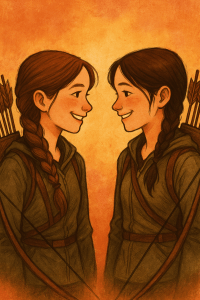
Two readers dressed as Katniss Everdeen smiling at each other, representing shared fictional experience.If you’ve ‘visited’ a fictional world and someone else has also visited that fictional world, then you have something odd in common, and with it, you both share a novel way to connect and understand one another that those who haven’t read that book lack.
If this stranger goes on to tell you that they feel a connection to a certain character, you can already start to understand what sort of person they are. Purely by knowing what it would mean to like that character, you can unpack some ideas about who this stranger is at their core.

Here’s a simple example: say someone strongly identifies with Katniss Everdeen from the Hunger Games series. You might infer that this individual feels inclined towards taking on responsibility; they may have a very serious, practical, grounded view of the world.

If they reference particularly telling scenes from the book, you might learn even more about them and update your view of them accordingly.

Shared experiences like these help you connect in quick and comfortable ways. It feels safe and natural to communicate with someone we see as like-minded. The Crawford & Cribb study describes this as a form of ‘cultural capital’.

It’s strange to think, but a shared interest in Michael Crighton’s Sci Fi, or Bridget Jones’ diary for example could be the difference between making a connection with a superior at work and blending into the rest of the workforce.

Mind-reading using alien worlds

This ‘cultural capital’ is really unusual but sort of amazing. At no point have either of you talked about any ‘real’ place or any events that ‘really’ happened, but still, you can gain a qualitative understanding of the person you are speaking to.

You’ve both ventured through the same world, with the same characters, on the same adventures. When you talk with someone about these things, their reactions to these people and events let you know real things about this stranger. You might get a feel for subtle things like their moral code, their sense of humour, their values, and their tastes. All in a comfortable and surprisingly fast exchange (it could be as simple as “What Hogwarts house would you be in?”)

In short, the fictional world you both share increased your empathy but also gave you an instant shortcut in the way you can get to know others who have visited the same fictional place.

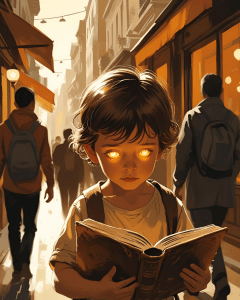
A whimsical image of a reader with glowing eyes, symbolising how reading fiction gives you 'telepathy'.Not everyone is an extensive reader, but you could be, and in visiting more worlds, you increase the odds of having read a book that another stranger regards as their favourite. You increase your mind-reading power with every fictional world tour. With every strange adventure, you open up the possibility of making a connection with someone at lightning speed.
With such a powerful key to so many different minds, why wouldn’t you read all the fiction you could? (If access to fiction is tricky, this post shows you how to get free books on almost any device.)

Applying the Mind-reading to yourself

When you turn the lens in on the strange worlds that appear in your daydreams, your imaginings, and even when you play out a different way that you would have liked an uncomfortable situation to have gone, you create a tiny fictional world. When you expand it and try to tell that story, you open up the same mind-reading power on yourself.

Writing like this will make you much more aware of yourself, and if you’re lucky, much more comfortable with yourself. What’s more, if you read more fictional worlds, and meet more fictional characters, you furnish your own imagination with even more scenes and characters to blend together and create a new place, a new character. You give yourself the chance to make even better stories.

The evidence is pretty clear, and my own personal experience backs this up; read more (and write more) and your life gets better. Visiting all of those imaginary worlds is like a literal golden ticket to a happier, more fulfilled version of yourself.

Know a few young people who might enjoy an in-class writing workshop or a free book talk?

John Bray leading a school author talk in Perthshire with engaged children.I run free school author talks that aim to unpack the empathy, imagination, and big ideas that help make the best stories.

If you’re a teacher looking for a fresh way to open creative conversations in class, I’d love to help. Simply click this link for details about my free author talks and writing workshops, as well as contact details.

Thanks, as always, for stopping by.

All the best, John

*Enjoyed this post? You can subscribe for updates using the box below, or check out my books for young readers by clicking this link.*

Green Flame Books: The Power of Reading Week long discussion

Is reading for 20 minutes a day the ‘magic ticket’?

Reading for 20 minutes a day is often linked to better academic results, but what’s the science behind it?

Is there more to the story than test scores? And how big a deal is book ownership when it comes to childhood literacy?

This week’s Green Flame Books discussion dives into the power of reading and why access to books really matters. We’ll start tonight with a focus on “What Reading can do for you”: a post about the power of reading and why it’s not all about test scores.

You can also watch this post as a vlog on YouTube or watch or listen to it on the podcast on Spotify, listen here or click through to watch/listen on your app of choice:

Scroll down for a quick overview of the other topics we’ll explore together this week. Then join the chat on the blog and Instagram to share your thoughts.

Never Miss a Moment

Love a topic below? Tap the button to add ‘Green Flame Books: Literacy Discussions’ to your calendar.

You’ll get gentle reminders all week so you can join the conversation when it suits you best.

Click here to add the Green Flame Books calendar

Mon, 28 July

📖 Blog: Is 20 minutes the magic number?
Do test scores tell the full story about reading?

Tue, 29 July

📸 Instagram: Who Gets to Own a Book?
Let’s talk about book access—past and present.

Instagram posts page

Wed, 30 July

📸 Instagram: Book-rich or Book-poor?
Can digital books close the literacy gap?

Instagram posts page

📖 Blog: 1 in 5 UK kids don’t own a book
Could buying a book change a life?
📸 Instagram: Reading Lets You Share Worlds…
Which stories built your closest bonds?

Instagram posts page

Thu, 31 July

📸 Instagram: What Stories Do You Carry?
What tale from childhood has stayed with you?

Instagram posts page

Fri, 1st August

📸 Instagram: Which Story Opened Your Eyes?
What book helped you understand others?

Instagram posts page

📝 Instagram Prompt: Write about someone who loves what you hate
Can a character change your mind?

Instagram posts page

Sat, 2nd August

📖 Blog: Reading Fiction is Reading Minds
How shared stories build empathy in writers.

Sun, 3rd Aug

📸 Instagram: Why Do We Want Kids to Write?
What motivates young writers today?

Instagram posts page

To add the calendar to your own and join the discussion

Join the Green Flame Books Literacy Discussions Calendar

Alternative link to download an ical file if the one above link isn’t working

Good Gracious it HAS Been a While!

Jack Reusen and the Chilren of Fate sneak peek cover 2I have been away from here for far too long. The perfect proof of this occurred to me a few weeks ago when someone who had attended one of my first-ever school talks (as a pupil) drove past me in Crieff High Street in a learner car.
Not only does that make me feel ridiculously old but it also highlights just how long I’ve been working on getting book three of the Jack Reusen series done. So I thought it was time for a very frank and honest update.

As of this afternoon, I am editing p167 of 202 of the final (post-editor, so it better be final) draft of Jack Reusen and the Children of Fate.

Karen, the illustrator has created a stunning cover for the book as well, and I’ve been in communication with the printers regarding pricing and print times for the first run (the first run of prints unfortunately always costs more and takes longer).

(Spoilers for book 2 ahead…)

This new addition to the Jack Reusen world follows Jack after he, his family, and his uncle’s cottage and garden landed in the heart of an ancient magical woodland within the world of Fey.

You’ll get to spend longer in Fey than you have in any previous Jack Reusen book. You’ll meet a strange new character who seems to be following Jack from inside his own mind. What’s more, you’ll get to learn more about Fey and how it’s connected to the Matter World. It’s a big story without being too big a read and I hope you enjoy it.

(…Book 2 Spoilers END)

There are twenty-one chapters in this new book (if you include the epilogue) and I’m currently editing chapter sixteen. I’m getting through about a chapter per day and I have some time off work so I may even get through more than that.

So, with only five chapters to go, I think it’s safe to say that I should be finished editing by the end of this week.

After literally years of plodding through drafts, I can’t believe I can say that the book will be ready in a week!

Jack Reusen and the Chilren of Fate sneak peek coverPrint turnaround can be as much as a month. However, as soon as I can get it uploaded, the book will be available digitally to read via Amazon Kindle (you can either read this on a Kindle reader or you could download the app and read it on any Android or Apple device).
I’ll obviously be back on here at each step of the process to keep people updated (especially once there are print copies available too). However, I promised myself that today’s post would be brief and to the point so that I could get back to work on the editing.

Wait What’s Happening?!

In brief:

The final draft of Jack Reusen and the Children of Fate will be done by the end of this week.

The digital edition should be available sometime next week.

And finally, at long last, the paperback edition should be available to buy in late April.

More to come…

fey-flameExtra Note: I also have plans to get an audiobook version of the first book out. This would take the form of either a podcast or an Audible audiobook, to be released sometime in the next few months. This is dependent on getting my office/ recording space in proper order so expect updates on that too.
For now, thank you so much for stopping by and please accept my apologies for the long (long long long…) wait for this next book in the series.

I hope you enjoy reading it as much as I have enjoyed writing it. It’s been a labour of love. The first version was very long. The delay has mainly come from trimming it into the reader-accessible version we now have.

I always want to create books that are as accessible to as many sorts of readers as possible, and I am really happy with the story we have now.

Thanks for stopping by, below you’ll find the mandatory self-promotional book plugs but you can skip these if you’ve already read the stories so far.

Thanks for stopping by and I’ll be much quicker to get back on here again next time,

All the best, John

***

Read my books digitally for FREE

reading reader kindle female

Photo by freestocks.org on Pexels.com

If you’d like to catch up on the first two books in the series you’ll find details on where to get these digitally (and potentially read them for free) below.

As always, you can get hold of print versions of the first two books from Fun Junction Toy stores, as well as by buying directly on this site (I’ll even sign a copy for you before it’s posted out). To buy from this site using PayPal, follow this link and click on the buttons for the books you’d like to buy.

Kindle Unlimited

All of my books are free to read for those with an Amazon Kindle Unlimited membership.

Kindle Unlimited currently offers a free trial for two months so you can see if you like their service.

After that, your membership would cost just £7.99 per month and you can cancel any time you like (including before the end of your two-month trial membership.

You said I could read your books for free?

Both of my main children’s fantasy books (The ‘Jack Reusen’ books, for 6 and up) are available on Kindle Unlimited. Here are the links for Amazon UK for ‘…Fey Flame‘ and for ‘…Spark of Dreams‘. On top of this, you can also find a short Christmas story I wrote a few years back, as well as my dark fantasy book (10-12+) ‘Marcus‘ (set in and around the old abandoned Victorian school in my home town of Crieff).

These are all available to read for free (even as part of your free trial) with Kindle Unlimited. What’s more, it’s always good to know that people are reading (and hopefully enjoying) my books.

If you’re in the USA, Kindle Unlimited has a similar free trial and you can find all of my books on my Amazon Author page.

A little more about my own books:

Once you’ve signed up to Kindle Unlimited, you’ll see that both of the Jack Reusen books come up as ‘free’, so you can read the whole adventure so far, for nothing.

Jack Reusen and The Fey Flame‘ introduces you to the land of Fey, as creatures (and other things) make their way through to the ‘matter-world’ (basically our world). Jack and his family have to discover a way of closing a collection of ‘breaches’ between the two worlds to make their world safe again.

*

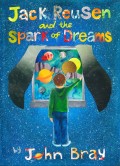
cover with blurb and barcode 2 trimmed‘Jack Reusen and the Spark of Dreams‘ is a slightly different kind of adventure. People are losing their ability to dream. Every night more and more people lose the certain something that makes human beings so good at solving problems and creating things; the spark of dreams. Jack discovers that he could be the key to understanding what’s causing this change, and he may even be the only person who can solve it and bring back the dreams and imaginations of hundreds of people.

I hope that both of the Jack Reusen books give you and/or your kids something to enjoy as you read them. Let me know what you think.

As always, thanks for stopping by my site, and I can’t wait to share even more details of my newest book,

All the best, John

5 Huge Benefits of Using Google Docs for Writers

wp-16647885873378466379242986409189

I have a feeling you might scroll past this but if you’re a writer who has trouble finding time to write then please don’t! I used to be pretty dedicated to my ‘old faithful’ word processing software too I get it, but please read on.

Like me, you’ve probably been using the same application for years. After all; it’s familiar, your previous work is all formatted that way, and you can’t be bothered learning a new thing when inspiration hits. You just want to write.

I’m not going to try and convince you to switch permanently but I want to briefly highlight how useful Google Docs can be for writers. Over the past couple of months, I’ve been able to get a surprising amount of extra work done and this is thanks, in no small part, to Google Docs.

Quick Disclaimer (By the way, I haven’t received any payment or any other benefit from Google for this post. I genuinely find it useful and thought that other writers may find it useful too)

Before I start the proper list I’d be foolish to skip one of the most obvious benefits; it’s free. I’m not going to list this as one of the ‘real’ benefits, mainly because so many other excellent word processing programs/ apps are available for free as well.

My all-time favourite free word processing program/ app is still OpenOffice. It has a layout similar to a very early Microsoft Word and also comes with the added benefit of customisable predictive text. This means that a suggested word will come up from your custom dictionary and you simply hit enter to have the word typed into the document for you (a massive time-saver and writing-speed boost).

However, recently I’ve come to realise that there are some clear and distinct features of Google docs which combine to offer a really unique and useful writing experience for me (and, I would imagine, any writer). Here’s the list:

1. Access anywhere

Munro perthshire scotland green hills mountains write anywhereI used to text myself notes whenever I was out and about and had a flash of inspiration. This was my simplest way of keeping track of my writing when I couldn’t access the actual document.

Notebooks didn’t work for me as I would always forget to bring them with me when I left the house. I have a drawer of lovely, special notebooks with attractive covers and a comfortable feel. All of which were purchased whilst out and about, only to be filled with a page or two of notes and then forgotten the next time I left the house.

Google Docs are in the cloud, I can access them using any device (including my phone) at any time. I have separate folders for different projects. Inside these folders are various documents with notes on the plot, characters, etc.

If I have an idea now, I can open the relevant document on my phone and add the note to the correct place. This saves me wasting time hunting through text messages or handwritten notes for that idea I had last Thursday or, worse still, losing ideas completely.

Losing ideas completely!? That brings me to the next brilliant feature…

2. Always saved

polar bear and cub scotland highland safariWhether your PC goes on fire, you drop your phone in the toilet, or your tablet is stolen by a rampaging bear. All your work is still safe.

When I was working on my master’s degree we were all given MacBooks by the university. They were great, (and, you know, free), so I fired it up and got on working on my thesis, saving everything I did in that one portable, easy-to-use device. Then it died…

Three months of notes, saved sources, and around a chapter of my written thesis were on that hard drive and apparently (according to the university tech guys and the Apple folk they spoke to), no force on this earth could bring them back to me.

For a month I looked for options. Then for another month, I learned a lot more about how laptops (and hard drives) work. With the help of online message boards and hints and tips from a few really nice computer experts, we managed to discover a way to hack into the hard drive and get some of my files back using a different operating system running from a USB drive.

Overall, (even with the online help) it was a nightmare to fix and it used up a significant portion of my time and energy, only for me to retrieve a fraction of what I had. I never looked at saving my work in quite the same way after that.

From that point onwards I was meticulous about saving copies of work. My work is now saved in multiple places and in multiple ways (I also vowed to myself that I would never use another Apple product, but that’s a whole different thing).

For many years I’ve saved a copy of all my books (and draft projects) in a Google Drive folder, a Dropbox folder, on my personal PC, on a backup hard drive, and on a USB stick. I also have at least one full printed copy of the first draft kicking about the house for beta reading and editing. It seems like overkill, I know it’s overkill, but I don’t care.

However, the one downside of all these copies was that, despite all the different storage locations, I could only edit the document on my home PC as the format was for OpenOffice.

Fast forward to my switch to Google Docs: I now save a copy of each book in the Google Doc format as well. It’s a little slower to load for reading but the upside is that it’s fully accessible for editing on any device (as I said above). This means that I have a safely stored copy of my current work in progress that automatically gets saved the second I make a change to it.

So long as I’m connected to the internet I can edit on the go. If I close my device my work is still saved right up to the moment I last edited it.

In fact, Google Docs even helps me with my edits:

3. Google Docs has Grammarly built-in

There’s a streamlined, free, beta-test version of Grammarly built into Google docs.

It catches basic spelling errors and also gives you hints about four key measures in your writing.

google docs grammarly colour color coded writing suggestionsIt will tell you whether what you have written would score high on correctness, clarity, engagement, and delivery. Each hint they give you is colour-coded to highlight which area will improve with the suggested change.

I haven’t yet, but you can also go ‘premium’ with Grammarly (for an additional charge). Those premium features will also be added to your Google Docs experience. This would offer you more comprehensive insights into your writing, along with deeper explanations regarding grammar and style suggestions.

As I say, I haven’t subscribed to Grammarly’s premium features. I feel that what you get is just enough to help without getting in the way of your writing.

After all, I use a real-life, human editor for my books who can help me fix much (much) more than the issues that Grammarly premium would spot.

Importantly, I also prefer to have a pair of human eyes take a look at my text (computers will always miss something) so I would be paying for an editor anyway.

4. Notes

google docs contributors adding comments to your workThere are multiple ways to utilise the ‘notes’ feature on Google docs but one of the most useful is the collaborative option.

So far I haven’t used it this way with my books but I have used it on copy with my copywriting clients multiple times. You can invite multiple users to access your document and add notes.

The editor for my books prefers to work with a paper copy. I understand her thinking, paper copies offer a distraction-free reading experience. On top of this, a paper copy allows you to write notes on top of the text itself.

However, if you were working with someone who is happy to work digitally the notes option is a fantastic real-time resource for suggesting and tracking changes to your document.

5. Compatibility

google docs text file formats available to export or downloadSpeaking of collaboration, if you need to have multiple people access your document Google Docs is a great option. You don’t need them to download software, they simply go to the document link you provide them and log into their Google account to access it.
From here anyone with an internet browser can read, comment on, or edit your document (depending on what level of access you give them).

This said, there will always be a stickler out there who prefers a particular document format. Fortunately, you can cater to them as well, as Google Docs allows you to save your work in a number of different formats.

This means that you can easily turn your text into (most) recognised document formats, as well as save your document into epub format (meaning it could be read on an e-reader such as a Kindle).

That’s pretty much it!

I’ve had great experiences so far using Google Docs for parts of my day job (the copywriting bits at least), and this year I’m starting to make use of the benefits of using it for bigger projects like my books.

Limits! (It can get a… bit… slow…)

Snail Race

‘Snail race’ by Noj Han at Flickr

There is one drawback which I’ve already hinted at. Currently, Google Docs is a bit slow and clunky with larger documents.

Once I pass around a hundred pages I definitely see a slow-down in what Google Docs can handle. However, it still works and still offers all the features I’ve mentioned above.

For the most part, I write children’s books. Most of my books are fifty thousand words or less. However, even at this, I can see some slowing. If your work is longer than this I might suggest saving your book as separate chapters and editing each one individually.

Having a newer device with a faster processor and more memory for your web browser to use will apparently help.

However, in my case, the problem seems to persist to a certain degree on all of my devices (no matter how new and/or powerful) so some of the problems are likely on Google’s end. I like to hope that any server-side issues will eventually be improved by Google as well.

As I said at the start, I don’t expect anyone to change from their favoured software. Nonetheless, I’m also all about helping make it easier to write (for myself and other writers), so I hope you give Google Docs a try. If you do, please pop back and leave a comment about your experiences.

As always, thanks for stopping by my site,

All the best, John

Fantasy and Adventure FREE on any device

Photo credit: Shoe Lane library via Flickr

Do you love leaping into strange new worlds with just a glimpse at words on a page? Then read on…

As I said in a previous post, a lot of children in the UK report not owning a single book. Whilst I love an old-fashioned physical book, sometimes the digital equivalent can offer space-saving and cost-reducing components.

The average ebook tends to be considerably cheaper than its paper equivalent. In fact, many classic books which have fallen into the public domain are actually entirely free to download to your device. (Are the classics more important than contemporary fiction? Pop over here to join in the debate). Whether you have a Kindle e-reader or not you can read any book in Amazon’s digital Kindle book catalogue.

Basically, if you have the equipment to view this blog post, you have the equipment to read a kindle e-book.

I’m not the biggest fan of every aspect of Amazon but their Kindle library is one thing that they’ve done remarkably well.

Don’t have a Kindle e-reader?

Kindle_UnlimitedIf you don’t have a kindle it’s no problem. So long as you have something that can run the kindle reader app (click on the link for a list of devices and how to use the app on them) then you can get hold of any book in their library.

Just the classics?

As I say, many classic works are free to read already but on top of this, you can also read thousands of contemporary books for free as well using a Kindle Unlimited membership.

They currently offer a free trial for two months so you can see if you like their service. After that, your membership would cost just £7.99 per month and you can cancel any time you like.

That doesn’t make sense, how do the Authors and Publishers make money if I read the book for free?

Kindle Unlimited doesn’t pay the Author the same as a digital purchase but it will pay them a small percentage of the pool of all Unlimited membership fees, depending on how many pages someone reads from your book.

For example (with a shameless self-plug for my books) all of my books are on Kindle Unlimited. (You’ll find proper descriptions of these at the bottom of this post).

Both of my main children’s fantasy books (‘Jack Reusen and the…’, for 6 and up) are available on Kindle Unlimited. Here are the links for Amazon UK for ‘…Fey Flame‘ and for ‘…Spark of Dreams‘. On top of this, you can also find a short Christmas story I wrote a few years back, as well as my dark fantasy book (10-12+) ‘Marcus‘ (set in and around the old abandoned Victorian school in my home town of Crieff).

These are all available to read for free (even as part of your free trial) with Kindle Unlimited. I get a fraction of a pence for every page of one of my books which is read. This definitely adds up and is 100% better than if someone didn’t buy any of my books at all. What’s more, it’s always good to know that people are reading (and hopefully enjoying) my books.

If you’re in the USA, Kindle Unlimited has a similar free trial and you can find all of my books on my Amazon Author page.

A Few Fantastic FREE Books to get you started

Some real favourites of mine which appear to still be available to read as part of your Kindle Unlimited membership are (Click the images below for the links):

ALL of the Harry Potter books: I don’t really need to describe these do I? World-famous fantasy books about a boy wizard and his adventures at a secret wizarding school.

*

Skulduggery Pleasant (by Derek Landy): These books are phenomenal. A bit grittier and more violent that Harry Potter (Landy is a black belt and a screenwriter so his action scenes are superb, yet intense). NOT for younger readers. As far as I can see you can read the whole series FREE on Kindle Unlimited.

*

The Lord of the Rings series by J R R Tolkien: An absolute classic and (probably) the core of most modern fantasy stories. An absolutely epic adventure. A famous Sunday Times quote is often cited about Lord of the Rings “‘The English-speaking world is divided into those who have read The Lord of the Rings and The Hobbit and those who are going to read them.”

The Hobbit: OK, this is almost the same but it’s worth stating that there are a heap of digital editions of The Hobbit by J R R Tolkien but this is the only one I can see that is free on Kindle Unlimited. A total fantasy classic and suitable for a (slightly) younger audience than the Lord of the Rings books.

*

The Jungle Book by Rudyard Kipling: A very different story than the one put together by Disney but very much worth a look. It includes lessons on life and has a general fable-like quality that you don’t often see in modern fiction anymore. Another great book you can read for free on Kindle Unlimited.

*

Jane Austen’s Complete novels, all in one book: These aren’t really for kids but they are some of my favourite books of all time. Austen is an absolute genius when it comes to dry wit and establishing character. Reading her works is an utter masterclass in writing characters and dialogue. I’m so happy to see her novels in one digital volume to read for free on Kindle Unlimited.

*

You can also access an amazing collection of comic books and graphic novels for free with your Kindle Unlimited membership. My only warning would be that parents of younger children supervise what their child downloads.

Comic books and graphic novels may look like they are for kids but some are wildly inappropriate for younger ages so be sure to read the description before downloading to your app (or to your kindle).

It’s also worth noting that many actual Amazon Kindle devices can only display in greyscale so you may not be able to properly use colour copies this way.

And, of course, you can access my own books FREE too:

Once you’ve signed up to Kindle Unlimited, you’ll see that both of the Jack Reusen books come up as ‘free’, so you can read the whole adventure so far, for nothing.

Jack Reusen and The Fey Flame‘ introduces you to the land of Fey, as creatures (and other things) make their way through to the ‘matter-world’ (basically our world). Jack and his family have to discover a way of closing a collection of ‘breaches’ between the two worlds to make their world safe again.

*

cover with blurb and barcode 2 trimmed‘Jack Reusen and the Spark of Dreams‘ is a slightly different kind of adventure. People are losing their ability to dream. Every night more and more people lose the certain something that makes human beings so good at solving problems and creating things; the spark of dreams. Jack discovers that he could be the key to understanding what’s causing this change, and he may even be the only person who can solve it and bring back the dreams and imaginations of hundreds of people.

I hope that both of the Jack Reusen books give you and/or your kids something to enjoy as you read them. Let me know what you think.

I also hope that my other Kindle Unlimited reading hints are useful to you too. If you know of other great books available free through Kindle Unlimited please feel free to post them in the comments below.

As always, thanks for stopping by my site,

All the best, John

A young child sits alone in a quiet library corner — evoking the quiet, unseen moments of book deprivation.

One in Five UK children do not own a single book

You’re wrapped in blankets, it’s way past bedtime, torch and book in hand, you venture off to other worlds and wild adventures…

You’re in a calm spot in the playground during lunch, snack in hand and one of those awesome books from the book fair in the other…

You look up from a two-hour car journey, oblivious to the entire drive because you were so engrossed in your story…

Having that book in your hand may have been a significant part of your childhood (I know it was part of mine).

However, for almost one out of every five UK children, these experiences may sadly be alien and unheard of for them. Though, as we may find below, the truth could be a little more promising.

The headline behind the headline

Headline illustration showing that 1 in 5 UK children do not own any booksIn a study conducted by the National Literacy Trust, researchers found that 18.6% of UK children aged between five and eight do not have a single book that is theirs at home.

It’s a fairly shocking statistic, and one that can be hard to imagine for book lovers. It’s also one that many commentators (such as this recent Guardian article) have been quick to jump on.

Personally, I find the focus on book ownership a bit odd. After all, you can own a whole library of books and never read any of them. In fact, there are considerably more concerning statistics to consider (which I’ll go into later in this post).

How do different families define ‘ownership’?

On the subject of ‘ownership’, I have a few concerns. Firstly, children self-reported their book ownership, and this leaves a lot of room for misunderstandings and misinterpretations.

It’s also worth remembering that these children may have hand-me-down books from older siblings or parents. The chance that this alone would prevent a child from describing such books as ‘theirs’ is minimal. However, it does speak to a potential bias to be found when assessing ‘ownership’ in some households.

I had access to many books as a child, only a handful of these were books I would have described as ‘mine’ at the time, and even then I would only think of myself as ‘owning’ books when I was a little older. The other books in the house were treated in a more utilitarian manner. Basically, most of the books in our house were ‘family books’.

Books as a shared family resource

Illustration of a cozy family setting where multiple children share books and toys togetherMany families encourage an outlook like this regarding resources like books, toys, games, game systems, and more. A more utilitarian approach could come from a number of reasons, whether it’s a household where money is tight or simply a household that avoids conflict over leisure resources. In households where parents choose this more utilitarian approach, the children themselves may not feel that it’s appropriate to describe themselves as ‘owning’ certain toys, and perhaps books as well.
A favourite teddy bear may belong to an individual child but maybe toy cars or lego blocks are sort of “everyone’s”. In circumstances such as this, books could theoretically be regarded in a similar fashion.

I’m not saying this is the situation in the case of every one of those ‘one in five’ but the potential is there for a five-year-old to regard themselves as a non-book-owner in a household where books are a family resource.

Libraries are amazing!

It’s also worth remembering that library use is heavily promoted by most primary schools at this stage in a child’s life (5-8 years old). They might not consider themselves to own any books, but they could still be reading regularly.

Half of the children surveyed said that they read daily, with twelve in every thirteen children saying that they read sometimes at home.

This made me pause; if twelve children out of thirteen still read occasionally at home, then where are they getting access to that reading material? As noted, maybe self-reported book ownership isn’t everything.

A More Concerning Statistic

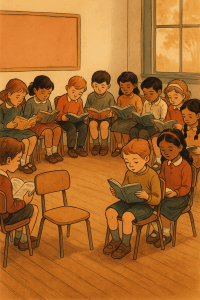
Illustration highlighting that 1 in 13 children don’t read for pleasure, with a lone chair highlighting a non reader in classroom reading circle.However, let’s circle back to a more real and still troubling statistic.

It’s true that, despite the apparent lack of access implied by not owning their own books, twelve out of every thirteen children reported that they read at home. If these results are to be believed, then twelve out of thirteen children aged 5 to 8 are reading sometimes.

Something encouraging seems to be happening here. I’d like to think that access to library books and other borrowed reading material plays a role (though I don’t have any figures to back that up).

However, we still have a child missing out on the benefit of reading. It may not be the one in five kids who report not owning a book, but there is a child in every thirteen who reports never reading. I feel this is the child we should be concentrating on.

Who isn’t reading?

The related statistic that I feel we should return to is this idea that one in thirteen of the children surveyed supposedly ‘never read’.

However, even here, I can’t help but wonder if this ‘scary number’ might be able to be softened a little.

First, let’s think about their sample age group; the children in this study were between the ages of five and eight. Whilst many five-year-olds can read surprisingly well, I do have doubts that a significant number of them would be doing so with enough confidence to say that they read for pleasure themselves at home.

Let’s also remember that reading confidence may come on much more slowly for some children. Factors such as learning impairments, as well as issues regarding concentration, will inevitably make it harder for a child to self-describe as a ‘reader’.

Just looking at dyslexia, the NHS website lists the estimated UK incidence of dyslexia as one in ten. However, Dyslexia comes in varying levels of severity, so I wouldn’t suggest that this will be the only influence on readership in children between five and eight years old.

I know several people with dyslexia who happen to be more avid readers than I am (and were so as children too), so I won’t simply jump to the conclusion that a child being dyslexic will instantly mark them as a ‘non-reader’.

All in all, I’m finding it hard to come to any concrete conclusion from the National Literacy Trust’s findings. So let’s return to the matter that many news outlets have focused on; book ownership.

Why get so hung up on book ownership?

Image of a large stack of unread books The 'To-Be-Read Pile’ emphasizing book ownership versus actual readingAs an author, I obviously see a more pragmatic benefit from people buying my books for their children. Book ownership supports your favourite authors and helps ensure the publication of more books you like. Is this important for child literacy, though? No, not really.
So, what is the argument for having a child perceive some books as ‘theirs’?

For some families, the purchase of a book may seem frivolous, an unnecessary expense when libraries are available. As a parent, I’m aware of how much it costs to provide your child with all the other things they need. If money gets tight, I imagine sacrificing book ownership seems like a small sacrifice in the face of other financial concerns.

I prioritise book ownership because I (and my wife) like to read. However, this isn’t enough on its own for anyone to criticise or question another parent who doesn’t prioritise book ownership.

My children typically get a few new books for their birthdays and more for Christmas. I also use Kindle Unlimited myself, meaning that they can access any Unlimited book they like using my account (and read it using our kindle, our household tablet, or on the app on their phones).

They both read fairly regularly, and I know that this provides considerable educational benefits (as I’ve noted in a previous blog post). However, they also both get books from the library. Between library use and the Kindle Unlimited lending library, often what they read wouldn’t count as ‘their’ books either.

This said, I know my children are in a privileged position when it comes to book ownership. Reading for pleasure and literacy proficiency aren’t just ‘nice to have’ perks; they have a profound and tangible effect on job prospects.

Keep reading for pleasure

Oxford Uni conducted a study on the correlation between reading for pleasure as a teen and management positions later in life. The results are fascinating, but, needless to say, it’s probably a good idea to encourage teenagers to read for pleasure as well.

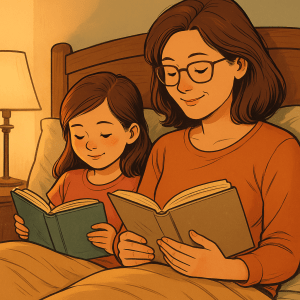
Warm, cozy illustration of a child reading in bed her mother reading by her side evoking the joy of reading for pleasureChildhood reading can also influence your adult wage level (especially if you start off less well off). In a study for ‘The Institute for Fiscal Studies’ (Crawford and Cribb, 2015) their findings gave little correlation for other quality of life indicators. However, in terms of average wage, those who read as children had a much better rate of pay as adults.

In another study (2021), The National Literacy Trust pointed out a similar important correlation between book ownership and literacy:

“…children who reported that they had a book of their own were not only more engaged with reading but also six times more likely to read above the level expected for their age than children who didn’t own a book (22% vs. 3.6%)…” (‘Book Ownership in 2021‘ posted on the National Literacy Trust’s website 12 Nov 2021

There’s no question that book ownership is a good thing for children. My primary concern is whether news sources like the Guardian are focusing too strongly on ownership. As though simply owning a book is ‘enough’.

But why are so many children not reading at all?

Perhaps, but perhaps some children aren’t reading for other reasons. I’m most interested in what’s happening with the one in thirteen who report that they ‘never read’.

The statistics for non-readers are presented in the Guardian as though they’re a worrying new development. However, it would seem that 1 in 13 non-readers has been a UK constant for some time.

Is this lack of reading a ‘new development’?

Illustration of a puzzled child sitting alone while others are enjoying books, representing children who don’t read for pleasure at allThe reported one in thirteen ‘non-readers’ (7.7%) is remarkably close to the same figures regarding ‘non-readers’ in a similar 1980s study on the same subject (here it was 7.3%). This study was conducted by the Centre for Longitudinal Studies, Institute of Education, University College London.
For four decades (at least), one out of every thirteen British children has reported themselves as not reading for pleasure/recreationally.

Many factors may lead to their lack of recreational reading. A lack of book ownership may (of course) play some part in this, but I suspect that it isn’t the only reason that these children don’t read.

Whatever the cause may be, there’s little doubt that their lack of recreational reading will have a negative effect on both their personal and professional lives.

In a previous post, I looked in much more detail at the positive effects of recreational reading, so I won’t go into it too much here. Needless to say, reading recreationally is proven to be good for an individual on multiple levels.

The positive responses to a tricky problem

Obviously, any country would hope to promote a behaviour that has a positive effect on its citizens’ future. Seeing the number of non-recreational readers go up over the course of forty years is not exactly ideal (if only by a fraction of a percent). It is, however, promising to hear the measures described at the end of the Guardian article.

Private companies such as McDonald’s have made a concerted effort to get more books into the hands of children. On top of this, we have phenomenal events like World Book Day, which also strive for the same outcome.

In fact, World Book Day (also run by the National Literacy Trust) goes a step further, by hosting and promoting events and activities which help to normalise reading for children who may not otherwise recognise it as a ‘normal’ behaviour.

1 in 13 children not reading in 2022 is as troublesome now as it was in 1980. We should be doing what we can to lower this number. Reading is a phenomenal activity, whether viewed as leisure, an escape, or as a learning tool.

However, this statistic has only shifted by a minimal amount over the course of forty years so I’m also wary of treating it like a new development.

I suppose the moral of the story is that we should read more to our children. We should also buy books as gifts for any children we know (when finances allow), and (crucially, perhaps) we should try to normalise reading for pleasure. Children mimic what they see adults do, after all; if we adults read more, then it seems more like the ‘done thing’.

Normalising a healthy habit

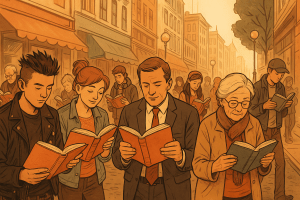
Illustration of a busy city street where people from all walks of life—students, businesspeople, pensioners, teens—are all reading books.The 1980s study also checked in with the children when they reached 16. At this point they asked about ‘reading culture’ at home. Only 43.6% reported that their dads read books, and 57.6% reported their mums reading books. Maybe if more of us allowed our children to see us reading (and enjoying) books, they might be more inclined to do it themselves.

The forty-year span of the one in thirteen non-readers may seem fairly inescapable. From the data we see, it would be easy to assume as much. However, I wouldn’t want to suggest that we go so far as to throw the baby out with the bath water.

Statistics such as these focus our attention on what matters to us as a culture. Do we want to promote literacy? Do we, as a culture, recognise its benefit?

Do we feel like we could (and should) encourage those final one in thirteen children to read?

If we answer yes to these (and it’s hard to find anyone who wouldn’t). If the end result of studies like the one conducted by the National Literacy Trust is more effort to get children reading. Then the study has done its job. Big headlines aside, the studies and stories themselves are there to remind us that, as a culture, we all want more children to feel the benefits of reading.

Starting small

If this post makes you feel inclined to buy a book for a young person you know, I would thoroughly recommend purchasing from a local bookshop. Your local bookshop will be able to advise you on great stories and appropriate reading levels, with marked expertise and you will also help support your local economy.

The range of children’s books available now is a vast, incredible cavalcade when compared to my childhood bookshelves. There are so many options that a child of any age and any interest might like. Your local bookshop will be able to guide you to the perfect book for the child you want to buy for.

What’s important to remember is this: even if all you do is share a love of reading, you’re already doing something fantastic. It allows you the chance to make a lasting impact on a young person’s wellbeing and learning journey.

Please don’t feel obligated

Alternatively, if you would like to buy one of my books, you could go to Fun Junction’s book section.

They deliver throughout the UK and have always been big supporters of my books, so I always like to return the favour where I can.

(Amazon is always there, and you can get my books on Kindle here, but I always personally prefer to support smaller, more independent online retailers).

Fun Junction also stocks a brilliant selection of toys, games, and puzzles for children and adults, so it’s well worth a visit to their website.

As always, thanks for reading, all the best, John

setting a scene young writer children stories

Writing tips for kids: Setting the scene

An Example of a Two-hundred Word Short Story:

Photo by Ylanite Koppens on Pexels.com

She pulled the blanket around herself, steadying her hot chocolate and sinking into the soft cushions. She reached for her book and balanced it on her knee, creasing open well-worn pages. Both hands now free, she clasped her mug, enjoying the warmth as it flowed into her fingers.

The crash from upstairs was sharp. Sudden.

Chocolate stained her book and splashed over her blanket as she lept up.

She left the mess on the floor and crept to the door. A deep pounding, like ocean waves, thrummed in her ears.

Photo by George Becker on Pexels.com

She reached for the door handle, releasing her stifled breath.

The hinge squeaked. She stopped, dreading another sound from upstairs. Silence.

She entered the hallway. The gasping rhythm of her breath the only sound. Feet stretching in shaking tiptoes, she took the stairs.

A single creak. That traitorous step announced her, and a crash from upstairs answered the call.

She stopped in horror as more crashes followed. Then thumps. Fast, rhythmic beats.

Photo by Francesco Ungaro on Pexels.com

They grew closer. Her throat tightened. She could feel her pulse in every breath. Then she saw it.

A pair of huge ears popped up over the top step.

The rabbit had escaped from its cage again.

Share your Storytelling Talents and Win a BRILLIANT Prize

The above story is one hundred and ninety-nine words long. I chose this wordcount very much intentionally as I’ve been invited to judge a local short story writing competition for children (I live in Crieff, which is the largest town in Perthshire, Scotland).

The maximum word count for entries is two hundred words (hence my own demo). Entries can come from any child aged from five to fourteen. Entries are separated into three age categories (5-7, 8-11 and 12-14) and the deadline is this coming Monday. Click here to find more information about Crieff Hydro’s National Storytelling Week Competition.

Perhaps you are one of the hundreds of children looking to enter the competition or a parent of a child who intends to enter. Alternatively, you may simply have arrived here because you like telling stories and are looking for writing advice. Either way, I thought I might offer a few hints and tips to help you set the scene in your writing.

Setting a scene

There are tons of different ways to set a scene but today I’m going to concentrate on three: pace, mood, and direction. Strictly speaking, these things aren’t simply connected to setting a scene but knowing about these will help you understand good ways to make a scene more interesting and easy to follow.

Setting the Pace

As a writer, you are in control of a few unusual things outside of your story. One of these is the fact that you have a small amount of control over your reader’s breathing.

Even when someone reads inside their head, the placement of commas and full stops (and any other types of punctuation), controls how they will breathe while reading.

You can use this change in breathing to influence their feelings in relation to your writing.

Short sentences, fast pace

Photo by Sourav Mishra on Pexels.com

If time is passing quickly, then a short, sharp sentence will help move things along much better than a long one. You can still be descriptive but use description sparingly and concentrate on really powerful descriptive terms.

In the sample story above you feel the story’s speed increase partly by experiencing the shorter sentences. Even if you don’t read it out loud, a short sentence will make you think of breathing quickly. Short sentences are good for suspense, action, and excitement.

Long sentences, slower pace

Photo by David Dibert on Pexels.com

Longer sentences (like the paragraph at the start of the story) can be a good way to make a reader feel relaxed (though it can also be used to show off different emotions). Longer sentences slow the reader’s breathing. This can be relaxing, but really the sentence length is a simple way of helping a reader feel that time is moving slowly.

Be careful not to make a reader take too long on each sentence though, or they might get so relaxed that they lose interest in your story!

Not a hard and fast rule

As with so many things relating to anything artistic, rules like these don’t always work. People can always find interesting ways to break rules or simply bend them.

However, it is hard to deny the influence that a writer has over a reader’s breathing, and it would be a shame not to remember this simple trick when writing. It’s a really easy and clear way to ensure that the pace of your story is the pace you want.

Setting the Mood

The mood of a story can be hard to show but there is one simple thing to look at when testing out a scene. What a character does is shown in the verbs you choose but there are hundreds of different ways of describing a movement. Take walking as an example:
A character can stride into a room. Right away we know that they are relaxed and confident.

Alternatively, they could slip into a room. In this case, we imagine that they are quietly trying to enter without being noticed. They may be shy, or scared, or both.

Another possibility is that they could creep into a room. This character sounds sneaky, but you would need to add other things in your sentence to help the reader understand whether they are being devious or careful in their movement.

With just one word you can help draw focus onto the mood that you want your reader to feel. Verbs are doing words but the right verb can also be amazingly descriptive.

Adjectives are the words we normally think of as ‘describing words’ (words like ‘blue’, ‘warm’, ‘smelly’). However, sometimes a sentence with one good verb and no adjectives can do a lot more for your story than a sentence with a basic verb and two or three good adjectives. This can be even more important when you have a small word count (like you might find with a word limit of two-hundred words).

Setting the Direction

Photo by Ekrulila on Pexels.com

You always know more about the direction or plot of your story than your reader does. This is yet another thing that gives you control over how someone will experience your story. You can choose to let a reader in on a secret that your main character doesn’t know or you can keep the reader in suspense alongside your main character.

In the story example above, the ending would be less impactful if the reader knew about the escaped bunny at the start of the story. they wouldn’t feel the fear and panic of the ‘intruder’ along with the main character if all along they knew that the noises were just a rabbit.

However, there are times when knowing more than the main character could help make the story more enjoyable.

Maybe your main character doesn’t know that they have a winning lottery ticket in their pocket and you tell the reader in line one of your story.

Now, every time your main character worries about how much something costs, or complains that they hate their job, you can let your reader enjoy knowing that lovely secret for the whole story until the big reveal at the end. It should still be fairly easy to get the reader to feel that excitement along with your character. In fact, they may even enjoy it more as they know how much the main character needed that money.

Go Write Your Story!

There are so many other factors that go into writing a story but hopefully, the tips in this post have helped you a little. Whether you are away to write your short story for Monday’s competition, or if you are simply reading this for general storytelling tips, I wish you the best of luck.
I would also love to hear about your stories so please leave a comment and tell me about what you’ve chosen to write. (Feel free to ask me questions too)

Thanks for popping by my site,

all the best, John


Help the universe that lives on your doorstep (shop with your local bookshop)

If reading a book takes you into another world then it goes without saying that your local bookshop is a universe right on your doorstep.
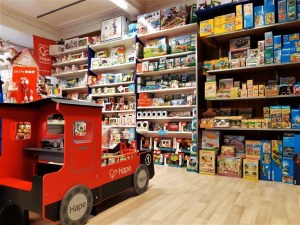
We can’t get into those micro-universes at the moment but right now, up and down the country, small shops are working to give us a glimpse of what they used to be able to offer. They’re working on social media profiles, youtube channels, and they’re either making their websites more functional or, in many cases, they are setting themselves up for online shopping for the first time ever.

These new web sites might be a little less glamorous than larger sites. They might not have every item you could possibly want. They might not be exactly what you’re used to. All the same, they are little windows into lovely places that are doing what they can to keep themselves relevant in a very odd new world.

If you take the time to visit you might be lucky enough to find some unique features too. There may be quirky copy to read, video tours of ‘Aladdin’s caves’ of wonders, crazy cat pictures, or they might link you up with communities you didn’t know were so close to home. These new sites are well worth a look.

A special shout out

One local shop that has always been good to me is Fun Junction. They have shops in Crieff and in Perth and both of them are in tier four lockdown at the moment.

They recently updated their website to include a small selection of books. They’re not exactly a ‘book shop’ but their Crieff shop is probably the only thing that counts as a ‘proper book shop’ in my immediate area right now.

If you’re looking to order any of my books I’d really appreciate it if you headed their way.

You’ll find ‘Jack Reusen and the Fey Flame’ here.

The second Jack Reusen book ‘Jack Reusen and the Spark of Dreams’ is here.

You’ll also find ‘Marcus’ my dark fantasy book for older readers here.

While you’re looking through their small selection of books you can also have a look at their magic tricks section, their games and logic puzzles, or even grab a few wee things from their pocket money section. They’re a lovely shop and well worth a (digital) visit. You can also find them on Facebook and on Twitter.

A few other shout outs

Some other books shops that I’ve really enjoyed visiting in the past/ wish I’d been able to visit before lockdown happened are:

The Watermill (Aberfeldy)

Not that these guys really need advertising (they’re a very well known secret among book-lovers throughout Scotland) but the Watermill is one of my favourite days out. In fact, their cafe was the first place I went for a coffee after the last lockdown ended.

The book shop is really unique with a brilliant range of books, a really cosy cafe (with a real wood stove in situ), and a fantastic homewares shop right next door (called ‘Homer‘).

Their Facebook page is loaded with book suggestions and an active reading community who also offer insights into these great reading suggestions. They’re also over on Twitter.

J & G Innes Ltd (St Andrews)

This bookshop is like something out of Harry Potter! A rustic outside that absolutely proclaims ‘bookshop’ (and has a really deep history linking it to modern printing). In the same spot since the late 1800s and now on its fourth generation of Innes (I don’t know the plural of Innes, Innesses? Inness? Inni?…).

You’ll find a slightly more modern experience on the inside (when you’re allowed back into book shops again that is). They also offer a huge and comprehensive range of stationery and art supplies as well, so my writerly/artsy side was absolutely hooked when I came across this place a couple of years ago when on holiday near St Andrews.

Their Facebook page is absolutely filled with fluffy cat pics at the moment and (when their doors were still open) it also had lots of info about books, gifts, and art available in store.

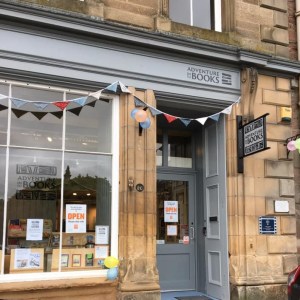
Adventure into Books (Blairgowrie)

I’m listing a shop I’ve never been to here. ‘Adventure into Books’ launched amid the multiple restrictions of 2020. I’m really looking forward to getting up to Blairgowrie and seeing the place as it sounds great. Unfortunately, that’ll have to wait.

In the meantime, they have a great wee website with book suggestions and information about their business and a Facebook feed full of a steady stream of new book suggestions.


Share your own favourites

I’ve put together a very small list so far on here but if you know of an indie bookshop that could do with a little shout out please feel free to tell me in the comments and I’ll be sure to add them too.

A last wee extra

I’ve missed sitting in a bookshop with a coffee, a book (and some time to kill), so much during lockdown. If you feel the same, this ambience video might help you. Pop it on, get a coffee in that favourite mug, and grab your book. Instant book shop experience.

3 easy ways to make reading fun for kids

I’ve now been on bedtime story duty for twelve years. We’ve been on adventures in day-to-day worlds, trailed through fantastical realms, crept through sinister space ships, been on arctic expeditions, and much more besides.

It’s great to read to your kids, it offers lots of benefits. I’ve written before about the importance of reading to children. If you’d like to check that out just click this link.

If you are an adult in the UK who struggles to read but would like to get better you can get help from ‘The Big Plus’. You can find out more by clicking this link or phone them on 0800 917 8000.

Make Storytime Fun

In the past twelve years of bedtime stories, I’ve explored as many different ways of holding a child’s attention as I could think of. Some of these didn’t work, some had the opposite effect, and some were downright ridiculous.

However, in among all of the experimentation I’ve found at least a few things that definitely helped keep my kids enthralled enough for a half-hour or so of reading each night. This immersion in the story world has definitely helped develop their own love of reading too (to the point where I’m steadily being made redundant).

Giving the characters some personality

Photo by Gravitylicious.com on Pexels.com

The big thing that really caught their attention in the early days of story reading was something that might make many feel self-conscious, but it’s well worth the effort…voices.

You don’t have to be perfect; your Winnie the Pooh doesn’t have to sound exactly like the Disney version, your Gruffalo doesn’t have to sound like Robbie Coltrane, and later on, your Hagrid won’t have to sound lie Robbie Coltrane either.

You’re not trying to win an award, your kids won’t be overly critical (especially if you start early). Just make an effort. Changing your voice, even a little, will encourage most children to pay attention.

At baby and toddler stage they’re keyed-in to notice even the slightest changes in your voice. The more you change your speech patterns, the bigger the interest will be (at least that’s what I found).

I’ve always included voices when reading. They haven’t always been perfect but when we moved on to books without pictures it almost became a necessity. With a larger group of main characters, it helped a lot to have different voices so my kids could keep up with the story.

This has apparently had such an effect that my eldest son recently told me that when he reads by himself he hears different character voices inside his head. Good to know it was worth the odd sore throat.

Set the scene

Another important discovery in the early days of storytime was to add a bit of theatre to make ‘story time’ into an event.

We didn’t do this all the time but sometimes I felt it was necessary. One of the biggest changes was the move on to chapter books. Without pictures, it was sometimes necessary to do something to draw my kids deeper into the story. I had to think outside the box.

For example, we might build a fort in their room after tea, then read in it for bedtime. I sometimes set up special lights to make the room look different (cheap battery-powered fairy lights bought in the pound shop or other bargain shops were ideal for this).

Whatever made storytime stand out was worth a try. If we had time, it could be something big but most nights it was as simple as switching off the room light and using a reading lamp and some fairy lights. Here’s one tactic that I found really useful.

Let them pick

You should let them pick their own story. I won’t lie to you here; you may have to read the same picture book every night for a month if you do this. However, back at a time when their whole day was dictated by others (where they went, who they met, what they ate), this was one of the only ways my kids were getting to engage in making their own choices in life (albeit on a pretty small scale).

What’s more, it also gave me an early insight into their tastes and personalities. They’ve surprised me many times, especially at the library or book shops when looking for something new.

Let them look through and see what stories really stand out to them. This is actually a lovely experience, and it’s something I’m sure most parents will get a kick out of.

Try and enjoy it yourself

This is a sort of ‘bonus tip’ on top of the three mentioned so far I’d add this extremely important extra. Make sure you’re comfortable, happy, that you’ve got a good seat/beanbag/ whatever you like to sit on, and most importantly that you’ve got a wee cup of tea/coffee on hand to stop sore throats.

It can be hard to disconnect from things now. I know my phone beeps multiple times an hour, I’m guessing yours does too. I’ve come to see that half-hour as a welcome break in that constant stream of information. I put my phone away, I grab a cup of coffee, my kids get into bed (or sometimes sit with me) and we take a step away from our world for a little bit.

Reading to your kids doesn’t have to be a begrudging task that we do because we feel we ‘have to’. It can be a relaxing break from day-to-day life. Do what you can to enjoy the slower pace, the focussed time, the moments to catch up and laugh with your kids. Don’t get me wrong, I’ve had more than a few nights where I can’t believe we’re reading the Gruffalo AGAIN (for example), but most of my nights have been something brilliant.

I wouldn’t give up story night for anything and I hope these hints help you find ways to enjoy it more too.

Please let me know if you try any of these hints in the comments below and as always thanks for reading,

All the best, John